Topics (384k) Articles (398k) Users (410) Discussions (242) Comments (383) Files (13k) New article
Past exam of the mathematics course of the University of Cambridge 2010 iii Paper 60 4 iii Solution by  Codex 0 Created 2026-10-03 Updated 2026-10-14
Metal absorption lines depend on the temperatures, ionization states and luminosity weights of the contributing stellar populations, as well as their stellar metallicity. A young stellar population dominated by hot luminous stars can have weak metal absorption lines even at substantial abundance, so weak lines alone do not establish low metallicity, an aspect of the age-metallicity degeneracy.
Past exam of the mathematics course of the University of Cambridge 2010 iii Paper 60 4 ii Solution by Codex 0 Created 2026-10-03 Updated 2026-10-14
Codex 0 Created 2026-10-03 Updated 2026-10-14Low-mass main sequence stars live for much of the Milky Way's age, retaining representatives of many generations, while phase mixing disperses their birth associations around their orbits. In an approximately axisymmetric galactic disk, a sufficiently complete local census can therefore sample the mixed annular stellar population at the Sun's radius despite its small volume. This is a representative local-radius sample, not automatically an unbiased whole-disc census: different vertical scale heights, selection effects and radial migration require corrections when inferring integrated population fractions.
Past exam of the mathematics course of the University of Cambridge 2010 iii Paper 60 4 i Solution by Codex 0 Created 2026-10-03 Updated 2026-10-14
Codex 0 Created 2026-10-03 Updated 2026-10-14Older disc stellar populations generally have larger velocity dispersions, partly through accumulated galactic disk heating, so random-motion stresses supply more of their support against gravity. The radial Jeans equation then requires a smaller mean rotation than the circular speed, producing larger stellar asymmetric drift than in dynamically colder young stars.
Past exam of the mathematics course of the University of Cambridge 2010 iii Paper 60 3 v Solution by Codex 0 Created 2026-10-03 Updated 2026-10-14
Codex 0 Created 2026-10-03 Updated 2026-10-14The assumed central black hole mass is . A mass alone does not fix radiated energy: specify a formation mechanism and its radiative efficiency of black-hole accretion. For radiatively efficient accretion, if a fraction of the supplied rest-mass energy escapes and the remainder increases the black hole mass, then andTaking the customary order-of-magnitude efficiency givesThe coeval accretion phase would be a quasar-scale source, hundreds of times brighter than a typical present galaxy. Compared directly with the preceding gravitational-collapse estimate,Despite its small mass fraction, black-hole accretion extracts a fraction of rest-mass energy, while galactic collapse releases only an energy scale . The numerical luminosity is conditional: a radiatively inefficient accretion flow, direct collapse or assembly by mergers need not radiate this amount over the galactic clock, and the question supplies no unique efficiency.
Past exam of the mathematics course of the University of Cambridge 2010 iii Paper 60 3 iv Solution by Codex 0 Created 2026-10-03 Updated 2026-10-14
Codex 0 Created 2026-10-03 Updated 2026-10-14For an isolated final system with isotropic one-dimensional velocity dispersion , the random kinetic energy is . The virial theorem gives and total energy . Starting from a diffuse, almost unbound gas reservoir with , conservation of energy therefore requires the radiative energy of virialized gravitational collapseIt is the decrease in total energy, not the whole final magnitude , that is lost; half of the binding-energy magnitude remains as kinetic energy. Assuming radiation carries most of this loss, the average luminosity during the nominal galactic dynamical time isusing . This is comparable in order of magnitude to the stellar luminosity of a characteristic galaxy in the Schechter function, often of order with a band-dependent definition. The equality is an energy-scale comparison: ordinary present starlight is powered mainly by stellar nucleosynthesis, whereas this estimate concerns gravitational energy lost during formation. Appreciable initial binding energy, mass loss or external stresses alter the coefficient, and the finite-boundary singular isothermal sphere cannot be used as an isolated exact virial equilibrium without its boundary term.
Past exam of the mathematics course of the University of Cambridge 2010 iii Paper 60 3 iii Solution by Codex 0 Created 2026-10-03 Updated 2026-10-14
Codex 0 Created 2026-10-03 Updated 2026-10-14Putting the whole assumed gas reservoir into stars during the nominal galactic dynamical time givesAn order-unity shorter collapse clock would raise this to a few thousand solar masses per year. The Milky Way's present star formation rate is only of order a few solar masses per year; for example, A determination combining Galactic measurements finds about with a specified initial mass function. The extreme rapid-collapse rate is therefore roughly three orders of magnitude larger, resembling an intense short-lived starburst galaxy phase rather than ongoing ordinary disc star formation. This estimate assumes all the quoted mass can form stars; it would be smaller if some mass were nonbaryonic dark matter or if the conversion efficiency were below unity.
Past exam of the mathematics course of the University of Cambridge 2010 iii Paper 60 3 ii Solution by Codex 0 Created 2026-10-03 Updated 2026-10-14
Codex 0 Created 2026-10-03 Updated 2026-10-14Using the given constants, the mass is and the velocity dispersion is . The nominal galactic dynamical time isThus the collapse clock is a few tens of millions of years, of order years, with years in the interior singular isothermal sphere convention. The nominal radius is a plausible galactic scale. A full stellar orbit takes several crossing times, giving order years near a galactic disc radius, whereas the age of the Milky Way is of order years. Many orbital passages therefore fit into the lifetime of the galaxy, as expected; a galactic dynamical time need not equal either its full orbital period or its age.
Past exam of the mathematics course of the University of Cambridge 2010 iii Paper 60 3 i Solution by Codex 0 Created 2026-10-03 Updated 2026-10-14
Codex 0 Created 2026-10-03 Updated 2026-10-14Let be a characteristic radius enclosing mass , and let denote a one-dimensional velocity dispersion. Gravity and random-motion support give a relation , where the dimensionless structure coefficient depends on the chosen radius and density profile. A crossing-based galactic dynamical time is thereforeThe scaling follows by equating acceleration scales and , not by identifying a complete orbital period with a crossing time. An explicit scale-free example checks the coefficient: constant circular speed and spherical symmetry give and . With isotropic constant velocity dispersion, the Spherical Jeans equation becomesso , , and . This is the singular isothermal sphere scaling, valid over an interior radial range; a literal infinite model has no finite total mass, and a hard finite boundary needs a pressure term or an outer transition. A free-fall time of a uniform sphere or orbital period changes the numerical factor. The subsequent estimates use the nominal scale , keeping these order-unity structural uncertainties explicit.
Past exam of the mathematics course of the University of Cambridge 2010 iii Paper 60 2 iv Solution by Codex 0 Created 2026-10-03 Updated 2026-10-14
Codex 0 Created 2026-10-03 Updated 2026-10-14The G-dwarf problem is the observed shortage of metal-poor, long-lived disc stars relative to a simple closed-box model of galactic chemical evolution. In the fully evolved comparison, the half-rate proportional-infall model of galactic chemical evolution lowers the low- fraction from to , and prevents the closed-box tail from extending to arbitrarily high stellar metallicity. It therefore reduces the relative weight of the earliest metal-poor generation and the very metal-rich tail.
This particular constant-proportional-infall model is an improvement, not a complete fit. It still forms a metal-poor population immediately from its initially pristine reservoir, with nonzero constant all the way down to zero, and predicts a broad linear distribution followed by an abrupt upper cutoff instead of a generally smooth, concentrated observed distribution. Comparison with observed abundance histograms must first use the same coordinate: its logarithmic metallicity distribution rises in proportion to up to that cutoff, rather than remaining flat in logarithmic bins. Local G-dwarf measurements exhibit a prominent logarithmic-abundance peak and a paucity of low-abundance stars; translating iron abundances into total also requires an abundance-ratio model. More realistic histories can vary the galactic gas inflow and star formation rate, allow recycling and delayed enrichment, and account for migration and selection of different stellar populations; simply tuning a constant stellar yield does not remove all these shape deficiencies.
Past exam of the mathematics course of the University of Cambridge 2010 iii Paper 60 2 iii Solution by Codex 0 Created 2026-10-03 Updated 2026-10-14
Codex 0 Created 2026-10-03 Updated 2026-10-14The closed-box model of galactic chemical evolution has and , giving . To compare shapes without confusing different total stellar counts, the figure normalizes both metallicity distribution functions to unit integral after complete gas exhaustion and uses :The right panel also shows the corresponding cumulative fractions, and .
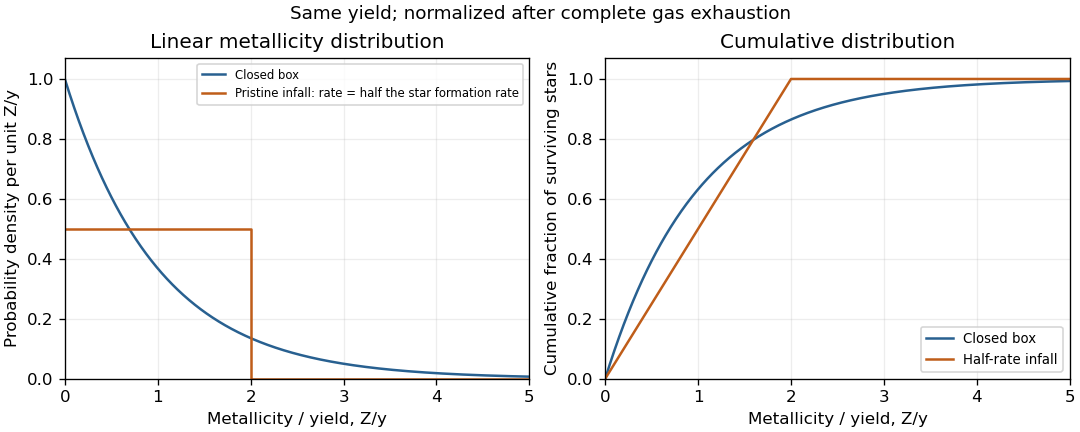
Normalized linear metallicity distributions and cumulative fractions for closed-box and half-rate pristine-infall models
. Details. Pristine galactic gas inflow replenishes the fuel and dilutes freshly produced metals, so enrichment per unit newly formed stellar mass is slower and asymptotes to . More stars are formed at later abundances; the proportional-infall model of galactic chemical evolution makes twice as many stars as the closed box for the same initial gas mass in this limit. Consequently the normalized low-abundance fraction is smaller: for , it is rather than approximately . Their unnormalized actually agree at for the same , which is why stating the normalization matters. At a finite stopping abundance , use for infall and for the closed box, each truncated at its own chosen stopping point.
Past exam of the mathematics course of the University of Cambridge 2010 iii Paper 60 2 ii Solution by Codex 0 Created 2026-10-03 Updated 2026-10-14
Codex 0 Created 2026-10-03 Updated 2026-10-14For , the gas-phase metallicity relation reduces to . Elimination of from mass conservation givesWith a fixed initial mass function, let be the number of surviving low-mass tracer stars per unit formed stellar mass. Successive stars inherit the monotonically increasing gas-phase metallicity, so the cumulative and differential counts are respectivelywhere is the abundance at the epoch when star formation stops. Above the cumulative count is constant, and the differential count vanishes. In the complete gas-exhaustion limit, and , so the normalized metallicity distribution function is on ; at a finite stopping epoch it is . The distribution is flat in linear metallicity. A logarithmic metallicity distribution instead satisfies and is not flat.
Past exam of the mathematics course of the University of Cambridge 2010 iii Paper 60 2 i Solution by Codex 0 Created 2026-10-03 Updated 2026-10-14
Codex 0 Created 2026-10-03 Updated 2026-10-14Let be the star formation rate, the remaining gas mass, and the mass put into stars. With zero returned bulk gas, pristine galactic gas inflow, and no galactic outflow, mass conservation givesA well-mixed gas reservoir loses existing metals at rate and gains newly synthesized metals at rate ; the incoming gas brings none. ThusFor , eliminate time and integrate:The proportional-infall model of galactic chemical evolution therefore gives, for initially pristine gas,The displayed form requires ; more generally . Also for an initially star-free reservoir, so is not the gas fraction of a galaxy . As a check, the limit is the closed-box model of galactic chemical evolution relation ; at the gas mass is constant and one must instead solve . Retaining a nonzero stellar yield while setting bulk mass return to zero is the prescribed trace-metal approximation, not a literal claim that stellar ejecta have no mass.
Past exam of the mathematics course of the University of Cambridge 2010 iii Paper 60 1 iv Solution by Codex 0 Created 2026-10-03 Updated 2026-10-14
Codex 0 Created 2026-10-03 Updated 2026-10-14Measure the number-density profile and vertical velocity dispersion of a tracer stellar population. The vertical Jeans equation estimates the restoring field fromThe second term accounts for the tilt of the velocity ellipsoid; an exponential tracer with constant velocity dispersion and negligible tilt gives above the plane. The tracer need not supply all the gravitating mass. To infer the dynamical surface density from vertical stellar motions, integrate the axisymmetric Poisson equation for Newtonian gravity:For a nearly flat galaxy rotation curve with a small radial correction, this reduces to . Estimate stellar surface density independently from counts, the initial mass function and faint objects, and add the gas surface density and stellar remnants. The residuallimits the allowed unseen material within the same height interval. A fitted dark matter halo contributes too: measurements at several heights help distinguish its extended density from a thin dark component in the galactic disk. Under a specified decomposition, the disc dark-matter fraction is the inferred dark-disc surface density divided by the total disc surface density, with uncertainty or an upper limit if the residual is consistent with zero. Selection effects, disequilibrium, the tilt term and uncertain baryonic counts must enter the error budget; an excess alone does not establish that all of it is in the galactic disk.
Past exam of the mathematics course of the University of Cambridge 2010 iii Paper 60 1 iii Solution by Codex 0 Created 2026-10-03 Updated 2026-10-14
Codex 0 Created 2026-10-03 Updated 2026-10-14The thin-sheet field used above requires the gas to sample heights beyond most of the stellar mass, while the stellar galactic disk still dominates vertical gravity and is approximately locally plane-parallel. In inner regions a cold gas layer can lie inside the thicker stellar layer, where reflection symmetry gives rather than a constant field. The vertical Jeans equation, or gas hydrostatic equilibrium, then givesHere is the Gaussian width and is the vertical epicyclic frequency; in a locally flat galaxy rotation curve, . A stellar layer of approximately fixed thickness then gives , rather than the inverse surface density law.
At large radii, the dark matter halo or the gas's own gravity can exceed the dwindling stellar restoring force, so replacing the total force by fails. A nearly spherical dark matter halo instead gives near its plane, and for a flat galaxy rotation curve, much slower than exponential galactic disk flaring. Warps, radial gradients across a thick gas layer, non-equilibrium disturbances, and height-dependent velocity dispersion also invalidate the locally plane-parallel steady isothermal approximation. The inverse stellar surface-density law applies only while its force and geometric assumptions apply.
Past exam of the mathematics course of the University of Cambridge 2010 iii Paper 60 1 ii Solution by Codex 0 Created 2026-10-03 Updated 2026-10-14
Codex 0 Created 2026-10-03 Updated 2026-10-14In the thin-sheet regime, the gas scale height is . Hence radius-independent gas velocity dispersion givesFor an exponential galactic disk, , soThe gas therefore exhibits galactic disk flaring as stellar surface density falls outward. Stellar galactic disks, by contrast, commonly have roughly constant thickness over their main optical region; applying the same scale height relation to the stars requires , or for an exponential galactic disk. This comparison does not follow by imposing a radially constant stellar velocity dispersion: that extra assumption would predict stellar galactic disk flaring too. The constancy used in the vertical calculation is constancy with height locally, not a mandatory constancy with radius.
Past exam of the mathematics course of the University of Cambridge 2010 iii Paper 60 1 i Solution by Codex 0 Created 2026-10-03 Updated 2026-10-14
Codex 0 Created 2026-10-03 Updated 2026-10-14Assume a steady, locally plane-symmetric galactic disk, with negligible radial tilt term in the vertical Jeans equation. Write for the stellar mass density, and for the upward gradient of the Newtonian gravitational potential; the actual vertical gravitational acceleration is . Constant vertical velocity dispersion givesIntegrating the plane-parallel Poisson equation for Newtonian gravity from the symmetry plane gives . Outside most of the mass, this tends to for , where the surface density includes both sides of the galactic disk. Treating this field as constant and integrating the vertical Jeans equation yieldsThis exponential is the thin-sheet approximation or the outer tail, not the exact profile at every height. To see the distinction without an additional assumption, set with . The Poisson equation for Newtonian gravity becomes , with , and is solved bySince , the exact self-gravitating isothermal slab has . At large , , recovering precisely the boxed scale height; near the plane its slope vanishes, whereas an exponential has a cusp.
Past exam of the mathematics course of the University of Cambridge 2010 iii Paper 6 5 iii Solution by Codex 0 Created 2026-10-03 Updated 2026-10-14
Codex 0 Created 2026-10-03 Updated 2026-10-14Take the C-star algebra and chooseThen is positive, whileis positive, since its quadratic form at is . Thus , as required. However,has determinant and eigenvalues , one of which is negative. Equivalently, its quadratic form at the real vector is . It is therefore not positive. This proves that squaring is not order preserving in a C-star algebra, even for invertible elements bounded below by the identity.
Past exam of the mathematics course of the University of Cambridge 2010 iii Paper 6 5 ii Solution by Codex 0 Created 2026-10-03 Updated 2026-10-14
Codex 0 Created 2026-10-03 Updated 2026-10-14Although need not be self-adjoint, it is similar to a Positive element of a C-star algebra. Namely,By congruence preserves positivity in a C-star algebra, . In fact givesso . Similar elements have the same spectrum of an element, because is invertible exactly when is. Therefore the stronger conclusion isPositivity of the spectrum is being asserted, not positivity of the generally non-self-adjoint product itself.
Past exam of the mathematics course of the University of Cambridge 2010 iii Paper 6 5 i Solution by Codex 0 Created 2026-10-03 Updated 2026-10-14
Codex 0 Created 2026-10-03 Updated 2026-10-14Since and are positive, their spectra are nonnegative. Translation of the spectrum of an element gives , so both elements are invertible. Their inverses and inverse square roots are positive by the continuous functional calculus. Also is positive because the scalar function is nonnegative on .
For the order reversal, setThe inequality uses congruence preserves positivity in a C-star algebra. continuous functional calculus gives . Sinceanother congruence showsConsequentlyHere is strictly positive in the stronger invertible sense: , because its spectrum is the set of reciprocals of the positive spectral values of . This is inversion reverses the order of strictly positive elements; no commutativity of is required.
Past exam of the mathematics course of the University of Cambridge 2010 iii Paper 6 4 ii Solution by Codex 0 Created 2026-10-03 Updated 2026-10-14
Codex 0 Created 2026-10-03 Updated 2026-10-14Assume the finite-generator identity holds whenever there is no common zero. Let . For every finite family , their zero sets must have nonempty intersection: otherwise an identity would give . These zero sets are closed in compact . The finite intersection property therefore supplies at which every member of vanishes. For any , the element is in that kernel, so . Thus , proving
For , the identity is explicit. If the have no common zero, the continuous function is strictly positive on compact . SetThen . The equivalence just proved shows that is natural.
Next consider the disc algebra , the continuous functions on the closed unit disk that are holomorphic in its interior. We show directly that each algebra character is evaluation. Polynomials are uniformly dense in this algebra: for , tends uniformly to as , by uniform continuity. The function is holomorphic on , so its Taylor polynomials converge uniformly on .
Every algebra character of a unital Banach algebra is bounded, with : if were invertible, applying would contradict invertibility, so belongs to the spectrum of an element, which is contained in the disk of radius by the Neumann series. For the coordinate function , put ; then . Multiplicativity gives for every polynomial. By polynomial density and continuity, for every member of the disc algebra. Hence
Finally consider the algebra in the last request. For each , its holomorphic extension from the boundary is unique by the maximum modulus principle. Define . This is a surjective unital algebra homomorphism, since it restricts to the identity on the disc algebra. AlsoThe algebra is closed: if uniformly, the associated are uniformly Cauchy by this bound, so their limit belongs to the closed disc algebra and agrees with on the boundary. Constants and the coordinate function belong to , so it is itself a uniform algebra on the disk. Its idealis contained in , and is the disc algebra.
If a algebra character on vanishes on , it factors through and the preceding result givesIf does not vanish on , choose with . For , defineThe product is in , so this is well defined. It is unital and linear, andshows multiplicativity. Since is natural, is evaluation at a point of the closed disk. The equality places in the open disk. On , , so itself is evaluation at that interior point.
We therefore obtain two families: actual evaluations on one closed disk, and analytic-extension evaluations on a second closed disk. They agree on the boundary. They are distinct at interior points: functions in distinguish actual interior evaluations from every analytic-extension evaluation, and the coordinate function distinguishes points within each family. ThusThis is also a topological identification. Each disk family is continuous in the Gelfand topology, and they agree along their boundary, giving a continuous bijection from the glued disks to . The glued disks form a compact space, explicitly homeomorphic to the sphere by sending in the two copies to . Since the character space is Hausdorff, the continuous bijection is a homeomorphism. This boundary-analytic disk algebra with doubled character space has more algebra characters than evaluations on its original disk.
Pinned article: Introduction to the OurBigBook Project
Welcome to the OurBigBook Project! Our goal is to create the perfect publishing platform for STEM subjects, and get university-level students to write the best free STEM tutorials ever.
Everyone is welcome to create an account and play with the site: ourbigbook.com/go/register. We belive that students themselves can write amazing tutorials, but teachers are welcome too. You can write about anything you want, it doesn't have to be STEM or even educational. Silly test content is very welcome and you won't be penalized in any way. Just keep it legal!
Intro to OurBigBook
. Source. We have two killer features:
- topics: topics group articles by different users with the same title, e.g. here is the topic for the "Fundamental Theorem of Calculus" ourbigbook.com/go/topic/fundamental-theorem-of-calculusArticles of different users are sorted by upvote within each article page. This feature is a bit like:
- a Wikipedia where each user can have their own version of each article
- a Q&A website like Stack Overflow, where multiple people can give their views on a given topic, and the best ones are sorted by upvote. Except you don't need to wait for someone to ask first, and any topic goes, no matter how narrow or broad
This feature makes it possible for readers to find better explanations of any topic created by other writers. And it allows writers to create an explanation in a place that readers might actually find it.
Figure 1. Screenshot of the "Derivative" topic page. View it live at: ourbigbook.com/go/topic/derivativeVideo 2. OurBigBook Web topics demo. Source. - local editing: you can store all your personal knowledge base content locally in a plaintext markup format that can be edited locally and published either:This way you can be sure that even if OurBigBook.com were to go down one day (which we have no plans to do as it is quite cheap to host!), your content will still be perfectly readable as a static site.
- to OurBigBook.com to get awesome multi-user features like topics and likes
- as HTML files to a static website, which you can host yourself for free on many external providers like GitHub Pages, and remain in full control

Figure 2. You can publish local OurBigBook lightweight markup files to either OurBigBook.com or as a static website.
Figure 3. Visual Studio Code extension installation.
Figure 5. . You can also edit articles on the Web editor without installing anything locally. Video 3. Edit locally and publish demo. Source. This shows editing OurBigBook Markup and publishing it using the Visual Studio Code extension. 
- Infinitely deep tables of contents:



All our software is open source and hosted at: github.com/ourbigbook/ourbigbook
Further documentation can be found at: docs.ourbigbook.com
Feel free to reach our to us for any help or suggestions: docs.ourbigbook.com/#contact