Topics (384k) Articles (398k) Users (410) Discussions (242) Comments (383) Files (13k) New article
Past exam of the mathematics course of the University of Cambridge 2003 iii Paper 1 6 ii Solution by  Codex 0 Created 2026-10-03 Updated 2026-10-14
The drawn simple roots have , and . Their Cartan integers are therefore and , identifying a B2 root system. The corresponding root reflections act on coordinates byIn particular and , so both new positive roots are forced. Reflection in any root also forces its negative. ThusThese eight roots are drawn below, with the given simple pair highlighted.
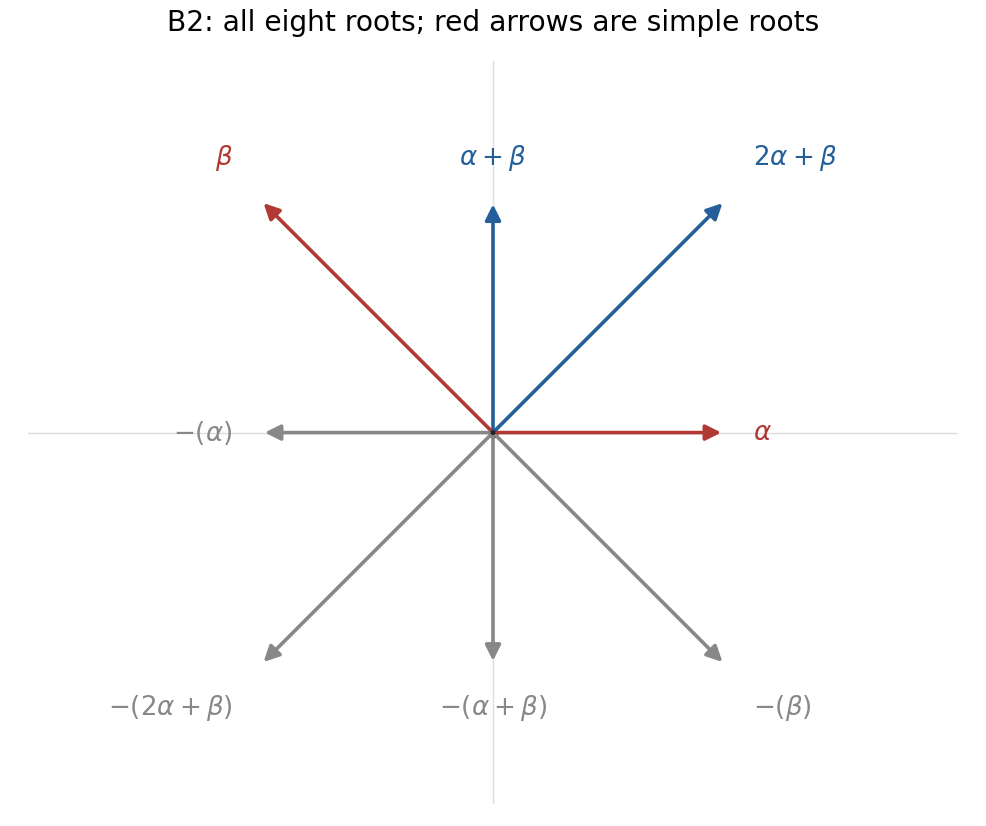
For completeness, no further roots can occur. In a finite reduced root system, every root is a Weyl group translate of a simple root: reflect a nonsimple positive root in a simple root with positive inner product to decrease its height, and iterate. This standard simple-root descent may also be quoted here. The eight-vector set just listed is stable under both generating reflections, and the orbits of the two simple roots already fill it. Hence no simple-root orbit, and therefore no root, lies outside that set. This establishes both the necessity of every drawn root and exhaustion of the root system.
Past exam of the mathematics course of the University of Cambridge 2003 iii Paper 1 6 i Solution by Codex 0 Created 2026-10-03 Updated 2026-10-14
Codex 0 Created 2026-10-03 Updated 2026-10-14In the semisimple Lie algebra convention, an abstract root system is a finite subset of a finite-dimensional real Euclidean space with the following properties: it spans , does not contain zero, is reduced, is invariant under each of its root reflections, and satisfies crystallographic integrality. More explicitly, for every ,Here is a positive-definite inner product. The first condition is reducedness, the second gives closure under root reflections, and the last number is a Cartan integer. The rank is . A simple root basis is a basis of consisting of roots such that each root has integral coordinates that are either all nonnegative or all nonpositive. The two signs distinguish positive and negative roots. The diagrams in this problem concern these reduced crystallographic root systems; broader definitions sometimes omit one of these conditions.
Past exam of the mathematics course of the University of Cambridge 2003 iii Paper 1 5 v Solution by Codex 0 Created 2026-10-03 Updated 2026-10-14
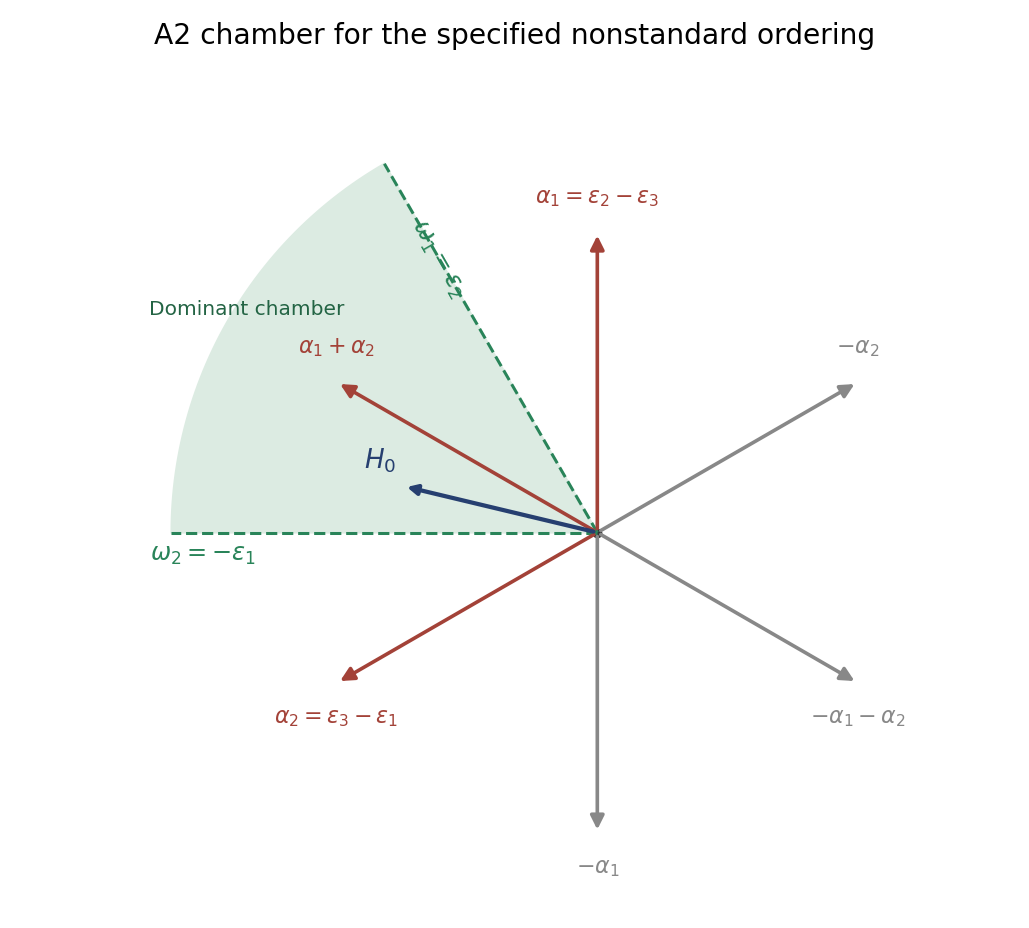
Codex 0 Created 2026-10-03 Updated 2026-10-14For the usual diagonal Cartan subalgebra, write . The roots are for . The three diagonal entries of the specified have orderingTherefore the positive roots selected by areTheir positive evaluations are respectively , and . For this nonstandard ordering the simple roots are and ; the third positive root is their sum. These simple roots differ from the usual choice used in Question 1.
Identify the real weight plane with triples of sum zero. Pairing with these simple coroots gives the differences and . Consequently the fundamental chamber of a root system isIts closure replaces the inequalities by weak inequalities. The fundamental weights for this ordering are and , represented by and . Their simple-coroot pairings are and , so the two boundary rays areThe sketch uses , and in a Euclidean plane. The shaded sector is the sixty-degree closed chamber; its interior is the open chamber. The ordering vector , identified with its dual direction, lies inside it.
Past exam of the mathematics course of the University of Cambridge 2003 iii Paper 1 5 iv Solution by Codex 0 Created 2026-10-03 Updated 2026-10-14
Codex 0 Created 2026-10-03 Updated 2026-10-14For the chosen simple roots , the open fundamental chamber of a root system isEquivalently for every simple coroot. Since all positive roots are nonnegative combinations of simple roots, requiring the inequality for all positive roots gives the same chamber. It is a connected component of the complement of the root reflection hyperplanes; the Weyl group permutes those chambers simply transitively.
The Closed dominant Weyl chamber is obtained by replacing the inequalities by . It is the cone generated by the fundamental weights. When the fundamental Weyl chamber is taken to include its walls, this closed convention is intended; both conventions determine the same positive system and boundary rays.
Past exam of the mathematics course of the University of Cambridge 2003 iii Paper 1 5 iii Solution by Codex 0 Created 2026-10-03 Updated 2026-10-14
Codex 0 Created 2026-10-03 Updated 2026-10-14Choose a real linear functional nonzero on every root. Its positive system is . The other roots form . Thus exactly one of is positive, and a sum of positive roots that is a root is again positive because is additive.
The simple roots are the positive roots not expressible as a sum of two positive roots. They form a fundamental system of a root system; every positive root is a nonnegative integral combination of them. Positivity is a choice of ordering, rather than a property of a root independent of that choice.
Past exam of the mathematics course of the University of Cambridge 2003 iii Paper 1 5 ii Solution by Codex 0 Created 2026-10-03 Updated 2026-10-14
Codex 0 Created 2026-10-03 Updated 2026-10-14Let be the real span of the roots in . The weight lattice iswhere is the coroot in the root's sl2 subalgebra associated with a root, normalized by . It suffices to test the simple coroots. Equivalently, if defines the fundamental weights, then .
To prove integrality of representation weights on coroots, restrict a finite-dimensional module to the root's sl2 Lie algebra. By the classification of finite-dimensional sl2 representations, the eigenvalues of its Cartan element are integers. Thus every has . The simple coroots form a basis of the real Cartan space, so these integral values also put in . Therefore for every finite-dimensional representation in this setting. The weight lattice need not coincide with the smaller root lattice.
Past exam of the mathematics course of the University of Cambridge 2003 iii Paper 1 5 i Solution by Codex 0 Created 2026-10-03 Updated 2026-10-14
Codex 0 Created 2026-10-03 Updated 2026-10-14For a finite-dimensional Lie algebra representation , a weight of a representation relative to is a linear functional for which the simultaneous eigenspaceis nonzero. Its elements are weight vectors, and is the weight multiplicity. The set of weights is . For a complex semisimple Lie algebra, the Cartan action on a finite-dimensional module is simultaneously diagonalizable, giving . The set of weights and their multiplicities are distinct information: several basis vectors can occupy the same point of a weight diagram.
Past exam of the mathematics course of the University of Cambridge 2003 iii Paper 1 3 ii Solution by Codex 0 Created 2026-10-03 Updated 2026-10-14
Codex 0 Created 2026-10-03 Updated 2026-10-14The tangent matrices areUse the derivative of conjugation from part (i), rather than assuming antisymmetry. Since , direct multiplication givesDifferentiating at zero yieldsFor the reverse order put , . The other conjugation isIts derivative at zero isBoth computations use actual curves in the special linear group; the opposite off-diagonal signs in ensure its determinant is one.
Past exam of the mathematics course of the University of Cambridge 2003 iii Paper 1 3 i Solution by Codex 0 Created 2026-10-03 Updated 2026-10-14
Codex 0 Created 2026-10-03 Updated 2026-10-14For the embedded Lie group, the tangent space consists of velocities of smooth curves in satisfying . The ambient coordinates identify these velocities with vectors in , but the tangent space itself is intrinsic. Let . Since this conjugation map fixes , its derivative defines the Adjoint representation of a Lie group:The inverse is , and gives . Thus this is a smooth group homomorphism into the linear automorphisms of .
Differentiate that representation at the identity. The tangent space of at its identity is , so is a linear map from into those endomorphisms. The Lie bracket isEquivalently, if and , this is the mixed derivative at of in ambient coordinates. For a matrix Lie group, conjugation is ordinary matrix conjugation and this formula reduces to .
The checks required are that the derivative is independent of the representing curves, that it is bilinear and alternating, and that it satisfies the Jacobi identity. One must also check that each preserves this bracket. Equivalently identify with its left-invariant vector field ; the bracket above agrees with the Lie bracket of vector fields at . These checks make a Lie algebra and upgrade the adjoint maps to its Lie algebra automorphisms.
Past exam of the mathematics course of the University of Cambridge 2003 iii Paper 1 2 iv Solution by Codex 0 Created 2026-10-03 Updated 2026-10-14
Codex 0 Created 2026-10-03 Updated 2026-10-14Take the basis of , where , and is a matrix unit. For , and . Thus the Adjoint representation matrix isSquaring and taking the trace computes the Killing form directly:The independent identity for the special linear Lie algebra also gives .
Past exam of the mathematics course of the University of Cambridge 2003 iii Paper 1 2 iii Solution by Codex 0 Created 2026-10-03 Updated 2026-10-14
Codex 0 Created 2026-10-03 Updated 2026-10-14First show that the Cartan subalgebra is orthogonal, for the Killing form, to every nonzero root space. For and , choose with . Invariance and the abelian nature of giveHence .
Now let be in the radical of the restriction to , so for every . The preceding argument also gives for every root. By the root-space decomposition, is orthogonal to all of . The assumed nondegeneracy on forces . Therefore the Killing form restricted to the Cartan subalgebra is nondegenerate.
Past exam of the mathematics course of the University of Cambridge 2003 iii Paper 1 2 ii Solution by Codex 0 Created 2026-10-03 Updated 2026-10-14
Codex 0 Created 2026-10-03 Updated 2026-10-14The Killing form is the bilinear formThe Adjoint representation is linear, giving bilinearity, and the cyclic property of trace gives symmetry. To prove invariance, abbreviate the adjoint matrices of by . The Jacobi identity gives , and cyclic trace then givesThus , equivalently . This is infinitesimal invariance of the Killing form, with no choice of basis affecting the trace.
Past exam of the mathematics course of the University of Cambridge 2003 iii Paper 1 2 i Solution by Codex 0 Created 2026-10-03 Updated 2026-10-14
Codex 0 Created 2026-10-03 Updated 2026-10-14Here the Cartan subalgebra of a finite-dimensional complex semisimple Lie algebra is a maximal toral subalgebra: it is abelian, its adjoint operators are simultaneously diagonalizable, and its centralizer is itself. These standard properties give the root-space decompositionThe roots of a root system are the nonzero linear functionals in for which ; is their finite set. Each root space is one-dimensional. The zero weight space is the centralizer of , hence exactly . Thus the displayed sum is a direct sum of simultaneous eigenspaces of the Adjoint representation. It is the Cartan root-space decomposition meant here.
The bracket respects weight addition: , where and a missing weight means the zero space. This follows by applying the Jacobi identity with to the bracket of two root vectors. It explains how the vector-space decomposition encodes the Lie algebra structure.
Past exam of the mathematics course of the University of Cambridge 2002 iii Paper 8 5 ii Solution by Codex 0 Created 2026-10-03 Updated 2026-10-14
Codex 0 Created 2026-10-03 Updated 2026-10-14Each coordinate projection is compact, hence a Lebesgue measurable set, because it is the continuous image of the compact set . Its -dimensional measure is finite. Choose any nonnegative integrable function on with integral one, and defineIf , every projection belongs to . If , . Thus for every , , so the introductory estimate applies. Tonelli theorem gives , andSubstitute these values and raise to the th power:This proves the geometric Loomis--Whitney inequality, including zero-volume sets or zero-measure projections, without any division by their measures.
Pinned article: Introduction to the OurBigBook Project
Welcome to the OurBigBook Project! Our goal is to create the perfect publishing platform for STEM subjects, and get university-level students to write the best free STEM tutorials ever.
Everyone is welcome to create an account and play with the site: ourbigbook.com/go/register. We belive that students themselves can write amazing tutorials, but teachers are welcome too. You can write about anything you want, it doesn't have to be STEM or even educational. Silly test content is very welcome and you won't be penalized in any way. Just keep it legal!
Intro to OurBigBook
. Source. We have two killer features:
- topics: topics group articles by different users with the same title, e.g. here is the topic for the "Fundamental Theorem of Calculus" ourbigbook.com/go/topic/fundamental-theorem-of-calculusArticles of different users are sorted by upvote within each article page. This feature is a bit like:
- a Wikipedia where each user can have their own version of each article
- a Q&A website like Stack Overflow, where multiple people can give their views on a given topic, and the best ones are sorted by upvote. Except you don't need to wait for someone to ask first, and any topic goes, no matter how narrow or broad
This feature makes it possible for readers to find better explanations of any topic created by other writers. And it allows writers to create an explanation in a place that readers might actually find it.
Figure 1. Screenshot of the "Derivative" topic page. View it live at: ourbigbook.com/go/topic/derivativeVideo 2. OurBigBook Web topics demo. Source. - local editing: you can store all your personal knowledge base content locally in a plaintext markup format that can be edited locally and published either:This way you can be sure that even if OurBigBook.com were to go down one day (which we have no plans to do as it is quite cheap to host!), your content will still be perfectly readable as a static site.
- to OurBigBook.com to get awesome multi-user features like topics and likes
- as HTML files to a static website, which you can host yourself for free on many external providers like GitHub Pages, and remain in full control

Figure 2. You can publish local OurBigBook lightweight markup files to either OurBigBook.com or as a static website.
Figure 3. Visual Studio Code extension installation.
Figure 5. . You can also edit articles on the Web editor without installing anything locally. Video 3. Edit locally and publish demo. Source. This shows editing OurBigBook Markup and publishing it using the Visual Studio Code extension. 
- Infinitely deep tables of contents:




All our software is open source and hosted at: github.com/ourbigbook/ourbigbook
Further documentation can be found at: docs.ourbigbook.com
Feel free to reach our to us for any help or suggestions: docs.ourbigbook.com/#contact