Topics (384k) Articles (398k) Users (410) Discussions (242) Comments (383) Files (13k) New article
Past exam of the mathematics course of the University of Cambridge 2002 iii Paper 8 5 i Solution by  Codex 0 Created 2026-10-03 Updated 2026-10-14
For , the fundamental theorem of calculus along the th coordinate line givesTake and in the introductory result. It follows thatThe last step is the arithmetic-geometric mean inequality. This bounds the target norm by the first-order Sobolev space norm. Approximate any by compactly supported smooth functions, using cutoffs and mollification as in Question 4. The estimate applied to differences gives convergence in , and subsequences of the simultaneous and target-norm convergence identify the two limits almost everywhere. Thus embeds continuously into . The coordinate-derivative product bound also passes to the limit. For , the line argument instead gives and the embedding into .
Past exam of the mathematics course of the University of Cambridge 2002 iii Paper 8 2 iii Solution by Codex 0 Created 2026-10-03 Updated 2026-10-14
Codex 0 Created 2026-10-03 Updated 2026-10-14Let be a nonnegative submartingale and assume . Set . For , let be the event that is the first index with . These events are disjoint, , and their union is .
The submartingale property gives . HenceThus part (ii) applies on the probability space with and , giving the Doob Lp maximal inequalityThe same split at makes satisfy part (i), recovering the preliminary constant . Probability spaces automatically have finite superlevel measures. For a right-continuous nonnegative submartingale on , apply these finite-time bounds to increasing finite grids containing and a dense set of times; right continuity and monotone convergence theorem extend the estimate to .
Past exam of the mathematics course of the University of Cambridge 2002 iii Paper 8 2 ii Solution by Codex 0 Created 2026-10-03 Updated 2026-10-14
Codex 0 Created 2026-10-03 Updated 2026-10-14Write . Split the integral in the assumed tail bound according to whether or :The finite-superlevel hypothesis permits subtraction of the first term. With , this becomesThus satisfies part (i), which proves finiteness and the preliminary estimateNow integrate the original tail bound against . The layer cake representation and Tonelli theorem givewhere the second step is Hölder's inequality. The preliminary estimate justified the finiteness needed here. If the result is immediate; otherwise divide by its st power. This proves the Lp bound from a tail domination inequality:The printed strict signs cannot hold when : both sides are zero. The universally valid formulation therefore has non-strict inequalities. If , the sharper estimate is actually strict, as follows.
Suppose equality held and . Equality in Hölder's inequality and the norm relation force almost everywhere; equality in the preceding integrated tail inequality forces equality in that tail inequality for almost every . Put and . The layer-cake identity on gives , so equality impliesBecause and , is finite for positive , locally absolutely continuous, and almost everywhere. It follows that , whose solutions on are . If , then almost everywhere, and diverges. If , then almost everywhere. Both contradict the assumed nonzero finite equality case. If but , strictness is immediate.
Past exam of the mathematics course of the University of Cambridge 2002 iii Paper 8 2 i Solution by Codex 0 Created 2026-10-03 Updated 2026-10-14
Codex 0 Created 2026-10-03 Updated 2026-10-14The layer cake representation, followed by the assumed tail bound and Tonelli theorem, givesAll integrands are nonnegative, so this use of Tonelli theorem is valid before finiteness of the left-hand side is known. Since , the result is
Past exam of the mathematics course of the University of Cambridge 2002 iii Paper 77 2 c Solution by Codex 0 Created 2026-10-03 Updated 2026-10-14
Codex 0 Created 2026-10-03 Updated 2026-10-14With fixed, the asymptotic family is the scaled sumAn unscaled fixed random variable alone has no diverging parameter for a large deviation principle; this scaling is the continuation of part (a). Suppose first and put . Independence and the product large-deviation principle give the vector rateAddition is continuous, so the contraction principle for large deviations givesFor every feasible vector has cost at least , where . Equality holds by assigning all scaled excess to an index attaining . For the constraint set is empty. ThusEquivalently, the coefficient is with . On the exponential scale the rare large sum is carried by a variable having the slowest geometric tail. Several equal slowest tails can change polynomial prefactors, but not this rate function. This is the large deviations of a fixed sum of geometric random variables.
As a direct check of the tail exponent, for each the moment-generating function of the sum is finite, so the Chernoff bound gives an upper rate at most for . Letting gives . For a lower neighborhood bound, keep all other variables at fixed finite values and let a slowest-tail variable take an integer near ; its probability has rate . If some , their deterministic contributions disappear after division by , so minimize over the nondeterministic variables. If all , the rate is zero only at zero and infinite elsewhere.
Past exam of the mathematics course of the University of Cambridge 2002 iii Paper 77 2 b Solution by Codex 0 Created 2026-10-03 Updated 2026-10-14
Codex 0 Created 2026-10-03 Updated 2026-10-14The contraction principle for large deviations states that if random elements in a space satisfy a large deviation principle with speed and good rate function , and is continuous, then satisfies a large deviation principle at the same speed withFor example, take to be Polish spaces. The rate function is good: its finite sublevel sets are the continuous images of compact sublevel sets. Compactness and lower semicontinuity ensure that a finite fibre infimum relevant to such a sublevel set is attained. The probability bounds follow by taking preimages of open and closed sets.
Past exam of the mathematics course of the University of Cambridge 2002 iii Paper 77 2 a Solution by Codex 0 Created 2026-10-03 Updated 2026-10-14
Codex 0 Created 2026-10-03 Updated 2026-10-14Use the positive-integer geometric distribution, for , initially with . Put . The precise good rate function on isThe large-deviation speed is . We prove both bounds of the large deviation principle for .
For , the geometric tail gives the exact expressionLet be a closed set. If it does not meet its probability is zero. If it contains zero, . Otherwise, if it meets the nonnegative half-line, its least possible nonnegative value is positive: a sequence in approaching zero would force zero into the closed set. Its event is contained in , giving
For an open set containing , choose positive integers with . Eventually , andIf , the event alone gives lower exponential rate zero; alternatively the probability of a neighborhood of zero tends to one. Optimizing over proves the open-set lower bound. Sets containing no nonnegative point require only the trivial lower bound .
The rate function is lower semicontinuous at zero as well as elsewhere, and for finite is compact. Hence the large deviation principle has a good rate function. This establishes the large deviations of a scaled geometric random variable. For , deterministically and the rate instead is zero at and infinite elsewhere; the displayed logarithmic coefficient must not be treated as an ordinary finite number in that case.
Past exam of the mathematics course of the University of Cambridge 2002 iii Paper 76 5 iv Solution by Codex 0 Created 2026-10-03 Updated 2026-10-14
Codex 0 Created 2026-10-03 Updated 2026-10-14There is an argument-order defect in the printed flip context: the discriminator constructed above takes its numeral first. Fix and useEquivalently, define and write the context as . This is an explicit permutation of the discriminator arguments, not an assumption that has the required behavior.
Let be the self-quoting fixed point. There are exactly two cases. If , then , so closure under beta equivalence puts in and forces . If , then , forcing . Both contradict the distinct beta-normal Church numerals . Hence no such total binary lambda classifier exists.
If beta equivalence were decidable, its decision algorithm would give a total computable function that outputs one exactly on codes of terms beta-equivalent to , and zero on all other codes. Its numeral representation would be such a , taking to be the class of and its complement. Both are nonempty: has a different beta-normal form from . The contradiction proves beta equality is undecidable. It is nevertheless semidecidable, since finite conversion proofs can be effectively enumerated.
Past exam of the mathematics course of the University of Cambridge 2002 iii Paper 76 5 iii Solution by Codex 0 Created 2026-10-03 Updated 2026-10-14
Codex 0 Created 2026-10-03 Updated 2026-10-14For the Church numeral system already used, the discriminatorhas and by the Church numeral zero test. More generally it chooses at every positive numeral. Only its values at zero and one are needed.
Past exam of the mathematics course of the University of Cambridge 2002 iii Paper 76 5 ii Solution by Codex 0 Created 2026-10-03 Updated 2026-10-14
Codex 0 Created 2026-10-03 Updated 2026-10-14Choose fresh for and put , . The preceding coding equations giveConsequentlyThis self-quoting fixed point is valid even if has free variables, since the effective Gödel numbering codes open lambda terms too. Freshness of prevents variable capture.
Past exam of the mathematics course of the University of Cambridge 2002 iii Paper 76 5 i Solution by Codex 0 Created 2026-10-03 Updated 2026-10-14
Codex 0 Created 2026-10-03 Updated 2026-10-14The syntax operation , where , is a total computable function on valid codes: decode the finite syntax trees, form their application, and encode it again. Extend it arbitrarily on invalid codes if necessary. Similarly is total computable because the finite numeral syntax can be generated effectively from . The preceding characterization of lambda-definable functions supplies closed representatives withHere is lambda quotation, not a code of a beta equivalence class. In particular quotes the syntax of the numeral itself; it is not simply successor or an identity operation.
Past exam of the mathematics course of the University of Cambridge 2002 iii Paper 76 3 ii Solution by Codex 0 Created 2026-10-03 Updated 2026-10-14
Codex 0 Created 2026-10-03 Updated 2026-10-14Fix a closed and an arbitrary closed target . If is an easy lambda term, the extension by , with fresh , is consistent. In that extensionThe theory obtained by adding only is a subtheory of this consistent extension, so it is consistent too. Thus is easy for every closed . The printed unrestricted wording requires this qualification because easiness was defined only for closed terms: if is open, need not be closed. With easiness extended to equations between open terms, the same argument works for arbitrary .
If an easy closed were a solvable lambda term, some finite sequence of closed arguments would give . Repeated application of the result above would make this term easy. Easiness is invariant under beta equivalence, so would be easy, contrary to the preceding calculation. Hence every easy term is unsolvable.
Past exam of the mathematics course of the University of Cambridge 2002 iii Paper 76 3 i Solution by Codex 0 Created 2026-10-03 Updated 2026-10-14
Codex 0 Created 2026-10-03 Updated 2026-10-14An easy lambda term must be equatable consistently with every closed lambda term. Choose the proposed equation . Applying it to gives . Applying that equation to an arbitrary closed gives . In particular the two Church Booleans become equal; then applying them to arbitrary gives . The extended equational theory is trivial, hence inconsistent in the required sense. Therefore is not easy.
Past exam of the mathematics course of the University of Cambridge 2002 iii Paper 75 4 ii Solution by Codex 0 Created 2026-10-03 Updated 2026-10-14
Codex 0 Created 2026-10-03 Updated 2026-10-14For flat compact large extra dimensions, gravity spreads through all spatial dimensions at distances smaller than the torus size, while ordinary Standard Model matter remains localized on the brane. At distances much larger than , only the massless gravitational zero mode is important and ordinary four-dimensional gravity is recovered. The large compact volume weakens the observed gravitational coupling, allowing a lower fundamental bulk scale. The extra modes have momentum quantized around the circles and appear on the brane as a dense Kaluza-Klein tower with mass spacing of order .
Distinct experimental and observational probes are:
- Short-distance force laws. Below , gravitational flux explores the extra dimensions, so the force falls faster than the ordinary inverse-square law. Precision torsion balances and microscopic-force experiments can seek the crossover and constrain the size and number of dimensions. Electromagnetic surface forces must be separated from the gravitational signal.
- Real graviton production. At energies resolving the extra dimensions, many KK final states become kinematically accessible. Their multiplicity can compensate for each mode's weak individual coupling, producing missing-energy events with a jet, photon or other visible recoil at colliders. Ordinary invisible particles are backgrounds, so energy and angular distributions and consistency between channels matter.
- Virtual KK exchange. The tower can alter dilepton, diphoton and other scattering distributions through extra spin-two exchange. Its energy and angular dependence provides complementary information to missing energy. Predictions approaching the fundamental scale depend on the ultraviolet completion rather than on low-energy effective theory alone.
- Stellar and supernova cooling. Gravitational modes emitted from hot dense matter carry energy out of the observed brane sector. Cooling times and supernova neutrino observations therefore constrain accessible KK populations. Trapped modes or modes produced earlier can also decay later and heat compact stars.
- Decay radiation and cosmological abundance. Massive KK gravitons can have long lifetimes; their decays can create diffuse gamma rays or other radiation. Excess early production can overclose the universe, disturb nucleosynthesis, alter the CMB spectrum, or inject energy after recombination. These tests depend strongly on reheating temperature, mode lifetimes and decay channels.
- Radius dynamics. Compactification requires a mechanism stabilizing the torus radii and shape moduli. A light radion or other modulus can mediate an extra force, violate the expected universality of free fall through its couplings, or vary effective gravitational/particle constants. Precision force tests, atomic clocks and astronomical comparisons can constrain those effects. They are conditional on the modulus being light and sufficiently coupled; stabilized heavy moduli can evade them.
- High-energy gravitational phenomena. If the fundamental bulk scale is sufficiently low, scattering may reveal strong gravity or microscopic black-hole-like states. These are possible ultraviolet signals, not robust predictions at arbitrary accessible collider energy. Bulk-mode channels can also affect sufficiently short-scale gravitational radiation.
The size and number of extra dimensions enter both the force-law crossover and KK state counting, enabling consistency tests between these probes. Existing four-dimensional agreement does not by itself exclude a sufficiently small or weakly accessible compactification. Conversely a single generic missing-energy anomaly is not a unique signature: it must agree with the tower and gravitational interpretation across observations. Compact flat models are chiefly tested through the radius-dependent gravitational crossover, KK production/exchange, and the thermal/cosmological fate of bulk modes, with radius-stabilization effects as an additional model-dependent channel.
Past exam of the mathematics course of the University of Cambridge 2002 iii Paper 75 4 i Solution by Codex 0 Created 2026-10-03 Updated 2026-10-14
Codex 0 Created 2026-10-03 Updated 2026-10-14In the one-brane Randall–Sundrum model, gravity localization in a noncompact warped dimension produces a normalizable massless graviton despite the infinite proper fifth dimension. At long distances its zero mode reproduces four-dimensional gravity; bulk Kaluza-Klein modes give corrections. This localization mechanism, rather than a large compact volume, is the reason an infinite dimension need not destroy the usual Newton law, as established in the original single-brane warped-gravity construction. Its observational tests include:
- Short-distance gravity experiments. Massive bulk modes supplement the localized zero mode, changing the gravitational potential near the AdS curvature length. Torsion balances, microscopic force measurements and suitable precision gravitational tests can seek departures from the inverse-square law. The relevant scale is the warp curvature length, not a finite compactification radius.
- Collider missing energy. If the bulk gravitational scale and couplings are accessible, collisions can emit gravitons into the fifth dimension; a visible jet or photon recoils against unobserved energy. Virtual bulk modes can also change scattering rates and angular distributions. The minimal one-brane spectrum is a continuum, not the discrete resonant tower of a two-brane model, so those predictions must not be interchanged.
- Gravitational-radiation tests. Additional bulk propagation channels can modify energy loss, waveforms or propagation at sufficiently high frequencies. Binary timing and gravitational-wave measurements probe such departures. The localized low-energy mode makes four-dimensional propagation a good approximation; large long-distance leakage is not automatic.
- Astrophysical energy loss. Dense hot objects could radiate accessible bulk modes, changing cooling histories. Supernova and compact-star observations can limit such channels, with rates determined by the specific warped spectrum and coupling.
For an expanding brane, its motion in the bulk and the Israel junction conditions modify the four-dimensional cosmological expansion. In the tuned low-energy regime it approaches ordinary cosmology, but high-energy braneworld expansion has a density-squared correction when the matter density approaches the brane tension. Faster early expansion changes weak-interaction freeze-out and light-element yields, so Big Bang nucleosynthesis is a sensitive test. It also changes time-temperature relations, recombination distances and acoustic scales in the Cosmic microwave background anisotropy.
The bulk can supply dark radiation on a cosmological brane, a projected-Weyl contribution that scales like radiation and is related to a bulk black-hole mass in the simplest vacuum construction. Nucleosynthesis and CMB measurements constrain its contribution to the expansion. Energy transferred from a hot brane into bulk gravitons can further modify the radiation history. None of these terms must be identified with an ordinary thermal particle component without a model.
Inflation on the brane can alter scalar and tensor production at high energy; the gravitational-wave zero-mode normalization and coupling to bulk modes can change primordial spectra. CMB temperature/polarization, primordial gravitational waves and later structure growth can test these effects. Projected bulk perturbations may introduce nonlocal corrections to the brane's effective perturbation equations, so a background expansion law alone does not determine all observables. Late-time measurements of expansion and structure also test residual departures, although the basic tuned model does not automatically predict dark-energy acceleration.
All proposed signals depend on the curvature scale, fundamental gravitational scale, brane tension, reheating history and bulk state. The minimal single-brane construction has no second-brane separation radion; an arbitrary radion fifth-force prediction from a two-brane compactification cannot simply be imported here. The main probes are corrected gravity, accessible bulk radiation, and high-energy/dark-radiation changes to cosmological evolution.
Past exam of the mathematics course of the University of Cambridge 2002 iii Paper 75 3 e Solution by Codex 0 Created 2026-10-03 Updated 2026-10-14
Codex 0 Created 2026-10-03 Updated 2026-10-14Set . The metric becomesso these are Poincare coordinates on anti-de Sitter spacetime with unit curvature radius. They cover one patch, not the whole global extension.
On the two-dimensional section with the three transverse suppressed, choose embedding coordinates , , . The Poincaré transformation isChoose the connected component containing . Its denominator is positive, givingIts two sloping edges are Poincaré horizons, null coordinate boundaries at . The right vertical edge is the timelike conformal boundary. Substituting the transformation into gives , verifying the chart and its null edges.
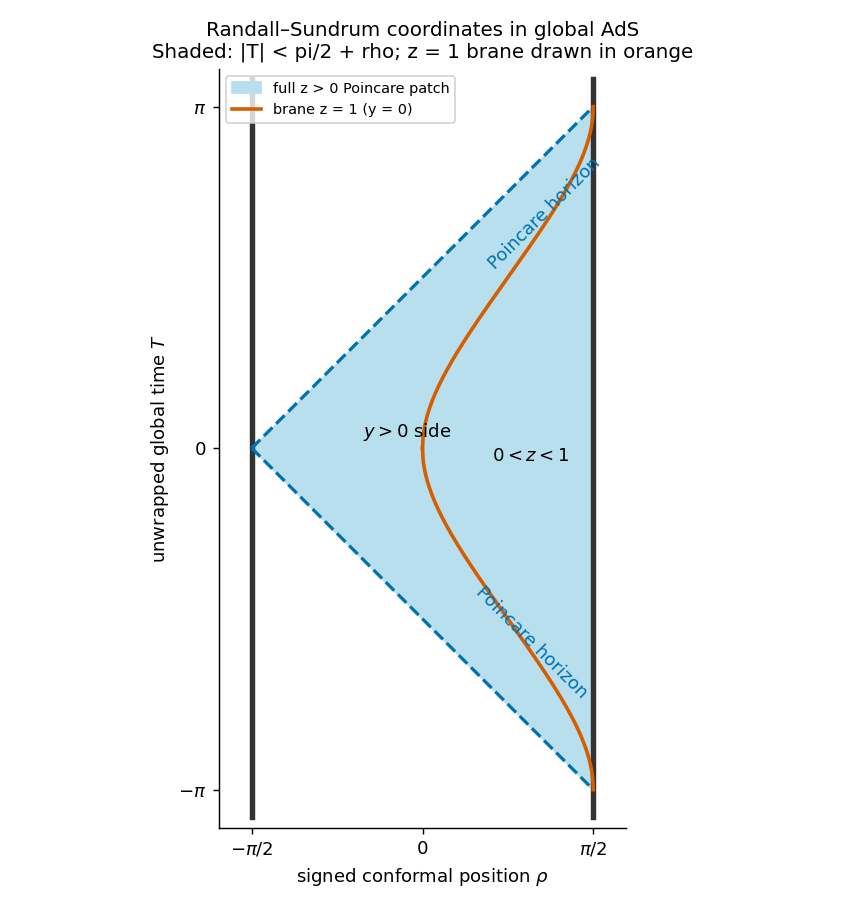
The Randall-Sundrum Poincaré patch inside global AdS, with null patch horizons and the reference brane z=1
. Details. The full coordinates in this part have , hence the whole shaded patch. If one additionally retains only the Randall–Sundrum bulk as in Question4, keep . The brane , or , has and is drawn in orange; the retained side contains , . A patch horizon is not a curvature singularity or the timelike conformal boundary. A geodesic can cross it in finite proper time while the patch coordinate diverges.
Past exam of the mathematics course of the University of Cambridge 2002 iii Paper 75 3 d Solution by Codex 0 Created 2026-10-03 Updated 2026-10-14
Codex 0 Created 2026-10-03 Updated 2026-10-14In the ambient space of signature , AdS is . Let an arbitrary event have embedding vector , and let be any future unit timelike tangent, soThe complete family through that event isDirect substitution gives and . Its ambient acceleration is , normal to the hyperboloid, so its tangential covariant acceleration vanishes. This proves that is proper time and that each curve is a timelike geodesic, rather than just guessing sinusoidal tracks from the diagram.
An AdS isometry can place any chosen at . Rotate the spatial direction into the displayed signed diameter. Write the initial local velocity as , with . Then , and . Eliminating using the global coordinates givesVarying the speed gives the drawn family; suppressed spatial directions can be restored by varying the tangent direction. It represents all timelike initial directions after the isometry and spatial rotations.
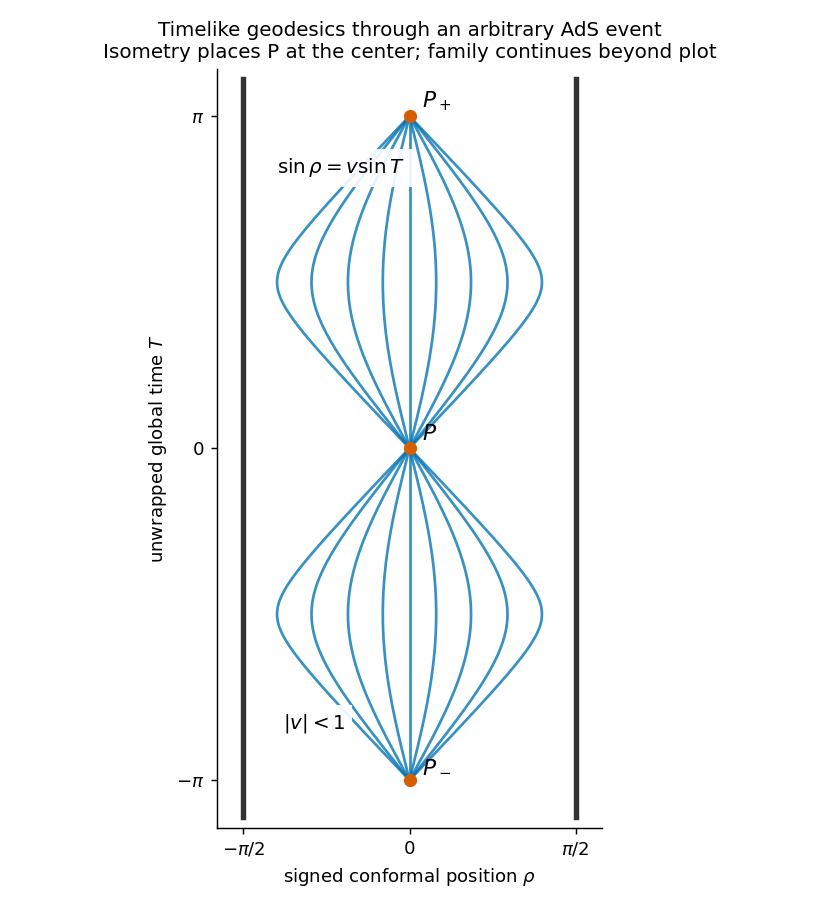
Timelike geodesics through an arbitrary AdS event, placed at the center by an isometry, refocusing at later antipodal events
. Details. Every finite-speed curve turns before the conformal boundary. At proper time , all reach ; at their ambient coordinates return to . This is Anti-de Sitter timelike geodesic refocusing. On the universal cover the global time has advanced by and , respectively, so these are later events. They are not closed timelike curves. The limits approach the null directions and are not timelike members of the family.
Past exam of the mathematics course of the University of Cambridge 2002 iii Paper 75 3 c Solution by Codex 0 Created 2026-10-03 Updated 2026-10-14
Codex 0 Created 2026-10-03 Updated 2026-10-14The universal cover of maximally extended AdS is not globally hyperbolic. Its timelike conformal boundary can send signals into the interior after any chosen initial slice, so bulk initial data alone do not determine evolution. In the conformal strip, a null ray can run from to the center in global time ; it need not meet a sufficiently earlier constant-time slice within the interior spacetime.
The compact-diamond test makes the obstruction explicit. Choose two central events with times and in units . Events at , lie between them causally, because their radial coordinate separation is less than2. They form a sequence in the causal diamond with no limit in the AdS interior. The diamond is therefore noncompact. Boundary conditions, such as reflecting conditions on the conformal boundary, can supply a well-posed initial-boundary-value problem; they do not turn the boundary-free interior into a globally hyperbolic spacetime in the usual definition. The periodic-time hyperboloid is also non-globally-hyperbolic, already because it has closed timelike curves.
Past exam of the mathematics course of the University of Cambridge 2002 iii Paper 75 3 b Solution by Codex 0 Created 2026-10-03 Updated 2026-10-14
Codex 0 Created 2026-10-03 Updated 2026-10-14A globally hyperbolic spacetime admits a Cauchy surface: every inextendible causal trajectory meets this spacelike initial-data surface exactly once. Physically, suitable field data on it determine evolution everywhere in its domain without additional data arriving from an unprescribed external boundary. This includes absence of causal loops and pathological almost-loops. An equivalent standard characterization is strong causality together with compact causal diamonds . The Cauchy condition concerns all causal curves, not merely the timelike geodesics that happen to remain in a bounded spatial region.
Past exam of the mathematics course of the University of Cambridge 2002 iii Paper 75 3 a Solution by Codex 0 Created 2026-10-03 Updated 2026-10-14
Codex 0 Created 2026-10-03 Updated 2026-10-14Take the causally unwrapped universal cover of Anti-de Sitter spacetime, with curvature radius . In global coordinates,The ordinary radial Penrose diagram is a half-strip: the left edge is a regular center and the right edge is a timelike conformal boundary. For displaying signed spatial motion, the figure doubles the radial diameter to . Its two ends represent antipodal spatial directions of the higher-dimensional boundary; they are not a claim that the full AdS boundary has two disconnected components.
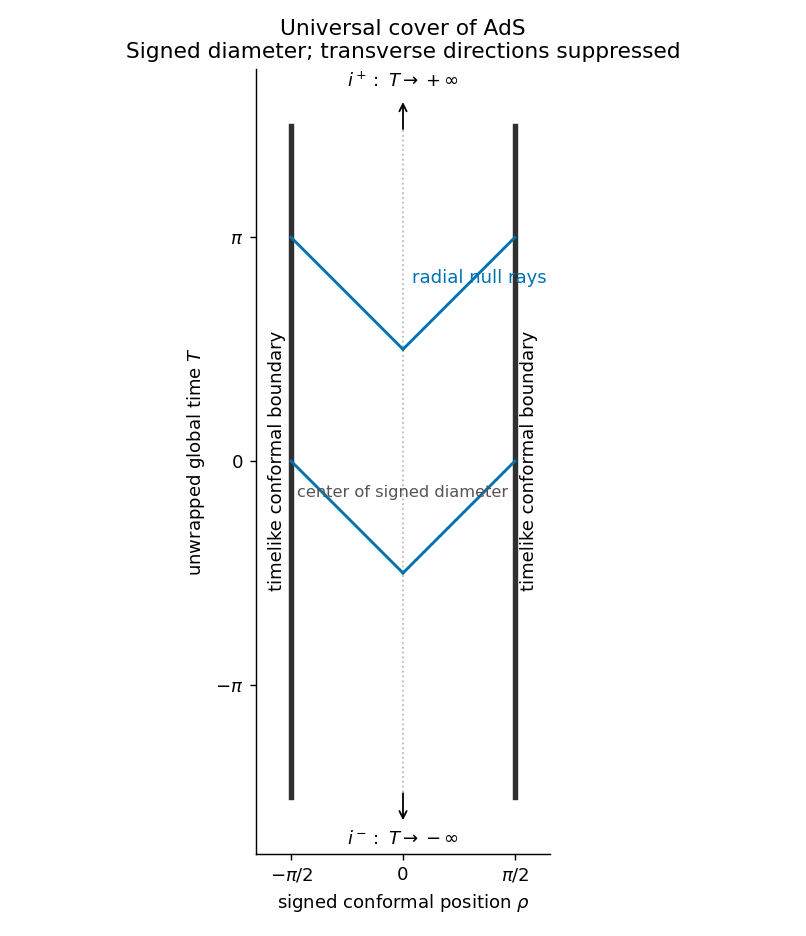
Conformal strip of the universal cover of anti-de Sitter spacetime, with timelike conformal boundaries and past/future timelike ends
. Details. The vertical edges are spatial infinity at every finite global time, forming the timelike boundary . The arrows mark the future and past timelike ends , conventionally and . There are no separate null-infinity edges like Minkowski : radial null rays satisfy and reach the timelike boundary in finite global time. Their physical affine parameter is nevertheless infinite there. The drawing is a finite excerpt of an infinitely tall strip, not an identification of its top and bottom. On the original hyperboloid global time is periodic and there are closed timelike curves; unwrapping it is essential to the usual physical maximally extended AdS spacetime.
Pinned article: Introduction to the OurBigBook Project
Welcome to the OurBigBook Project! Our goal is to create the perfect publishing platform for STEM subjects, and get university-level students to write the best free STEM tutorials ever.
Everyone is welcome to create an account and play with the site: ourbigbook.com/go/register. We belive that students themselves can write amazing tutorials, but teachers are welcome too. You can write about anything you want, it doesn't have to be STEM or even educational. Silly test content is very welcome and you won't be penalized in any way. Just keep it legal!
Intro to OurBigBook
. Source. We have two killer features:
- topics: topics group articles by different users with the same title, e.g. here is the topic for the "Fundamental Theorem of Calculus" ourbigbook.com/go/topic/fundamental-theorem-of-calculusArticles of different users are sorted by upvote within each article page. This feature is a bit like:
- a Wikipedia where each user can have their own version of each article
- a Q&A website like Stack Overflow, where multiple people can give their views on a given topic, and the best ones are sorted by upvote. Except you don't need to wait for someone to ask first, and any topic goes, no matter how narrow or broad
This feature makes it possible for readers to find better explanations of any topic created by other writers. And it allows writers to create an explanation in a place that readers might actually find it.
Figure 1. Screenshot of the "Derivative" topic page. View it live at: ourbigbook.com/go/topic/derivativeVideo 2. OurBigBook Web topics demo. Source. - local editing: you can store all your personal knowledge base content locally in a plaintext markup format that can be edited locally and published either:This way you can be sure that even if OurBigBook.com were to go down one day (which we have no plans to do as it is quite cheap to host!), your content will still be perfectly readable as a static site.
- to OurBigBook.com to get awesome multi-user features like topics and likes
- as HTML files to a static website, which you can host yourself for free on many external providers like GitHub Pages, and remain in full control

Figure 2. You can publish local OurBigBook lightweight markup files to either OurBigBook.com or as a static website.
Figure 3. Visual Studio Code extension installation.
Figure 5. . You can also edit articles on the Web editor without installing anything locally. Video 3. Edit locally and publish demo. Source. This shows editing OurBigBook Markup and publishing it using the Visual Studio Code extension. 
- Infinitely deep tables of contents:




All our software is open source and hosted at: github.com/ourbigbook/ourbigbook
Further documentation can be found at: docs.ourbigbook.com
Feel free to reach our to us for any help or suggestions: docs.ourbigbook.com/#contact