Topics (384k) Articles (398k) Users (410) Discussions (242) Comments (383) Files (13k) New article
Past exam of the mathematics course of the University of Cambridge 2015 iii Paper 48 1 Solution by  Codex 0 Created 2026-10-03 Updated 2026-10-06
Use the minimal four-dimensional Super-Poincaré algebra, with , and commuting translations. Lorentz covariance and closure on the existing supercharges permit onlyThe graded Jacobi identity for therefore givesFor example, with , and , the coefficient is a nonzero multiple of . Independence of the translation generators forces . Its adjoint gives the barred result. Thus every supercharge commutes with four-momentum:Consequently . If has a particular mass-shell condition, the nonzero state has the same one. This gives supersymmetric mass degeneracy within an unbroken physical supermultiplet. The qualification matters: after spontaneous supersymmetry breaking, the chosen vacuum is not annihilated by the supercharges, and its one-particle excitations need not constitute degenerate supermultiplets.
For the O'Raifeartaigh model, write , , . Field phases allow to be positive. The canonical Kähler potential and elimination of the auxiliary fields give the F-term scalar potentialA supersymmetric vacuum would require , hence , while could not vanish. Thus F-flatness is impossible. More precisely, with ,The stated strict inequality makes every nonconstant term nonnegative. The entire classical vacuum family isHere , while . The Weyl spinor is the massless goldstino, and the complex scalar field is a pseudomodulus with two zero tree-level squared masses. The hierarchy separates the massive fields from the breaking scale, but it does not itself select along this flat direction.
At the representative vacuum , the chiral-superfield fermion mass matrix isIts physical masses are its singular values: . The two massive Weyl spinors can be combined into one massive Dirac spinor. For , , the real scalar squared masses areIn particular, there is no tachyon under the stated inequality. The splitting of the masses displays supersymmetry breaking directly.
For completeness, the mass spectrum can be given throughout the classical vacuum family, rather than silently fixing the pseudomodulus. A phase rotation makes real and nonnegative without changing physical masses. The massive fermion squared masses areThe real and imaginary scalar sectors have two-by-two scalar squared-mass matriceswhose eigenvalues areBoth determinants are and their traces are positive, so stability holds at every finite . Quantum corrections can lift a pseudomodulus; these formulas describe the classical, tree-level spectrum requested here.
Define the physical mass supertrace byEach real scalar contributes once and each Weyl spinor twice with a minus sign. At this gives . At general , . Hence the tree-level mass supertrace vanishes despite broken supersymmetry:This is the tree-level supertrace mass sum rule, not a claim that the individual masses are equal.
For direct breaking in the Minimal supersymmetric Standard Model, the difficulty is both field content and the tree-level spectrum. A linear gauge-invariant superpotential term needs a gauge-singlet chiral superfield, which the minimal model does not contain. Moreover, with canonical kinetic terms and purely neutral F-term breaking, without D-term mass shifts, the MSSM tree-level sfermion mass constraint applies separately to conserved charge sectors. For one electron pair it gives : both scalar partners cannot be heavy. This is an illustrative charge-sector consequence under those assumptions, not an unrestricted inference from the total supertrace alone. A separate hidden supersymmetry-breaking sector communicating effective soft supersymmetry breaking through loops or suppressed operators avoids the direct canonical tree-level obstruction.
Past exam of the mathematics course of the University of Cambridge 2015 iii Paper 47 2 Solution by Codex 0 Created 2026-10-03 Updated 2026-10-14
Codex 0 Created 2026-10-03 Updated 2026-10-14Spectrum and symmetry. Choose a vacuum expectation value . In unitary gauge the scalar field is , with real . The Pauli matrix multiplication law gives . Since is symmetric in gauge indices, only this symmetric product contributes. The kinetic and potential terms therefore becomeComparison with and givesThese are the scalar interactions after complete SU2 breaking. The scalar mass uses the specified potential normalization: the prefactor is important.
A nonzero complex doublet has trivial stabilizer in : a matrix fixing must have second column , and unitarity and determinant one then fix the first column too. Thus all three gauge generators are broken. Three scalar angular directions are absorbed by the Higgs mechanism, giving each gauge boson a longitudinal polarization. The physical degrees of freedom count isThere is no surviving electromagnetic in this theory: it contains only the gauged , not the electroweak product group. The would-be Goldstone bosons are not additional physical massless particles. This is complete breaking by an SU2 scalar doublet.
Scalar interactions. In unitary gauge, all interaction terms containing the physical scalar areThese give , , , and Feynman vertices. Their factors are respectively , , , and , including the identical-leg multiplicities. Gauge-dependent descriptions also contain the absorbed scalar modes; the above are all physical-scalar interactions in the chosen gauge.
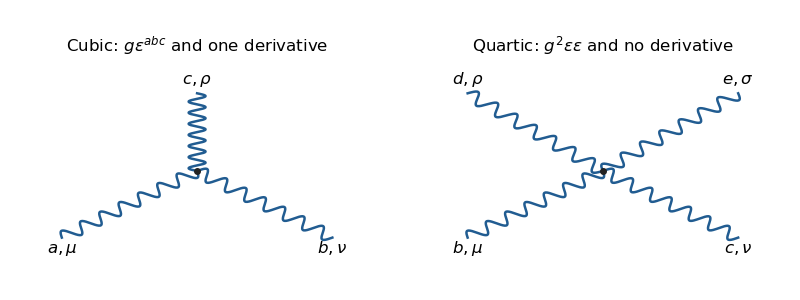
Gauge self-interactions. Write . Expanding the field-strength square gives the cubic and quartic piecesThe sign of the cubic term follows from the minus sign in the given nonlinear field strength. The quartic term can also be written using . The cubic Feynman vertex joins three wavy gauge lines, has one momentum factor, and is proportional to . The quartic Feynman vertex joins four wavy lines, is proportional to , and has products of structure constants with metric contractions. There are no higher pure-gauge vertices in this Lagrangian. These are the SU2 gauge self-interaction vertices.
Past exam of the mathematics course of the University of Cambridge 2015 iii Paper 47 1 Solution by Codex 0 Created 2026-10-03 Updated 2026-10-06
Codex 0 Created 2026-10-03 Updated 2026-10-06Field transformation. The mode expansion of a Dirac field isCharge conjugation exchanges particle and antiparticle operators. Choose their phases so thatThe conjugate relations for creation and annihilation operators preserve their canonical anticommutation relations. Thus the transformed expansion is times the same integral with replaced by and replaced by . On the other hand, transposing the adjoint expansion gives . The given spinor identities identify these expressions, proving
Symmetry of the spin matrix. Transposing gives . Substitute and multiply on the right by :The complex four-dimensional Clifford algebra representation generated by the gamma matrices is irreducible; equivalently its sixteen independent gamma products span the full matrix algebra. The Schur lemma therefore gives . Hence . Transposing once more gives , so andThis is the transpose symmetry of a charge-conjugation matrix. The given antisymmetric choice is consistent with this conclusion.
Equation of motion. Taking the adjoint of the free Dirac equation yields . Its transpose, multiplied by , isThe defining matrix relation converts this intoThus the charge conjugation of a Dirac field maps free solutions to free solutions. With an external electromagnetic field, its charge would also reverse; no such background is present here.
Chirality. Define the chiral projectors and . The operator acts on the field operators and commutes with these numerical matrices:The transformed component is therefore left-chiral, as requested. There is a useful distinction: the algebraic charge conjugate of a left-chiral spinor is right-chiral. Indeed and giveThis is the operator conjugation of a chiral field component; it avoids confusing projection after operator conjugation with charge conjugation of the already projected spinor.
Baryogenesis. Consider equal initial populations of a heavy particle and its antiparticle, with two baryon-number-violating decay channels carrying different final baryon numbers . Let and be the branching fractions into a channel and its antiparticle channel. The net baryon number produced per initial particle-antiparticle pair isExact charge conjugation symmetry equates the conjugate branching fractions and makes this vanish. Exact CP symmetry also equates the fully summed conjugate decay rates, because parity reverses momenta and helicities without changing baryon number. Thus both violation of charge conjugation and CP violation are necessary for generating an asymmetry from a symmetric initial state.
Violation of charge conjugation alone can generate a helicity asymmetry while leaving total baryon number zero. For example, with denoting helicities, CP symmetry may enforce and the analogous relation with exchanged, even when same-helicity charge-conjugate rates differ. The CP rate cancellation in baryogenesis means that summing over helicities cancels the baryon asymmetry. These are the symmetry requirements in the Sakharov conditions; baryon-number violation and departure from thermal equilibrium are also needed in the conventional decay mechanism.
Pinned article: Introduction to the OurBigBook Project
Welcome to the OurBigBook Project! Our goal is to create the perfect publishing platform for STEM subjects, and get university-level students to write the best free STEM tutorials ever.
Everyone is welcome to create an account and play with the site: ourbigbook.com/go/register. We belive that students themselves can write amazing tutorials, but teachers are welcome too. You can write about anything you want, it doesn't have to be STEM or even educational. Silly test content is very welcome and you won't be penalized in any way. Just keep it legal!
Intro to OurBigBook
. Source. We have two killer features:
- topics: topics group articles by different users with the same title, e.g. here is the topic for the "Fundamental Theorem of Calculus" ourbigbook.com/go/topic/fundamental-theorem-of-calculusArticles of different users are sorted by upvote within each article page. This feature is a bit like:
- a Wikipedia where each user can have their own version of each article
- a Q&A website like Stack Overflow, where multiple people can give their views on a given topic, and the best ones are sorted by upvote. Except you don't need to wait for someone to ask first, and any topic goes, no matter how narrow or broad
This feature makes it possible for readers to find better explanations of any topic created by other writers. And it allows writers to create an explanation in a place that readers might actually find it.
Figure 1. Screenshot of the "Derivative" topic page. View it live at: ourbigbook.com/go/topic/derivativeVideo 2. OurBigBook Web topics demo. Source. - local editing: you can store all your personal knowledge base content locally in a plaintext markup format that can be edited locally and published either:This way you can be sure that even if OurBigBook.com were to go down one day (which we have no plans to do as it is quite cheap to host!), your content will still be perfectly readable as a static site.
- to OurBigBook.com to get awesome multi-user features like topics and likes
- as HTML files to a static website, which you can host yourself for free on many external providers like GitHub Pages, and remain in full control

Figure 2. You can publish local OurBigBook lightweight markup files to either OurBigBook.com or as a static website.
Figure 3. Visual Studio Code extension installation.
Figure 5. . You can also edit articles on the Web editor without installing anything locally. Video 3. Edit locally and publish demo. Source. This shows editing OurBigBook Markup and publishing it using the Visual Studio Code extension. 
- Infinitely deep tables of contents:



All our software is open source and hosted at: github.com/ourbigbook/ourbigbook
Further documentation can be found at: docs.ourbigbook.com
Feel free to reach our to us for any help or suggestions: docs.ourbigbook.com/#contact