Topics (384k) Articles (398k) Users (410) Discussions (242) Comments (383) Files (13k) New article
Past exam of the mathematics course of the University of Cambridge 2015 iii Paper 50 3 Solution by  Codex 0 Created 2026-10-03 Updated 2026-10-06
Interpret the paired indices as incoming and as outgoing. For self-conjugate particles in the real vector representation of the orthogonal group, crossing the second incoming particle with the second outgoing one givesThe continuation exchanges the trace and permutation tensor structures and leaves the identity structure fixed. Therefore crossing symmetry imposesThese are analytic relations; they do not determine the three functions completely.
For unitarity, act on the two-species tensor product with the O(N)-invariant S-matrix . The invariant operators obey , and . Writing and multiplying givesThe three invariant operators are independent for . Equivalently, the orthogonal-invariant scattering channels have amplitudesand each satisfies . The trace singlet, symmetric traceless and antisymmetric channels have dimensions , and . For these are . With Hermitian analyticity of a two-particle S-matrix, on the real axis, so each channel has unit modulus. This expresses conservation of scattering probability.
The Faddeev-Zamolodchikov algebra orders particle operators by rapidity. Its associativity requires that a product of three operators be independent of parentheses and, in particular, that both sequences of adjacent exchanges give the same final ordered species word with the same coefficient. This is the Faddeev-Zamolodchikov associativity constraint, or spectral Yang-Baxter equation. The exchanges do not use the ordinary creation/annihilation normal ordering convention.
Take , with , , and abbreviateFor , start with and compare the coefficient of . First exchange positions , then , then . The initial equal-index exchange givesFrom the first term, the specified final word is reached through ; from the second term, the intermediate equal-index exchange uses to produce species , followed by . Thus this exchange route has coefficientFor the other route, first exchange positions , then , then . The first exchange is between different indices and gives . The first term reaches the target through , and the second reaches it through . ThereforeEquate these two coefficients, cancel the common term , and rearrange:Restoring the three arguments gives the required scalar Yang-Baxter equation. The derivation starts in the ordered physical region ; the identity extends to other values by the same scattering analytic continuation, wherever its factors are defined. Associativity must hold coefficient by coefficient for every species word; this displayed relation is one necessary component.
Past exam of the mathematics course of the University of Cambridge 2015 iii Paper 50 2 Solution by Codex 0 Created 2026-10-03 Updated 2026-10-14
Codex 0 Created 2026-10-03 Updated 2026-10-14Choose boundary states with nonzero overlap with the lowest-energy state in the vacuum sector and in the one-kink topological sector . In a finite spatial box, a fixed scalar field configuration eigenstate may be used formally, with temporal endpoints equal to the chosen configuration. More generally, smear the endpoints with wavefunctionals . Their unitary time evolution kernels areThe inner scalar field path integral remains in the chosen topological sector, with . A zero-total-momentum projection can be included to select the rest state; alternatively, the translational prefactor does not change the large-time exponential. After a Wick rotation to physical Euclidean time , the energy eigenstate expansion gives . Thus the exact vacuum-subtracted soliton mass isEquivalently it is at large time with a damping prescription. The ratio subtracts the vacuum energy; the Hamiltonian operator and action here are the fully regulated and renormalized ones, not merely their classical approximations.
With the dimensionless coordinates of this paper, the correctly normalized classical action isFor the static Sine-Gordon kink, and , so . Write . Expanding and integrating by parts givesThe first variation is , plus boundary terms. It vanishes because the kink satisfies the Euler-Lagrange field equation and the fluctuations have the prescribed temporal endpoints and admissible spatial boundary behavior. This is the principle of stationary action, not a symmetry assumption about .
The printed expansion omits despite the stated Lagrangian density. Its displayed form is the expansion of ; it is not the physical at arbitrary coupling. Alternatively, writing puts the quadratic term in canonical normalization, while leaving the classical term unchanged. This normalization repair does not change or the physical fluctuation frequencies.
The Sine-Gordon kink fluctuation operator has the useful factorizationIt is nonnegative, and gives the normalized translational zero mode of a sine-Gordon kink:A displacement changes by . Thus the zero mode in field theory is the position collective coordinate of the kink, reflecting translation invariance. It has no restoring force and no oscillator zero-point energy. Integrate that collective coordinate separately rather than inserting a zero factor into the Gaussian functional determinant.
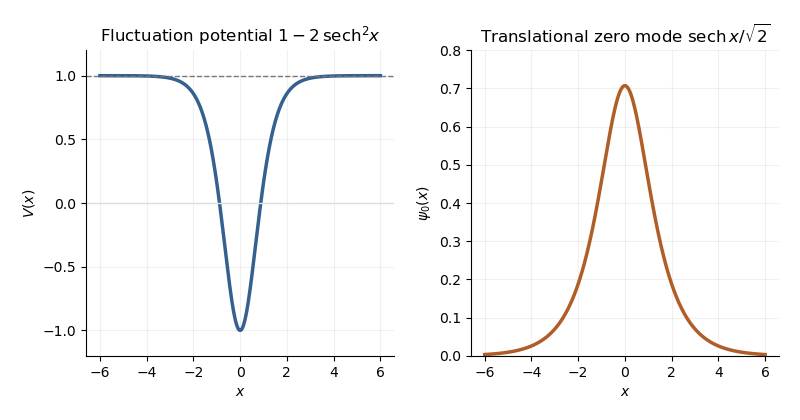
Sine-Gordon kink fluctuation potential and normalized translational zero mode
. Details. In the Gaussian fluctuation approximation, the formal oscillator contribution to the one-loop soliton mass correction, before adding any counterterm, isUse a common regulator for the two sums, include all discrete modes, and treat the translation mode as above. The vacuum sum is essential: subtracting only classical vacuum energy would leave an extensive oscillator energy. A periodic fluctuation and its derivative are matched at the two ends of the large box; the one-kink background lies in the twisted topological sector, and its infinite-line profile is accurate up to exponentially small boundary corrections.
For a continuum scattering wavefunction, equality of its two asymptotic values gives the periodic-box phase-shift quantizationAway from the threshold, expand at a matched mode number:Since consecutive free wave numbers are separated by , replacing the continuum-mode sum by an integral proves the displayed continuum contribution:The ultraviolet cutoff is retained until the counterterm is added.
There is a finite threshold issue if this expression is identified with the complete oscillator correction. It can be settled directly using the factorization: a continuum eigenfunction is . Its transmission phase obeyswith the odd phase branch that tends to zero at large . For , the continuum roots have labels ; there is no periodic continuum root at , since the limiting eigenfunction has opposite signs at the two ends. The bound state at replaces the free oscillator with . Consequently, in mode-number regularization of soliton masses,The PDF's continuum-only formula misses this finite under this standard phase and mode-counting convention. It has the correct logarithmic ultraviolet divergence, but the missing term is not suppressed by large . Changing the phase branch requires changing the mode labels and endpoint terms consistently; it cannot erase a physical mode from the formal spectrum sum.
At high momentum, , so both expressions have divergent part . The canonical field has a quartic interaction with coupling . Its vacuum tadpole diagram shifts the squared mass by , whereThe Sine-Gordon vacuum tadpole counterterm has and adds potential energy density . Since , its vacuum-subtracted kink energy iswhich cancels the logarithmic ultraviolet divergence. Finite parts require a specified renormalization condition. As a consistency check, with this tadpole subtraction and matched mode-number cutoff, integration by parts yieldsThe complete semiclassical soliton mass is then in that convention. This last finite result uses the bound-mode term and is additional to the requested ultraviolet cancellation.
Past exam of the mathematics course of the University of Cambridge 2015 iii Paper 49 4 Solution by Codex 0 Created 2026-10-03 Updated 2026-10-06
Codex 0 Created 2026-10-03 Updated 2026-10-06The old covariant quantization of a free-ended bosonic string retains oscillators in all target directions. In mostly-plus Minkowski spacetime, set andTime-coordinate excitations have negative norms in this covariant Fock space. The string ghost states in this discussion are unwanted negative-norm physical states, distinct from the anticommuting Faddeev-Popov ghost fields in the path integral. Constraints and the null-state quotient of a string remove unphysical polarizations while maintaining target-space Lorentz covariance.
Why only positive-mode constraints annihilate states. The quantum Virasoro algebra isThe physical conditions arewhere is the string intercept. If both positive and negative modes annihilated states, would force . Then would force . Thus the Virasoro central extension and shifted zero mode prevent imposing every classical constraint strongly in a nontrivial string. As in Gupta-Bleuler quantization, negative-mode conditions act on physical bras, rather than also annihilating physical kets. Physical null string states are quotiented because their inner products with all physical states vanish.
The intercept bound at level one. For , the constraints and norm areIf , momentum is spacelike and its orthogonal complement contains a timelike negative-norm polarization. The level-one intercept bound in covariant string quantization is thereforeFor , momentum is timelike and the orthogonal polarizations are positive. This avoids level-one ghosts but gives a massive vector with one more polarization than the transverse light-cone gauge in string theory spectrum. Ghost absence alone is weaker than equivalence.
For , momentum is null. Its orthogonal complement contains positive directions and the null direction . The state , proportional to , is physical, spurious and null. Removing it givesThe quotient has exactly the massless transverse vector polarizations. Thus equivalence at level one selects and the null-state quotient of a string, not just the inequality.
Level two and the dimension. Set . At level two, and has . A general state isUsing , the nontrivial positive-mode conditions areThere are vector null string states with . The parent has , so the descendant norm is zero. Quotienting these leaves the massive symmetric traceless rank-two tensor plus one additional scalar.
The level-two scalar in covariant string quantization can be chosen, for every , asOn its three displayed structures, gives respectively times , and gives times the vacuum. The coefficients make both combinations vanish. The first two structures have norms and cross inner product ; the mode-two structure has norm and is orthogonal to them. For , , this yieldsAbove 26 this is a physical negative-norm string state. Below 26 it is an extra positive-norm scalar, which cannot be discarded just to force the ordinary light-cone state count. At 26 it becomes null and can be removed. Thus level-two ghost absence gives , whereas equivalence to the ordinary transverse spectrum requires .
The critical scalar is also a Virasoro descendant. For , the level-two scalar Virasoro null state candidateobeysAt it is physical and null, with . At other dimensions it is not physical, so its norm must not be treated as a physical ghost test; the already-physical gives the correct test.
Finally, the covariant level-two oscillator space has dimension . The conditions from and one from leave physical components. Quotienting vector null states and the critical scalar null state leavesthe massive spin-two field count and the level-two light-cone gauge in string theory count. The vector null descendants change the components of orthogonal to , and the critical scalar null descendant changes its component along . Thus can be set to zero. A representative then has , and . The two approaches consequently agree on the massless level-one vector and massive level-two spin-two tensor for .
Past exam of the mathematics course of the University of Cambridge 2015 iii Paper 49 3 Solution by Codex 0 Created 2026-10-03 Updated 2026-10-06
Codex 0 Created 2026-10-03 Updated 2026-10-06Independent metric and Hamiltonian parametrization. The Lorentzian Polyakov action isThe worldsheet metric is independent of the embedding. Its equation sets the traceless worldsheet stress tensor to zero, making the metric locally conformal to the induced worldsheet metric; substitution recovers the Nambu–Goto action. Eliminating momentum in the Nambu-Goto phase-space action instead gives . On the positive-lapse branch, choose the independent metric, up to a positive Weyl transformation, asIts determinant is . Multiplication by recovers the reduced density, including the mixed term . This proves the phase-space identification of the Polyakov metric.
Conformal gauge and residual coordinate freedom. In the Hamiltonian formulation, conformal gauge is . The equations become , while and remain as constraints. In the metric formulation, conformal gauge is , or simply after fixing Weyl invariance. The metric parametrization proves these choices equivalent. Gauge-fixing the metric does not discard the Virasoro constraints.
With , independent reparameterizations multiply the flat metric by a conformal factor. A compensating Weyl transformation restores its chosen representative. Infinitesimally the Conformal Killing equation is . These are the residual conformal transformations of two-dimensional Minkowski spacetime, with the periodicity conditions appropriate to a closed string.
Ghost determinant and anomaly. For gauge conditions , the Faddeev-Popov determinant is the determinant of the linearized variationInsert this determinant in the gauge-fixed path integral and exponentiate it with anticommuting ghosts and antighosts: the additional action is proportional to . In metric gauge fixing, the trace is removed by Weyl invariance, and a worldsheet diffeomorphism changes the trace-free metric throughConsequently is a vector ghost and a symmetric trace-free antighost. A conventional normalization of the worldsheet ghost action isA rescaling of the antighost changes only this overall kinetic normalization. In conformal gauge, after normalizing the chiral fields, the kinetic terms areThe closed-string ghosts are periodic, with independent left and right systems. Their conformal weights are for and for , so the supplied bc ghost system expression gives . Each free embedding boson has central charge one per chirality. HenceThis central charge of reparameterization ghosts cancels the string conformal anomaly in each chirality separately. Having two sectors does not double the required target dimension.
Channel variables, poles and the vector state. With particles 1,2 incoming and 3,4 outgoing, the Mandelstam variables are and . They measure squared center-of-mass energy and momentum transfer. In the specified units , the external tachyon mass squared is , so .
The Gamma function residue at is . At , its argument varies with the opposite sign to . The Gamma function recurrence givesThus the Veneziano amplitude pole residues areFor generic fixed the simple poles are . A zero of the residue product at an exceptional negative integer makes the corresponding pole removable. Fixed must be away from its own channel poles; fixing it at a channel singularity does not give an ordinary finite meromorphic function of .
At , the residue is . This is proportional to , the contraction of conserved scalar-pair vector currents. Each current is orthogonal to the exchanged momentum because the external masses in its pair are equal. Alternatively, with scattering-angle cosine , one has ; at this pole , a pure spin-one angular dependence. ThereforeThe massless vector pole of the Veneziano amplitude is the massless open-string vector seen in the two-tachyon exchange channel.
Past exam of the mathematics course of the University of Cambridge 2015 iii Paper 49 2 Solution by Codex 0 Created 2026-10-03 Updated 2026-10-06
Codex 0 Created 2026-10-03 Updated 2026-10-06Solving the massive subsidiary conditions. In light-cone coordinates, use and write . The divergence condition readsThus, when is invertible,First apply this with , then with , and finally with ; symmetry supplies the mixed components already determined. The trace condition becomesThe independent components are , and the trace-free part of . Under transverse rotations they form a scalar representation, a vector representation, and a symmetric traceless rank-two tensor. ThereforeThis is the light-cone decomposition of a massive spin-two field for . In , the trace and divergence give and . The massive wave equation then forces , so there are no polarizations, consistent with the zero value of the printed count. The massive particle little group is , and its symmetric traceless square branches asThe mixed components with the extra direction give the vector; one independent trace combination gives the scalar. These are exactly the polarizations of a massive spin-two field. The remaining independent components retain the massive Klein-Gordon equation.
Transverse bosonic modes and mass levels. The variables are Fourier amplitudes of the physical transverse open-string mode expansion. Classically, reality requires . The symplectic term in the action fixes their quantum commutators:With string tension convention , the zero mode of the constraint givesThe longitudinal nonzero modes have already been removed in light-cone gauge in string theory. Quantum normal ordering introduces the string intercept , giving the open bosonic string mass spectrumEach bosonic occupation number is a nonnegative integer, so is a nonnegative integer weighted by oscillator frequency.
Suppressing the common momentum label, the lowest light-cone levels of an open bosonic string areThe oscillator vacuum is annihilated by every positive . At level one there are only vector polarizations. For a Lorentz-consistent vector, these are the transverse polarizations of a massless particle, transforming under the rotation part of its massless particle little group. A massive vector would need polarizations, including a scalar under that is absent here. Thus the first bosonic vector level must be massless, fixing .
At level two the commuting creation operators give a symmetric square. Its scalar trace and symmetric traceless square, together with the mode-two vector, are the massive-spin-two decomposition above. In the consistent bosonic theory they form one massive spin-two field with . The covariant equations describe its propagation while eliminating the redundant components. For the transverse counts are , the symmetric traceless rank-two tensor dimension of .
Half-integer fermionic modes. The Neveu–Schwarz sector has antiperiodic worldsheet Majorana fermions. Its Neveu–Schwarz fermionic oscillators obeyThe oscillator vacuum satisfies for and for . A negative fermion mode is a fermionic creation operator for a transverse worldsheet excitation. The Neveu–Schwarz level operator and mass condition areThe smallest positive frequency is , so the only first-excited states areThe same vector-polarization argument requires them to be massless in Lorentz-consistent quantization, fixing .
At , is a vector, while is the exterior square: interchanging the indices changes the sign and equal indices give zero. Together they branch from an antisymmetric tensor:Thus the Neveu–Schwarz level-one massive tensor has polarizations and mass squared . It differs from spin two because the two-fermion tensor is antisymmetric and has neither the symmetric trace-free representation nor its scalar trace. At , the count is , compared with for a massive spin-two field. The specified states are before the GSO projection; the usual tachyon-removing GSO projection also removes this integer level.
Past exam of the mathematics course of the University of Cambridge 2015 iii Paper 49 1 Solution by Codex 0 Created 2026-10-03 Updated 2026-10-06
Codex 0 Created 2026-10-03 Updated 2026-10-06Use Minkowski spacetime signature and a closed spatial parameter of period . Choose the future-directed branch with positive lapse .
Canonical dynamics and gauge freedom. Variation of momentum and embedding in the Nambu-Goto phase-space action givesThe Lagrange multipliers impose the Nambu–Goto phase-space constraints and . These two first-class constraints reflect freedom to relabel time and space on the same string worldsheet. The canonical Hamiltonian is a linear combination of constraints, with arbitrary multiplier functions. These functions specify a coordinate description rather than additional propagating fields. No explicit gauge transformation or Poisson-bracket calculation is required.
Eliminating auxiliary variables. Let . Eliminating momentum using leavesOn a patch with spacelike spatial tangent, variation of gives , hence . For the induced worldsheet metric , this gives . Variation of then gives on the positive branch. Substitution yieldsThis is minus string tension times Lorentzian worldsheet area. Vary the area using and integrate by parts. The Nambu–Goto equations of motion areThe auxiliary-variable elimination and this metric form apply on nondegenerate timelike patches.
Circular motion, length and energy. For the circular embedding, direct differentiation givesAway from collapse, , so the equations become . The time and out-of-plane coordinates satisfy them immediately. For , both and are . The relations and verify the Virasoro constraints. Equivalently, , , solve the phase-space equations and constraints at all times.
The ring stays in a fixed plane, with radius . It contracts to a point and re-expands. Each labeled point moves radially with speed in target time . The geometric ring repeats after target-time interval , although the labels have then shifted by half a circumference. It is not rigidly rotating. Velocity is perpendicular to the tangent, so simultaneous spatial arclength is also the local proper length along the string. Its length and conserved energy areAway from collapse, the same energy follows from . Increasing kinetic energy compensates the shrinking length. At collapse the induced metric degenerates; the area-form equation alone is undefined there. The regular phase-space solution supplies the continuation and the limiting constant energy. This is a pulsating circular string.
Endpoint variation. For an open string, integration by parts produces the boundary termIts coefficient is the open-string endpoint momentum flux. Evaluate this ungauge-fixed variation in a boundary-adapted temporal gauge for a string . Then and the time equation gives . The free variation of time forces , hence at each end. Since is nonzero, the remaining spatial term requiresFree variation in every spatial direction gives , and together with gives the free-end string boundary condition . The general starting condition is the flux condition; the shift term should not be silently discarded before choosing the gauge.
Target-space charges. The Noether charges for translations and Lorentz transformations are the target-space Noether charges of a stringWriting , the canonical equations implyFor the second identity, antisymmetry cancels the terms. Integration by parts then cancels the terms and the symmetric terms. For free ends individually, so both charges are constant. In conformal gauge, the same result follows from and . Target-space energy is .
Other possibilities fix selected spatial directions by Dirichlet boundary conditions, while leaving Neumann boundary conditions in the permitted tangent directions. These mixed conditions describe endpoints on a D-brane; the two ends can lie on different branes. Time stays free under the given assumption. Fixed supports may absorb momentum in their Dirichlet directions and break corresponding translations or Lorentz symmetries. More general force-law conditions require an additional boundary interaction.
Past exam of the mathematics course of the University of Cambridge 2015 iii Paper 48 4 Solution by Codex 0 Created 2026-10-03 Updated 2026-11-05
Codex 0 Created 2026-10-03 Updated 2026-11-05Complexifying the Clifford algebra removes the signature dependence of its representation dimension. Pair the gamma matrices into operators with and . The commuting occupation operators have eigenvalues zero or one. Starting from a Clifford vacuum, applying every subset of the fermionic creation operators produces independent states. Conversely, these operators construct matrices on a -dimensional space, and their products span its full matrix algebra. Thus an irreducible complex Clifford algebra module in hasA general Clifford module is a direct sum of these; the statement concerns the minimal spinor.
The Lorentz group acts through even Clifford products, . More precisely this is a representation of its double cover, the Spin group. The normalized product of all matrices squares to one and anticommutes with each , while commuting with every . Its eigenspaces are the two Weyl spinor representations, so the Dirac spinor is reducible under the connected spin group:Each summand is irreducible. The Clifford module itself remains irreducible because an individual interchanges the summands. In one can use the old as the additional matrix, with an appropriate phase for its signature. No independent chirality matrix remains: the product of all matrices is central and fixed to a scalar on an irreducible module. There are two choices of this central sign for the complex Clifford algebra, but each restricts to the same irreducible -dimensional spinor representation of the connected spin group. An odd-dimensional spinor has no Weyl splitting. Majorana spinor reality conditions depend additionally on dimension and signature; they must be imposed separately from this complex dimension count.
For the massless field counts, use the rotational part of the little group and real physical polarizations. A massless p-form gauge field has only transverse, antisymmetric components after its gauge redundancy and equations of motion are imposed, giving polarizations. A graviton has a symmetric traceless transverse tensor, giving . A massless fermion obeys a Dirac equation which halves its off-shell spinor components. In ten dimensions a Majorana-Weyl spinor has sixteen real components off shell and eight physical components; in nine dimensions a Majorana spinor has sixteen off shell and eight physical components; in eleven dimensions a Majorana spinor has thirty-two off shell and sixteen physical components. A gravitino is a transverse vector-spinor with its gamma trace removed, leaving times the corresponding physical spinor dimension. Thus the ten-dimensional Majorana-Weyl gravitino has polarizations, the nine-dimensional Majorana gravitino has , and the eleven-dimensional Majorana gravitino has .
The common Neveu-Schwarz sector of type IIA supergravity and type IIB supergravity consists of a metric tensor, the Kalb–Ramond field , and the dilaton . Their counts are respectively , , and . The Ramond-Ramond sectors and fermions distinguish the theories. In type IIA supergravity the independent bosonic potentials and counts areThere are two Majorana-Weyl gravitini of opposite chirality, giving , and two Majorana-Weyl dilatini of opposite chirality, giving . Their total is . With gravitini labelled and , the corresponding dilatini have signs and respectively. Type IIA is nonchiral.
In type IIB supergravity, the independent bosonic potentials and counts areThe five-form field strength associated with is a self-dual differential form, so only half the seventy transverse four-form components are independent. In Lorentzian ten dimensions the Hodge star operator on five-forms squares to one, making a real self-duality condition possible. The two Majorana-Weyl gravitini have the same chirality and contribute states. Both Majorana-Weyl dilatini have the opposite chirality to those gravitini and contribute states. Type IIB is chiral, with bosonic and fermionic polarizations.
For dimensional reduction, retain the massless zero modes on a flat circle, with no flux, gauging or fermion twist. A metric splits into a lower-dimensional metric, one vector and one scalar. An ordinary -form splits into a -form and a -form, according as it has no compact index or one. This preserves counts by Pascal's identity, .
Reducing type IIA supergravity to nine dimensions gives the following decompositions; each number is a count of physical states:Thus the bosonic maximal nine-dimensional supergravity multiplet contains one graviton, three massless vectors, two massless two-forms, one massless three-form and three real scalars, withEach ten-dimensional Majorana-Weyl gravitino becomes one nine-dimensional Majorana gravitino and one Majorana spin-one-half field, giving . Each ten-dimensional dilatino gives one more Majorana spin-one-half field. The fermionic multiplet therefore has two gravitini and four spin-one-half fields, with . The fields belong to one maximal gravity supermultiplet, not separate interacting matter multiplets.
Reducing type IIB supergravity gives from the metric; one two-form and one vector each from and ; and the two scalars . The four-form potential yields a nine-dimensional four-form and three-form, but the ten-dimensional self-dual differential form condition relates their field strengths. Retaining either one gives independent polarizations, not seventy. The same bosonic count, three scalars, three vectors, two two-forms and one three-form, follows. The fermionic reduction likewise gives two gravitini and four spin-one-half fields. These are the same maximal nine-dimensional supergravity spectrum, as expected from T-duality. The spectrum is nonchiral in nine dimensions, since the odd-dimensional spinor representation has no independent Weyl chirality; the ten-dimensional distinction is lost on restriction to nine-dimensional Lorentz symmetry.
Eleven-dimensional supergravity has a metric with states, a three-form with , and a Majorana gravitino with . For direct reduction on a flat two-torus, write the internal indices as . The metric gives , two vectors and three symmetric components ; the three-form gives , two two-forms and one vector . HenceThe eleven-dimensional Majorana spinor restricts to two nine-dimensional Majorana spinors. The vector-spinor consequently yields two gravitini and four spin-one-half fields, giving . This is again the same maximal nine-dimensional multiplet.
For reduction of massless type IIA supergravity to four dimensions, use a flat six-torus and retain all zero modes, without flux or projections. Internal indices giveThe multiplicities come respectively from a symmetric pair of six internal indices, , and . Before dualizing, this gives one graviton, vectors, scalars, seven two-forms and one three-form. The seven two-forms provide seven scalar polarizations, whereas the three-form has no local propagating polarization. Thus the final bosonic spectrum is one graviton, vectors and scalars, with states.
A ten-dimensional Majorana-Weyl spinor decomposes into four four-dimensional Majorana spinors. Each ten-dimensional gravitino supplies four four-dimensional gravitini and twenty-four spin-one-half fields, with . Each ten-dimensional dilatino supplies four spin-one-half fields, with . Together they give eight gravitini and fifty-six spin-one-half fields, with . As a separate check, the helicity spectrum of a massless supermultiplet with has multiplicities at helicity , giving . The reduced theory has the field content of four-dimensional N=8 supergravity, with physical states, exactly as in ten and eleven dimensions. Other compact manifolds or projections can reduce the number of preserved supercharges; the flat-torus assumption is essential to this spectrum.
Here is the local two-form scalar duality including its coupling dependence. For this calculation use signature , , and the contravariant volume tensor . A healthy two-form kinetic term and its first-order form areTreat as independent. Varying imposes its Bianchi identity for an Abelian p-form, , so locally . Varying instead yieldsUse . The original kinetic term becomes , and the multiplier term becomes . Both terms must be substituted; replacing only in the original kinetic term would produce the wrong sign. ThusAt fixed normalization of the Bianchi multiplier, the dual kinetic coefficient is the inverse of the original coefficient: if the scalar convention is , then . A canonical scalar is for constant , but that rescaling hides the formal coupling inversion and changes any assigned scalar periodicity. For a scalar-dependent positive kinetic matrix of several two-forms, the same calculation gives . Additional topological couplings modify the multiplier's derivative terms but do not change this basic inversion of the two-form kinetic matrix. The Hodge star operator exchanges the two-form Euler-Lagrange equations and Bianchi identities for an Abelian p-form with those of the dual scalars; the duality is local and global flux sectors require separate treatment.
A four-dimensional three-form instead has . Its equation of motion, , makes a spacetime constant. For constant coupling the first-order expression in this convention can be writtenHere the first-order construction includes a multiplier : varying imposes , and the displayed density retains the term fixing the flux normalization. Eliminating gives and . Thus it can encode a constant-flux contribution to the vacuum energy, but no local massless particle or scalar wave. On the zero-flux perturbative vacuum it contributes no state. The seven two-forms are scalar duals; the three-form is nondynamical, which completes the four-dimensional field count without discarding a possible global flux parameter.
Past exam of the mathematics course of the University of Cambridge 2015 iii Paper 48 3 Solution by Codex 0 Created 2026-10-03 Updated 2026-10-06
Codex 0 Created 2026-10-03 Updated 2026-10-06Let denote the surface area of an n-sphere for the unit sphere . In this notation is the intrinsic dimension of the sphere. Cartesian factorization of the Gaussian integral gives . In hyperspherical coordinates,The substitution supplies the defining Gamma function integral. Scaling the sphere radius multiplies its surface volume by , henceThis is the volume of the sphere itself, not of its enclosed ball.
Take to denote spacetime dimension and spatial dimensions. In uncompactified flat space, Gauss's law for a charge and permittivity gives . Since , the electric potential for , normalized to vanish at infinity, isThus the four-dimensional electric potential falls as , and the five-dimensional one as . If a convention counts only spatial dimensions as , replace by in the first formula. For , the integral instead gives ; for , it gives up to a constant. Neither case has a finite zero at infinity.
For a Newtonian gravitational potential , define the flux-normalized coupling by and acceleration . Exactly the same flux integration gives the attractive potentialIn , reproduces . If is defined by the -dimensional Einstein-Hilbert action , the weak static Einstein field equations give for . ThereforeIndeed, and in signature . A Poisson-defined Newtonian theory in two spatial dimensions has a logarithmic potential, but pure three-dimensional Einstein gravity has no analogous local Newtonian point-mass force; the relativistic normalization must not be extrapolated to that exceptional dimension.
For an unwarped product with a fixed extra-dimensional metric, normalize the Einstein-Hilbert action by . Integrating the part containing the four-dimensional curvature over the internal space gives . Thus, using the reduced Planck mass,This is a volume relation for compactification; a curved sphere additionally requires a mechanism supporting and stabilizing its background. It is not by itself a proof that a sphere times flat spacetime solves a vacuum gravitational theory.
With , and , the spherical-volume factors , , giveThe first estimate is astronomical; the second is roughly a tenth of a millimetre. If both Planck scales are instead defined by , the same algebraic volume relation uses the unreduced . Holding that convention's gives radii larger by : approximately , , . These are different conventions for what is held fixed at one TeV, not different scaling laws.
Finally, compactify the fifth coordinate on a circle of circumference . For a source and observer at the same compact coordinate, the method of images turns a five-dimensional static potential intoOne can derive this image sum without assuming a summation formula. The Fourier transform of is ; Poisson summation then gives , which is the displayed hyperbolic cotangent. ThereforeThe short-distance limit is ; the long-distance limit is the four-dimensional potential. These exponential corrections are the nonzero Kaluza-Klein modes, with masses . For electrostatics , so the effective permittivity is . For a Poisson-normalized gravitational potential, gives . A massless scalar associated with the circle radius also contributes in an unstabilized gravitational compactification; recovering pure four-dimensional Einstein gravity with requires its stabilization or removal. The crossover itself is independent of this tensor-versus-scalar normalization issue.
Pinned article: Introduction to the OurBigBook Project
Welcome to the OurBigBook Project! Our goal is to create the perfect publishing platform for STEM subjects, and get university-level students to write the best free STEM tutorials ever.
Everyone is welcome to create an account and play with the site: ourbigbook.com/go/register. We belive that students themselves can write amazing tutorials, but teachers are welcome too. You can write about anything you want, it doesn't have to be STEM or even educational. Silly test content is very welcome and you won't be penalized in any way. Just keep it legal!
Intro to OurBigBook
. Source. We have two killer features:
- topics: topics group articles by different users with the same title, e.g. here is the topic for the "Fundamental Theorem of Calculus" ourbigbook.com/go/topic/fundamental-theorem-of-calculusArticles of different users are sorted by upvote within each article page. This feature is a bit like:
- a Wikipedia where each user can have their own version of each article
- a Q&A website like Stack Overflow, where multiple people can give their views on a given topic, and the best ones are sorted by upvote. Except you don't need to wait for someone to ask first, and any topic goes, no matter how narrow or broad
This feature makes it possible for readers to find better explanations of any topic created by other writers. And it allows writers to create an explanation in a place that readers might actually find it.
Figure 1. Screenshot of the "Derivative" topic page. View it live at: ourbigbook.com/go/topic/derivativeVideo 2. OurBigBook Web topics demo. Source. - local editing: you can store all your personal knowledge base content locally in a plaintext markup format that can be edited locally and published either:This way you can be sure that even if OurBigBook.com were to go down one day (which we have no plans to do as it is quite cheap to host!), your content will still be perfectly readable as a static site.
- to OurBigBook.com to get awesome multi-user features like topics and likes
- as HTML files to a static website, which you can host yourself for free on many external providers like GitHub Pages, and remain in full control

Figure 2. You can publish local OurBigBook lightweight markup files to either OurBigBook.com or as a static website.
Figure 3. Visual Studio Code extension installation.
Figure 5. . You can also edit articles on the Web editor without installing anything locally. Video 3. Edit locally and publish demo. Source. This shows editing OurBigBook Markup and publishing it using the Visual Studio Code extension. 
- Infinitely deep tables of contents:



All our software is open source and hosted at: github.com/ourbigbook/ourbigbook
Further documentation can be found at: docs.ourbigbook.com
Feel free to reach our to us for any help or suggestions: docs.ourbigbook.com/#contact