Topics (384k) Articles (398k) Users (410) Discussions (242) Comments (383) Files (13k) New article
Past exam of the mathematics course of the University of Cambridge 2013 iii Paper 21 2 Solution by  Codex 0 Created 2026-10-03 Updated 2026-10-07
Normalize the discrete valuations so a uniformiser has value one, and write for the residue fields. The ramification index is specified by , and the residue degree is . For finite extensions of complete discretely valued fields, . One way to see the degree equality is that is a finite free -module of rank ; reduction modulo a uniformiser of has successive quotients isomorphic to , hence dimension over .
An unramified extension has and separable residue extension, equivalently with separable residue extension. A totally ramified extension has , equivalently . The separability condition in the unramified extension definition matters if the residue field is imperfect; it is automatic for finite residue fields.
Suppose is unramified. Choose a primitive element of a field extension for the finite separable extension and lift it to . Since the residue degree of is at least , necessarily . Its monic minimal polynomial of an algebraic element has coefficients in . Its reduction has degree and annihilates , whose minimal polynomial over has that same degree. The two coincide, so is separable.
Conversely, suppose , , and is separable. It must be irreducible: otherwise its coprime factors lift by the factorization form of Hensel's lemma, contradicting irreducibility of . Hence has degree over . The degree equality forces and , and the residue extension is separable. We have proved the unramified generator criterion with separable reduction:
Now let , . Every element of is a simple root of , whose derivative is a unit at each root. Hensel's lemma lifts each of these elements uniquely to a root in . Thus contains all roots of ; these are the nonzero Teichmuller lifts.
More generally, a root of unity of order prime to reduces injectively into . Indeed, if such a root reduces to , uniqueness in Hensel's lemma for makes it equal to . Consequently every prime-to- order divides .
A root whose order has a nontrivial -part produces a primitive th root of unity . It reduces to in characteristic . Sinceall the factors have the same positive integral valuation. HenceThis is the ramification bound for a primitive pth root of unity. ThereforeFor the hypothesis cannot occur, so that instance is vacuous rather than a claim excluding the ever-present root .
Past exam of the mathematics course of the University of Cambridge 2013 iii Paper 21 1 Solution by Codex 0 Created 2026-10-03 Updated 2026-11-05
Codex 0 Created 2026-10-03 Updated 2026-11-05An additive valuation on a field is a map , where is a totally ordered abelian group, with and whenever . Set . We consider nontrivial valuations; if the trivial valuation is allowed, it must be listed separately from the asserted classification. Two valuations are equivalent when their valuation rings agree, or equivalently their ordered value-group images identify in a way compatible with the maps. Real-valued equivalent nontrivial valuations differ by positive scaling.
For a valuation on , every integer has nonnegative value, because it is a sum of copies of or its negative. If all prime numbers had value zero, unique factorization would make the valuation trivial. Thus some prime has . There cannot be two such primes: for distinct , Bézout's identity gives with integers , and the valuation inequality would give . All other prime values therefore vanish. Factoring the numerator and denominator of a rational number givesThe image is the cyclic ordered group generated by , proving equivalence to the p-adic valuation. This is the classification of nontrivial valuations on the rational numbers; an Archimedean absolute value is not an additive valuation satisfying this ultrametric inequality.
The simple-root form of Hensel's lemma says that for a complete discrete valuation ring with maximal ideal , a polynomial and with and have a unique root in .
For over , all roots are integral: a negative valuation would make the leading term the unique term of lowest valuation. Modulo , the roots are , and is nonzero at each. Hensel's lemma gives three distinct lifts, and a cubic has no further roots. The number is .
For over , a root is again integral and reduces to zero modulo . Write it as with . The equation becomes , impossible modulo . The number is .
For over , a putative root of valuation gives term valuations . The first is uniquely minimal, a contradiction. Thus all roots are integral. Reduction modulo is , whose root zero is simple since the derivative is a unit everywhere. Hensel's lemma gives exactly one lift. The number is .
Past exam of the mathematics course of the University of Cambridge 2013 iii Paper 20 6 Solution by Codex 0 Created 2026-10-03 Updated 2026-10-14
Codex 0 Created 2026-10-03 Updated 2026-10-14A well-quasi-ordering is a reflexive transitive relation such that every infinite sequence has with . An infinite sequence without such a pair is a bad sequence. For a finite rooted tree, let denote the lowest common ancestor of two vertices. A homeomorphic embedding of a rooted tree into another is an injective map withThus it preserves branching and sends each edge to a nonempty downward path, with different branches separated. The source root may map to a vertex below the target root. Kruskal's tree theorem says that finite rooted trees are well-quasi-ordered under these embeddings.
We first establish the word lemma used in the proof. The Higman lemma says that finite words over a well-quasi-ordering are well-quasi-ordered by subsequence embedding with increased letters. Every infinite sequence in has an infinite nondecreasing subsequence. To see this, some term must have infinitely many later terms above it: otherwise, repeatedly choosing past all finitely many successors of earlier chosen terms constructs a bad sequence. Apply this observation again inside that infinite upper cone, and repeat.
If the Higman lemma failed, choose a minimal bad sequence of words , minimizing length at each position among choices admitting a bad continuation. None is empty. Write , with last letter , and choose indices on which the are nondecreasing. Thenis still a bad sequence. A comparison from the original prefix into some would give one into . A comparison would extend by to . Both contradict the original badness. But the replacement at position is shorter than , contradicting minimality. This proves the Higman lemma.
Now suppose Kruskal's tree theorem fails and choose a minimal bad sequence , minimizing the number of vertices at each stage. Let contain all proper descendant-rooted subtrees of all . We claim that is well-quasi-ordered by rooted-tree homeomorphic embeddings. Otherwise take a bad sequence from it. Each finite set of host trees supplies only finitely many subtrees, so after passing to a subsequence we may arrange that is a proper subtree of with . The sequenceis bad: a comparison from a prefix tree into would compose with its inclusion into and contradict the original badness; comparisons among the are excluded by construction. Yet is smaller than , contradicting minimality. This proves the claim.
List the immediate-child subtrees of each in any fixed order. These are finite words over . By the Higman lemma, some earlier child list embeds into a later one with increased letters. The selected child subtrees embed into distinct child branches of the later tree. Map the source root to the target root and use these embeddings in the selected branches. The paths from the target root to the embedded child roots are separated because the target child branches are distinct. The resulting injection preserves lowest common ancestors, giving , a contradiction. This proves Kruskal's tree theorem completely. It also gives the root-preserving homeomorphic version: once the weaker relation is well-quasi-ordered on all finite rooted trees, apply the Higman lemma to their child lists to obtain a comparison preserving the root.
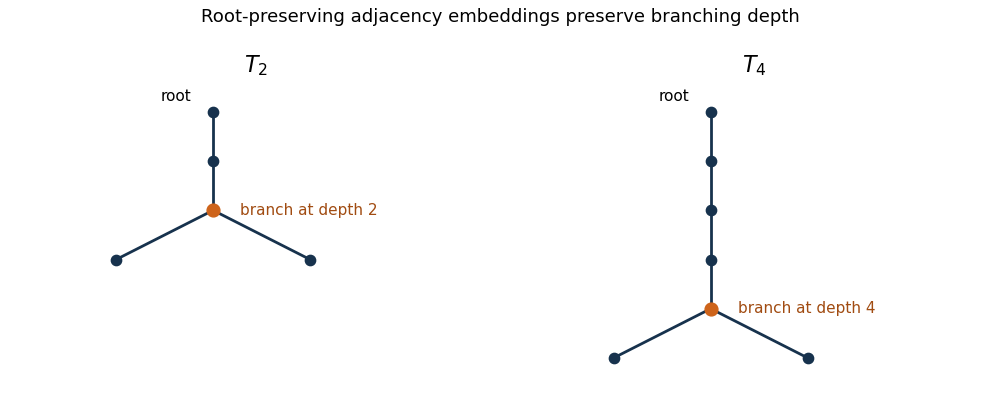
For the proposed adjacency-preserving rooted-tree embedding, the answer is no: it is not a well-quasi-ordering. For every , form from a stem of edges starting at the root and then attach two leaves to its terminal vertex. The only vertex with two children is at depth . A root-preserving adjacency injection preserves depths: the unique path of length from the root maps to a simple path of length from the target root. The image of a vertex with two children must still have two distinct children. Thus an embedding must send the branch vertex at depth to the unique branch vertex at depth , forcing . ThereforeThis is the branching-depth antichain of rooted trees. Homeomorphic embeddings can stretch the stem and hence do not have this obstruction.
Past exam of the mathematics course of the University of Cambridge 2013 iii Paper 20 5 Solution by Codex 0 Created 2026-10-03 Updated 2026-10-07
Codex 0 Created 2026-10-03 Updated 2026-10-07The equivalence classes of an equivalence relation are nonempty, pairwise disjoint, and partition . To construct a transversal of a set family for them, choose the least member of each class. Its set isEvery class has a least element by the well-ordering principle for the natural numbers, and that element satisfies the displayed condition. A nonleast element fails it because a smaller equivalent element exists. Therefore meets every class in exactly one point, not merely infinitely many classes.
The complement of is semidecidable, so for a given run the finitely many semidecision procedures for , , in parallel. Accept once all have accepted. If is a least representative, all finitely many computations halt; otherwise at least one never accepts. For , the empty list of tests succeeds immediately. This proves that is semidecidable. Equivalently, enumerate inequivalent pairs and output once all pairs with have appeared, dovetailing the requirements over all . This is the semidecidable least-representative transversal of a co-computably enumerable equivalence relation. Infinitely many classes make infinite, but that hypothesis is unnecessary for the existence and semidecidability of a complete transversal.
Past exam of the mathematics course of the University of Cambridge 2013 iii Paper 20 4 Solution by Codex 0 Created 2026-10-03 Updated 2026-10-07
Codex 0 Created 2026-10-03 Updated 2026-10-07In the simply typed lambda calculus, types are generated from atomic types by the arrow constructor . A typed lambda term is a lambda term equipped with a derivation of a judgement , where the context assigns types to its free variables. The basic typing rules areThe Implicational Curry-Howard correspondence reads atomic types as propositions and as logical implication. A typed variable is an assumption, abstraction is the implication introduction rule discharging that assumption, and application is the implication elimination rule. Consequently a typed lambda term is a proof in implicational Intuitionistic propositional logic, and a natural deduction proof recursively supplies such a term. For example, expresses implication reflexivity. Products, sums, and the empty type extend the correspondence to conjunction, disjunction, and falsity; pure arrow types give precisely the implicational fragment. Beta reduction removes an introduction followed immediately by its elimination, matching proof simplification.
A Church numeral iswhere means repetitions of application. At base type , it has type . The following Church numeral arithmetic terms use left-associated application:Their concise conclusions areFor successor, the initial adds one application. For addition, the inner supplies applications and supplies more. For multiplication, the repeated operation applies times, and repetitions give . For exponentiation, iterates the operation on : each iteration replaces a function by its -fold iterate, yielding . Zero iterations give , so this encoding takes , including . The explicit outer abstractions make the result the standard Church numeral even at exponent zero, without needing eta equivalence.
Successor, addition, and multiplication operate on the same . The displayed exponentiation term has type : its exponent iterates an operation on functions. Thus the numeral syntax admits several type instances; one should not force every occurrence into one fixed monomorphic Church type.
The Y combinator is the fixed-point combinatorFor , beta reduction gives . Since , we obtain . This allows a recursive program body to receive a representation of itself.
Here the computation is in the untyped lambda calculus. The self-application would require a simple type satisfying , impossible for finite simple types. Accordingly is not a typed lambda term of the simply typed system. The Strong normalization theorem for simply typed lambda calculus also rules out a universal divergent fixed-point operator there.
To obtain a lambda representation of partial computable functions, encode machine configurations as finite data using Church numerals, Church pairs, and Church Booleans. Initial configuration, one transition, the halting test, and output extraction are primitive recursive functions, represented by lambda terms through the initial functions, composition, and lambda definition of primitive recursion by pair iteration. If these representations are , , , and , defineUse normal-order beta reduction so the Church Boolean halting test selects one branch without evaluating the unused recursive branch. A halting computation follows finitely many transitions and returns the Church numeral of the output. A nonhalting computation forces successive tests forever and has no head normal form; by normal-order normalization theorem, it cannot be beta equivalent to a Church numeral. Thus every partial computable function is represented, with divergence preserved; every total computable function is the halting special case. This explains the role of in computational universality while keeping the typed proof interpretation precise.
Past exam of the mathematics course of the University of Cambridge 2013 iii Paper 20 3 Solution by Codex 0 Created 2026-10-03 Updated 2026-10-07
Codex 0 Created 2026-10-03 Updated 2026-10-07Interpret the language of ordered rings in the standard natural numbers, with nonlogical symbols . We give a single first-order formula defining , rather than a separate expression with multiplication signs. The key is Gödel beta-function sequence coding. The remainder relationuses only the allowed symbols; all variables range over . With , it assigns a unique remainder at each position .
The factorial graph formula via remainder coding asserts that one code contains the initial value , the final value , and every recurrence step. Here is the fully expanded formula, with no remainder-function or factorial symbol:The first equation represents remainder at position zero: its omitted explicit remainder bound follows from . The second line represents remainder at position . The universally checked equations represent the adjacent remainders and impose multiplication by . Uniqueness of remainders therefore forces them, successively, to be , proving by mathematical induction. When , the recurrence clause is empty and the two endpoint clauses force .
Conversely, choose a positive larger than every value in the finite sequence and divisible by each positive integer at most . The moduli , , are pairwise coprime. Indeed, for , a common divisor of divides and is coprime to , so divides . Since divides , the common divisor must be one. The Chinese remainder theorem gives a nonnegative with for every . The chosen values are smaller than their moduli, so they are the actual remainders; the appropriate quotient witnesses then make true. ThusThe formula has fixed length, independent of . For example, writing its displayed syntax in plain text with one-character variables, ordinary parentheses, and explicit logical connectives takes fewer than characters and fewer than logical-symbol tokens. Its length is therefore as a uniform definition of the graph. Numeral names for particular input values, if substituted for the variables, add their own encoding lengths. Over the ordered ring , restrict every quantifier to nonnegative integers and require ; this gives the same definition on its nonnegative part. It is the chosen arithmetic structure, not ring axioms alone, that makes the formula define factorial.
Past exam of the mathematics course of the University of Cambridge 2013 iii Paper 20 1 Solution by Codex 0 Created 2026-10-03 Updated 2026-10-07
Codex 0 Created 2026-10-03 Updated 2026-10-07Fix a finite alphabet . A regular expression is built recursively from , , and the letters , using union, concatenation, and Kleene star. Its interpretation is a formal language: the basic expressions denote , , and , while , , and denote , , and all finite concatenations of members of , including the empty concatenation. In particular, and are different expressions with different meanings.
Kleene theorem identifies exactly the languages described by regular expressions with those recognized by finite-state automata. Start with a deterministic finite automaton (DFA) having states , initial state , accepting set , and transition function . Let describe paths from to whose internal states lie among . At stage zero use the union of letters labelling direct transitions from to , with added if ; use if there are no such possibilities. Define the finite-state path expressions recursively byA path either avoids internally or decomposes at its visits to : an initial piece into , any number of return pieces at , and a final piece out. Each piece has no internal occurrence of . This proves the recursion by induction, including paths with or , where empty pieces are permitted. Thusis a regular expression for the DFA's accepted formal language. An empty accepting set gives the expression . This is the path form of state elimination for finite automata.
A nondeterministic finite automaton (NFA) replaces a single successor state by a set of possible successors. It accepts if there exists an accepting run with and . Rejection means that no accepting run exists, rather than that some run rejects. For an Epsilon-NFA, transitions labelled consume no symbol; acceptance means a path whose non-epsilon labels spell . In particular, acceptance of the empty word is tested using the epsilon closure of the initial state.
The same Kleene theorem holds for nondeterministic finite automata. For an NFA without epsilon transitions, the powerset construction has state set , initial state , transition on letter , and accepting subsets meeting . Induction on word length shows that its state is exactly the set of possible current NFA states. For an Epsilon-NFA, start from , where is epsilon closure, and useThis subset construction with epsilon transitions preserves the accepted formal language and gives a DFA with at most states. The already proved direction of Kleene theorem therefore gives a regular expression for every NFA language.
For the converse, recursively construct an Epsilon-NFA with a designated initial state and final state for a regular expression. Use two states with no connecting path for , one epsilon edge for , and one edge labelled for . Keep component state sets disjoint. Union uses a fresh initial state with epsilon edges into both components, and epsilon edges from their finals to a fresh final. Concatenation joins the first final to the second initial by an epsilon edge. For Kleene star, use fresh initial and final states, an epsilon edge directly between them for zero iterations, an edge into the old initial, and epsilon edges from the old final both back to the old initial and out to the new final. Each construction has exactly the intended union, concatenation, or iteration semantics. Induction on the regular expression proves correctness; the subset construction with epsilon transitions then gives a DFA. This proves both directions of Kleene theorem.
Past exam of the mathematics course of the University of Cambridge 2013 iii Paper 2 5 Solution by Codex 0 Created 2026-10-03 Updated 2026-10-07
Codex 0 Created 2026-10-03 Updated 2026-10-07Let be a commutative ring and . The Koszul complex packages these elements and their relations in a finite chain complex of free modules. With and basis , set for , and defineDeleting two distinct basis elements in the two possible orders gives opposite signs and the same coefficient, so . Equivalently is the tensor product of chain complexes of two-term complexes in degrees one and zero. The tensor differential is . This fixes the sign convention. On the exterior algebra, the differential is a graded derivation determined by .
For an -module , define the Koszul complex with module coefficients by . Its degree-zero Koszul homology isIts higher Koszul homology measures the failure of these equations to form a regular sequence on a module. Each annihilates every homology group. Indeed the Koszul homotopy for multiplication by a generator is , and the graded product rule givesFor coefficients in the same identity holds after tensoring. Thus multiplication by is zero on homology, and the homology groups are naturally modules over . If , choose ; then is a contracting homotopy, so the entire complex is contractible. These identities are also useful after localization of a ring: wherever one generator is a unit, the complex has zero homology.
The construction is functorial under a ring homomorphism, and base change gives , since its terms are free with the displayed basis and differential. An invertible change of generators gives a chain isomorphism by sending to and extending to exterior powers. In particular, permuting the generators changes only the exterior signs, not the isomorphism class of the complex.
The essential exactness theorem is that a regular sequence on a module gives zero positive Koszul homology. Recall that must act injectively on , with final quotient nonzero. Put . Adding the final two-term complex identifies with the mapping cone of multiplication by on , with the chosen tensor signs. The long exact sequence in homology consequently has segmentsFor , positive homology is exactly . By induction the preceding homology vanishes above zero. The final injectivity assumption kills , while the exact sequence kills every for . Thereforefor a regular sequence on a module. In particular is a finite free resolution of when is a regular sequence, with ranks and length .
There is a precise converse under local finiteness assumptions. Suppose is a Noetherian local ring, is finitely generated, and all . If positive Koszul homology vanishes, the same exact sequence makes multiplication by surjective on every for . These modules are finitely generated because the ring is Noetherian and the terms of the complex are finite modules. The Nakayama lemma gives . Induction makes regular on , and the degree-one part of the exact sequence makes injective on . The final quotient is nonzero, again by the Nakayama lemma. This proves the Koszul acyclicity criterion in a Noetherian local ring:The hypotheses matter: a unit ideal makes the complex contractible but cannot be a proper regular sequence.
Examples make both sides visible. For and , the Koszul resolution isThe signs agree with . For and , the degree-one cycles are and the boundaries are ; hence , while . The repeated element has exposed a relation that the first element already kills.
The Koszul complex also computes derived functors. If is a regular sequence on , its free resolution givesHere no regularity of on is assumed. For , tensor the Koszul resolution on the variables with . Every differential becomes zero, soThe top group is nonzero, showing that a free resolution of cannot be shorter than .
Finally, wedging complementary exterior degrees gives a perfect pairing . It identifies the dual cochain complex with the degree-reversed Koszul complex, after the appropriate signs. This self-duality of the Koszul complex shows, for a regular sequence, thatThus the same explicit complex simultaneously records quotient equations, regularity, relations, Tor functor computations and Ext functor computations. Its finiteness and exterior structure are what make it especially effective in commutative algebra.
Past exam of the mathematics course of the University of Cambridge 2013 iii Paper 2 4 Solution by Codex 0 Created 2026-10-03 Updated 2026-10-07
Codex 0 Created 2026-10-03 Updated 2026-10-07Let be a map of commutative rings. The Kähler differentials are generated as an -module by symbols , with relationsThese relations make the universal -derivation. Every -derivation into an -module factors uniquely through the map . Thus the universal property of Kähler differentials isThis constructs the module and proves its universal property, rather than merely listing a formal derivative rule.
For the polynomial ring , the Kähler differentials of a polynomial algebra form the free module . The usual formal partial derivatives prove that assigning arbitrary images to defines a derivation, and every polynomial involves only finitely many variables. For , the Conormal exact sequence for Kähler differentials givesThe map is well-defined because vanishes after reduction modulo . Its cokernel has exactly the universal property of derivations on that kill , so is . In a finite polynomial presentation this givesThere need not be injectivity at : in characteristic , the relation has derivative zero.
Localization of Kähler differentials commutes with localization of a ring:The quotient rule follows by differentiating . It extends every derivation uniquely and proves the isomorphism by the universal property. Likewise base change for Kähler differentials gives : a -linear derivation is determined by its values on , and the product rule extends those values to the tensor product.
For a tower , the Transitivity exact sequence for Kähler differentials isQuotienting by the submodule generated by differentials of elements of represents precisely the -derivations, which proves exactness. The first map need not be injective in general. To relate this to a transcendence basis, we need the stronger property supplied by a separable field extension.
If is finite separable and has minimal polynomial , differentiating its equation forcesThe denominator is nonzero by separability. Conversely this formula extends an arbitrary -derivation , for an -module , to ; it kills the relation and hence descends to . A tower of simple separable extensions proves unique extension for all finite separable . Therefore Kähler differentials under a separable field extension satisfyThis proves injectivity in this case, which would not follow from right exactness alone.
A transcendence basis for a finitely generated field extension has algebraic independence over and makes algebraic, hence finite. A separating transcendence basis additionally makes that finite extension separable. Apply the polynomial computation and the quotient rule to the rational function field , and then the separable-extension isomorphism. We obtain the central link:when the basis is separating. The dual statement says that any prescribed values of the extend uniquely to a -derivation of with values in . In characteristic zero every transcendence basis of a finitely generated field extension is separating, so Kähler differentials measure transcendence degree exactly.
There is also a characteristic-zero test for algebraic independence. If are algebraically dependent, choose a nonzero polynomial relation of minimum total degree. Some formal partial derivative is nonzero in characteristic zero, and it cannot also vanish on the tuple, since it has smaller degree. Differentiation therefore gives a nontrivial linear relation among the . Conversely, an algebraically independent tuple extends to a transcendence basis, whose differentials form a basis as just proved. Thus differentials detect algebraic independence in characteristic zero: a finite tuple is algebraically independent exactly when its differentials are linearly independent. Its differentials form a basis of exactly when the tuple is a transcendence basis.
The separability qualification is essential in positive characteristic. For and with , the extension is purely inseparable of degree , with transcendence degree zero. The polynomial presentation yields , because the defining relation has derivative zero. Also, in , the tuple is a transcendence basis but , while is a basis of the one-dimensional differential module. A chosen arbitrary transcendence basis therefore need not give differential coordinates in characteristic .
Finally, the presentation makes the relation useful geometrically. For in characteristic zero,After passage to the fraction field, it has dimension one, the transcendence degree of the curve. At the origin, tensoring with its residue field leaves both independent, so the differential fibre has dimension two. For a -rational point with maximal ideal , that fibre is the cotangent space of a local ring : write elements as their constant value plus an element of , and note that derivations into kill . This explains how Kähler differentials record both generic transcendental parameters and the extra tangent direction at a singular point.
Past exam of the mathematics course of the University of Cambridge 2013 iii Paper 2 3 Solution by Codex 0 Created 2026-10-03 Updated 2026-10-07
Codex 0 Created 2026-10-03 Updated 2026-10-07All rings below are nonzero and commutative with identity; the zero ring is trivially Artinian. A primary ideal is proper. An ideal is primary precisely when every zero divisor of is a nilpotent element. Its radical of an ideal is prime: if and , apply the primary property to to obtain a power of in . In a Noetherian ring, finite generation of gives for some . For generators with , one can take .
We first prove existence of primary decomposition. The ascending chain condition implies that every proper ideal is a finite intersection of irreducible ideals. Otherwise choose a maximal counterexample under inclusion. It is not irreducible, so with both strictly larger; their finite irreducible decompositions give one for , a contradiction.
An irreducible ideal in a Noetherian ring is primary. Pass to the quotient and suppose zero is irreducible. If with , the ascending chain of annihilators of stabilizes, say at . Any element of can be written . Then , so and . Irreducibility of zero implies , since . Thus is nilpotent. This proves irreducible ideals are primary in Noetherian rings, and hence the Lasker–Noether theorem.
An intersection of finitely many primary ideals with the same radical is again primary: if belongs to all of them and , the primary property forces into every component. Combining such components and removing redundant ones yields a minimal primary decompositionThe radicals are uniquely determined, but the components need not all be unique. Here is a proof identifying the invariant radicals as the associated primes of a module .
Every nonzero module over a Noetherian ring has a nonzero element with a prime annihilator: maximize the annihilator of a nonzero element using the ascending chain condition. If and , maximality gives and hence . This is the maximal annihilator of a module element is prime argument. For a -primary quotient , the radical of the annihilator of every nonzero element is : it is contained in by the primary property and contains a power of because . Thus the only possible associated prime is , and it does occur.
The diagonal injection shows that every associated prime of is one of the . Indeed, for an element whose annihilator is prime, that annihilator is the intersection of the finitely many component annihilators, all containing . Their product is contained in , so primality forces one of them to equal ; its component element is nonzero and has associated prime . Conversely, irredundancy gives . The nonzero cyclic submodule generated by embeds in . It has an associated prime, necessarily , which is then an associated prime of . We have proved the first uniqueness theorem for primary decomposition:Also the zero divisors on are exactly . For a scalar killing a nonzero element, extend its element annihilator to a maximal element annihilator containing it; the preceding argument gives an associated prime containing that scalar. The converse is immediate from the definition of an associated prime.
The minimal members of the set are the isolated primes of a primary decomposition. They are exactly the primes minimal over : if a prime contains , it contains one by the product argument. A component belonging to an isolated prime is unique. Localize at . Every other component becomes the whole ring, since its radical contains an element outside whose power lies in that component. A -primary ideal contracts unchanged from this localization, because with implies . Hence the second uniqueness theorem for primary decomposition givesAn embedded primary component can vary. For example, in ,Both second components are -primary, since their quotients are dual-number algebras. For the second equality, reducing modulo makes ; an element vanishes exactly when has zero constant term, giving . The isolated component is and the embedded associated prime is .
The relevance to Artinian rings is particularly sharp in Krull dimension zero. Suppose is Noetherian and all its primes are maximal. Apply a minimal primary decomposition to zero. Its radicals are distinct maximal ideals, so the components are pairwise comaximal ideals: each contains a power of its radical, and expanding for shows that powers of comaximal ideals remain comaximal. The Chinese remainder theorem gives the Artinian decomposition into local factorsEach factor has one maximal ideal, and that ideal is nilpotent. Its finite radical filtration has successive layers finitely generated over its residue field, hence of finite vector-space dimension. It follows that the factor, and therefore , has a finite composition series of a module, so is Artinian. This proves the Noetherian dimension-zero criterion for an Artinian ring in this direction. Applied to , it says that the quotient is Artinian exactly when all primes over are maximal. In that case no primary component is embedded, so all components are unique.
For completeness, the converse does not require initially assuming Noetherianity. In an Artinian ring, an Artinian domain is a field: stabilization of and cancellation gives an inverse to every nonzero . Thus every prime is maximal. There are finitely many maximal ideals, since infinitely many distinct ones would give strictly descending finite intersections; comaximality guarantees strictness by the Chinese remainder theorem. Its nilradical is nilpotent. Indeed, its powers stabilize at , with . If , choose an ideal minimal among those satisfying . Then , since . Choose with ; minimality also gives . Therefore for some . But is a unit, contradicting . Hence .
Now is a finite product of residue fields. Each is an Artinian module over that product, and therefore a finite direct sum of finite-dimensional vector spaces: an infinite-dimensional vector space would have a strictly descending chain of subspaces. The finite filtration by powers of makes a module of finite composition length, in particular Noetherian. Combining both directions yieldsThus primary decomposition separates the local pieces of a zero-dimensional ring, while their nilpotent maximal ideals record the multiplicities that the reduced set of primes alone does not detect.
Past exam of the mathematics course of the University of Cambridge 2013 iii Paper 2 2 Solution by Codex 0 Created 2026-10-03 Updated 2026-10-07
Codex 0 Created 2026-10-03 Updated 2026-10-07The Noether normalization lemma is valid over every field , including finite fields: a nonzero finitely generated algebra contains elements with algebraic independence over such that is finite as a module over the polynomial ring . We prove it without an infinite-field hypothesis.
Write and induct on . If the generators have algebraic independence, they already give a polynomial ring and the assertion is immediate. Otherwise choose a nonzero relation . Choose an integer larger than every exponent in the monomials of , and setIn , the largest power of has a nonzero coefficient in . Indeed, a monomial with exponents contributes top weight . These weights are distinct by uniqueness of base- expansion, so only one monomial contributes the highest power. After rescaling, the substituted relation is monic in .
Consequently is an integral element over , and is finite over . Apply the induction hypothesis to and compose the finite module extensions. This proves Noether normalization by weighted substitutions. The induction reaches , where . For an integral domain , taking fraction fields makes the resulting extension finite algebraic, so is the transcendence degree of . More generally : integral extensions preserve Krull dimension, and a polynomial algebra in variables has Krull dimension .
A useful bridge to the Hilbert Nullstellensatz is the Zariski lemma. If a field is a finitely generated algebra over , normalization makes it finite and integral over a polynomial ring . A subring over which a field is integral is a field: for nonzero , an integral equation for , multiplied by , expresses as an element of . Therefore must be a field. A polynomial ring in a positive number of variables is not a field, since a variable has no polynomial inverse. Hence and is a finite field extension. This proves the Zariski lemma.
Now let be an algebraically closed field. The Weak Hilbert Nullstellensatz says that every maximal ideal of is uniquely of the formTo prove it, the residue field is a field generated as a -algebra by the images of the variables. The Zariski lemma makes it finite algebraic over , and algebraic closedness makes it . Thus each has an image . The evaluation map has kernel the displayed ideal: subtracting the constant value of a polynomial expresses its difference as a combination of . That kernel is maximal and contained in , so equality holds. Conversely every evaluation kernel is maximal because its quotient is . Uniqueness follows from the variable images. Every proper ideal is contained in a maximal ideal, so it has a common zero; equivalently, an ideal with no common zero is the whole ring.
For an ideal , let be its common-zero set and let be all polynomials vanishing on that set. The Strong Hilbert Nullstellensatz statesThe inclusion follows because a field has no nonzero nilpotent elements. For the other inclusion, take vanishing on , with , and form the Rabinowitsch trick idealIt has no common zero: at a zero of the second generator has value one. The Weak Hilbert Nullstellensatz in variables gives . Hence a finite identity has the form , with . Substitute in the localization of a ring . Clearing the finitely many powers of occurring in denominators gives for some , so . The case is immediate. This completes all three proofs. The algebraically closed hypothesis belongs to the two forms of the Hilbert Nullstellensatz; it was not needed for the Noether normalization lemma or the Zariski lemma.
Past exam of the mathematics course of the University of Cambridge 2013 iii Paper 2 1 Solution by Codex 0 Created 2026-10-03 Updated 2026-10-07
Codex 0 Created 2026-10-03 Updated 2026-10-07Put and let be the integral closure of in . We first establish the elementary integral extension machinery, and then use the trace pairing to put inside a finite -module.
An integral element satisfies a monic polynomial over the base ring. If its equation has degree , the powers generate as an -module. More generally, adjoining finitely many integral elements gives a finitely generated module: reduce the exponent of each generator using its monic equation. Conversely, if an -submodule of an extension algebra contains , is finitely generated, and is stable under multiplication by , choose generators and write . Multiplying by its adjugate shows that its monic determinant annihilates every , hence annihilates . This finite-module criterion for integrality is the determinant trick.
If are integral elements, the finite -module is stable under , and . The criterion proves that these are integral elements. Thus the integral closure really is a subring. It also proves integral dependence is transitive: if is integral over an integral -algebra , take the finitely many coefficients of its equation, form their finite -subalgebra , and observe that is finite over and therefore finite over . The criterion applies to . In particular, an algebra generated by finitely many integral elements is a finite integral extension, even though an arbitrary integral extension need not be finite.
Choose a -basis of . Each basis element is algebraic over . Ifchoose a nonzero clearing all coefficient denominators. Then satisfies a monic equation with coefficients . Hence all belong to and still form a -basis. This is integral field basis by denominator clearing.
We next prove the trace of an integral element over a normal domain property. For , its images under all -embeddings of into an algebraic closure are integral elements over , because each satisfies the same monic equation. Their sum is integral by the subring property just proved. Since is a separable field extension, that sum is the field trace and lies in . The normality assumption means that is a normal domain, equivalently an integrally closed domain, soThe same conclusion applies to , since is a ring.
The trace pairing of a finite separable field extension is nondegenerate. One can see this directly using the allowed Galois theory: for a primitive element , the embedding matrix of is a Vandermonde matrix in the distinct conjugates of . Its determinant is nonzero, and the trace Gram matrix is its transpose times itself. Nondegeneracy is unchanged by a change of basis.
Let . Its trace-dual lattice isNondegeneracy supplies a trace-dual -basis , with . The coefficient formula givesEquivalently, the matrix has entries in and nonzero determinant ; if , then and the adjugate formula gives . Thus as well. Both descriptions exhibit a finite free ambient -module.
A finite -module is a Noetherian module when is a Noetherian ring, and every submodule of a Noetherian module is finitely generated. Since is an -submodule of , we obtainThis proves finiteness of integral closure in a finite separable extension. The hypotheses have distinct roles: separability makes the trace pairing nonsingular, normality puts integral traces back in , and Noetherianity makes the contained submodule finite. Also , since the integral basis elements span over , and is itself Noetherian because its ideals are -submodules of a finite -module.
Pinned article: Introduction to the OurBigBook Project
Welcome to the OurBigBook Project! Our goal is to create the perfect publishing platform for STEM subjects, and get university-level students to write the best free STEM tutorials ever.
Everyone is welcome to create an account and play with the site: ourbigbook.com/go/register. We belive that students themselves can write amazing tutorials, but teachers are welcome too. You can write about anything you want, it doesn't have to be STEM or even educational. Silly test content is very welcome and you won't be penalized in any way. Just keep it legal!
Intro to OurBigBook
. Source. We have two killer features:
- topics: topics group articles by different users with the same title, e.g. here is the topic for the "Fundamental Theorem of Calculus" ourbigbook.com/go/topic/fundamental-theorem-of-calculusArticles of different users are sorted by upvote within each article page. This feature is a bit like:
- a Wikipedia where each user can have their own version of each article
- a Q&A website like Stack Overflow, where multiple people can give their views on a given topic, and the best ones are sorted by upvote. Except you don't need to wait for someone to ask first, and any topic goes, no matter how narrow or broad
This feature makes it possible for readers to find better explanations of any topic created by other writers. And it allows writers to create an explanation in a place that readers might actually find it.
Figure 1. Screenshot of the "Derivative" topic page. View it live at: ourbigbook.com/go/topic/derivativeVideo 2. OurBigBook Web topics demo. Source. - local editing: you can store all your personal knowledge base content locally in a plaintext markup format that can be edited locally and published either:This way you can be sure that even if OurBigBook.com were to go down one day (which we have no plans to do as it is quite cheap to host!), your content will still be perfectly readable as a static site.
- to OurBigBook.com to get awesome multi-user features like topics and likes
- as HTML files to a static website, which you can host yourself for free on many external providers like GitHub Pages, and remain in full control

Figure 2. You can publish local OurBigBook lightweight markup files to either OurBigBook.com or as a static website.
Figure 3. Visual Studio Code extension installation.
Figure 5. . You can also edit articles on the Web editor without installing anything locally. Video 3. Edit locally and publish demo. Source. This shows editing OurBigBook Markup and publishing it using the Visual Studio Code extension. 
- Infinitely deep tables of contents:



All our software is open source and hosted at: github.com/ourbigbook/ourbigbook
Further documentation can be found at: docs.ourbigbook.com
Feel free to reach our to us for any help or suggestions: docs.ourbigbook.com/#contact