
Separation of charged molecules through a gel in an electric field. Denaturing conditions suppress folded structures, helping compare RNA lengths; matching migration alone does not establish an identical nucleotide sequence or identical covalent bonds. In the ribozyme experiments, labelled RNA was detected after separation by exposing photographic film.
In DNA agarose gel electrophoresis, the backbone phosphate groups carry negative electric charge under the usual mildly alkaline buffer solution conditions. DNA therefore moves toward the positive anode, away from the negative cathode.[ref]
Agarose Gel Electrophoresis by Addgene. Introduction; Loading Samples and Running an Agarose Gel, step 6: DNA migration toward the positive electrode
The electric field points the other way: the electric force reverses direction when . The apparatus is driven by an external source of electric potential difference; the positive anode convention here belongs to that operating mode. Direction follows electric charge, so it is not a rule that all molecules move toward the same electrode.
The useful result is a spatial comparison: a mixture becomes separated gel bands, which can be compared with a DNA ladder or recovered for subsequent analysis. Agarose gel electrophoresis of linear double-stranded DNA, gel electrophoresis of denatured RNA, and SDS-PAGE of proteins use different conditions to make migration informative about chain size. An electric field supplies motion; the gel supplies a porous obstacle course.
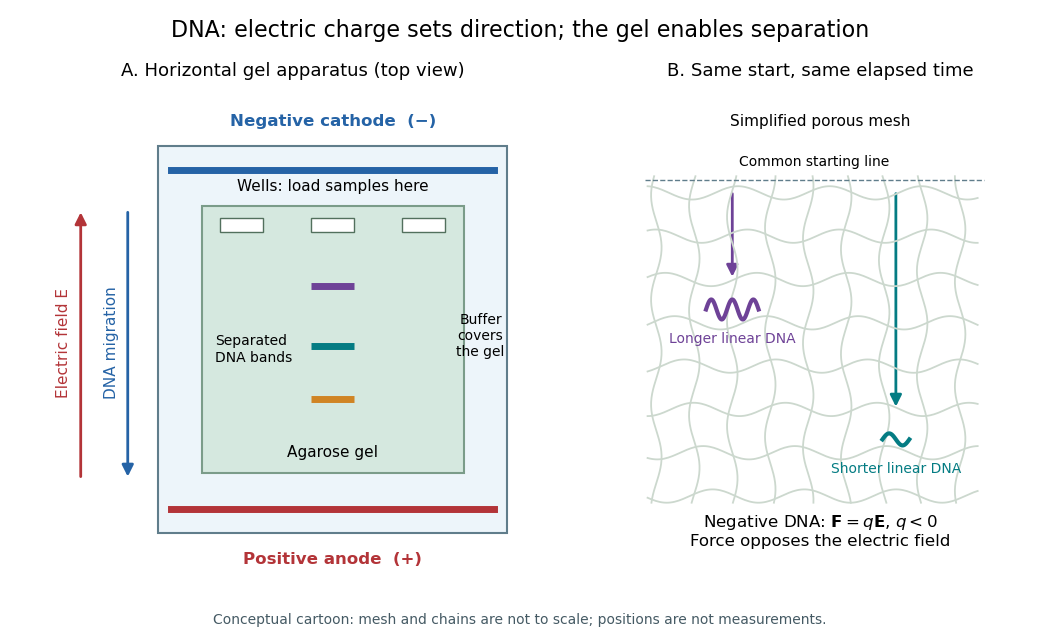
DNA migrates toward the positive anode, opposite to the electric field; the agarose mesh separates linear DNA fragments. Conceptual apparatus and mesh, not measured trajectories or a drawing to scale
. Details. 
Gel electrophoresis is a laboratory technique used to separate and analyze macromolecules such as DNA, RNA, and proteins based on their size and charge. The basic process involves the following key components and steps: 1. **Gel Matrix**: A gel, commonly made from agarose or polyacrylamide, serves as a medium through which the molecules will travel. The pore size of the gel can be adjusted by varying its concentration, allowing for separation of different sizes of molecules.


Technique widely used to measure the size of DNA strands, most often PCR output of a region of interest.
A simple sample application is gel electrophoresis alelle determination.
New to topics? Read the docs here!