Agarose gel electrophoresis uses a porous agarose polymer network. For linear double-stranded DNA within a suitable separation range, shorter fragments generally move farther in a fixed run. Raising the agarose concentration changes the mesh and the range of sizes that can be resolved.[ref]
Five Main Nucleic Acid Gel Electrophoresis Steps by Thermo Fisher Scientific. Step 1, Selection and gel preparation; Recommended percentage of agarose gels for separation of DNA fragments
A compact circular DNA molecule need not migrate like linear DNA of the same length: geometry affects passage through the mesh.[ref]Five Considerations for the Nucleic Acid Gel Electrophoresis Process by Thermo Fisher Scientific. Effects of conformation, Figure 1: nicked circular, linear and supercoiled forms of the same DNA
A concrete laboratory example is Addgene's documented DNA separation protocol. Its standard 1% gel contains 1 g of agarose in 100 mL of TAE buffer. Dissolved agarose sets in a casting tray around a comb; removing the comb leaves sample wells. The gel is covered with the same buffer solution in a box connected to a voltage source. Loading buffer contains glycerol to increase sample density and a tracking dye to show run progress. A DNA ladder occupies a separate lane beside the samples. With wells near the negative cathode, DNA migrates toward the positive anode. After separation, bound stain makes the DNA visible by fluorescence under a UV transilluminator. The DNA ladder supplies the size reference; the tracking dye monitors migration but does not identify sample DNA.[ref]
In the manufacturer's controlled comparison, the same DNA ladder runs in 1%, 2%, and 3% agarose gels with the same run time and other stated conditions. The changed gel band spacing shows why a calibration belongs to its particular gel conditions, rather than establishing a universal distance law.[ref]
Five Main Nucleic Acid Gel Electrophoresis Steps by Thermo Fisher Scientific. Step 1, Figure 3 and caption: same DNA ladder at three agarose percentages under the same conditions, including run time
In interpreting an unknown sample, a blank lane tests for detectable background or carryover in that blank, while the DNA ladder checks migration and detection of its known fragments. An empty sample lane cannot by itself distinguish absent DNA from unsuccessful loading or insufficient detection. These controls answer different questions; neither makes matching migration a proof of matching nucleotide sequence.
A DNA ladder contains DNA fragments of known lengths in base pairs. Its gel bands supply size references. Match the sample's strandedness and shape, and use the specified lengths for that DNA ladder. A size reference need not provide a quantitative mass standard.[ref]
Five Main Nucleic Acid Gel Electrophoresis Steps by Thermo Fisher Scientific. Step 2, Nucleic acid ladder selection guidelines: fragment structure, conformation, intended use and manufacturer-specific composition
A gel electrophoresis size calibration relates migration distance to known fragment lengths on the same gel. Here is an explicitly chosen model for linear double-stranded DNA, not measured data or a universal law. Let be the numerical length in base pairs and the numerical migration distance in millimetres from the wells:The logarithm has a dimensionless argument: is the length divided by 100 base pairs. The chosen DNA ladder fragments give , respectively. The gel bands therefore appear in the reverse order of length along the direction of migration.
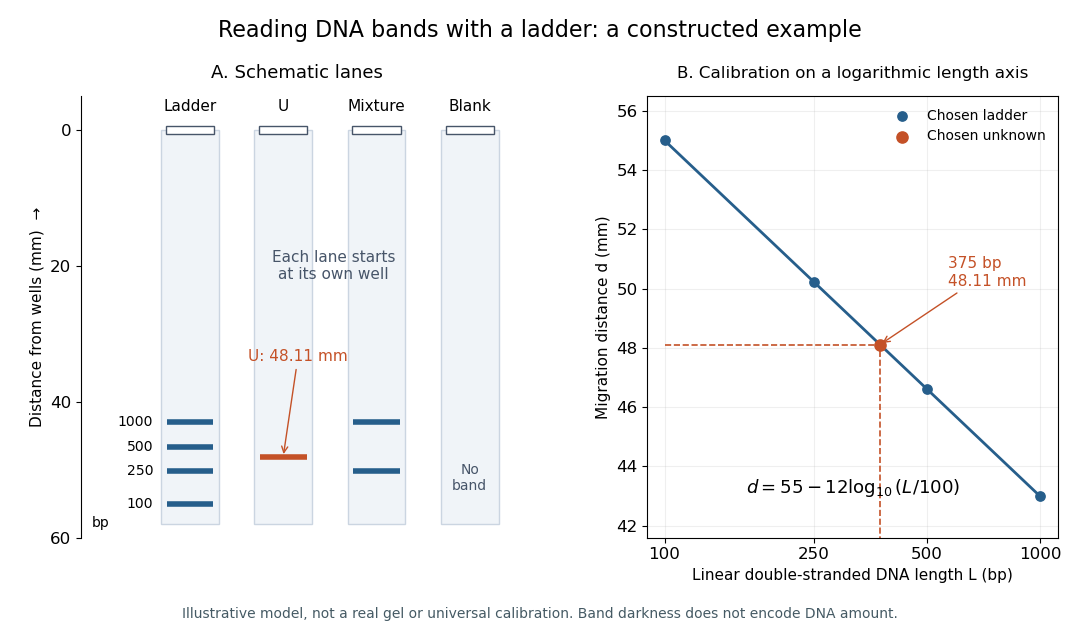
Constructed DNA ladder, unknown, mixture and blank lanes with a logarithm calibration. All positions follow the chosen model; the unknown is 375 base pairs at 48.11 mm, and darkness does not represent DNA quantity
. Details. To invert the calibration, rearrange the logarithm:Our chosen unknown gives , between the 250-base pair and 500-base pair references. Inserting that distance into the inverse recovers 375; retaining only gives about base pairs. The extra digits reflect rounding in this model, not the resolving power of a real gel.
For linear interpolation between those two reference gel bands, use the logarithm of length. Here the fraction of the distance from the 500-base pair reference toward the 250-base pair reference is , giving . Direct linear interpolation of lengths instead gives approximately base pairs. This difference explains why the choice of calibration coordinates matters. A real calibration must be checked over its usable range; folded RNA or circular DNA does not automatically share the linear double-stranded DNA calibration.
Articles by others on the same topic

Agarose gel electrophoresis is a widely used laboratory technique for the separation and analysis of macromolecules, primarily nucleic acids (DNA and RNA), based on their size and charge. The method involves several key components and steps: 1. **Agarose Gel Creation**: Agarose, a polysaccharide derived from seaweed, is mixed with a buffer solution and heated to dissolve.

