
The Hessian matrix describes how the slope of a function changes in different directions. For a real-valued function with continuous second partial derivatives on an open subset of , it isThe symmetry of second derivatives makes a symmetric matrix under these hypotheses. It is also the Jacobian matrix of the gradient: near , a small displacement changes by . Thus the gradient measures the current slope, while the Hessian measures its local variation. [ref]
For example, take the quadratic formIts gradient and Hessian matrix areThe only critical point is the origin. Completing the square gives , so the origin is a strict global minimum. The eigenvalues and are both positive, recovering the same conclusion from the positive definiteness of the Hessian. Its eigenvectors identify the rotated directions in which the quadratic form has its smallest and largest bending.
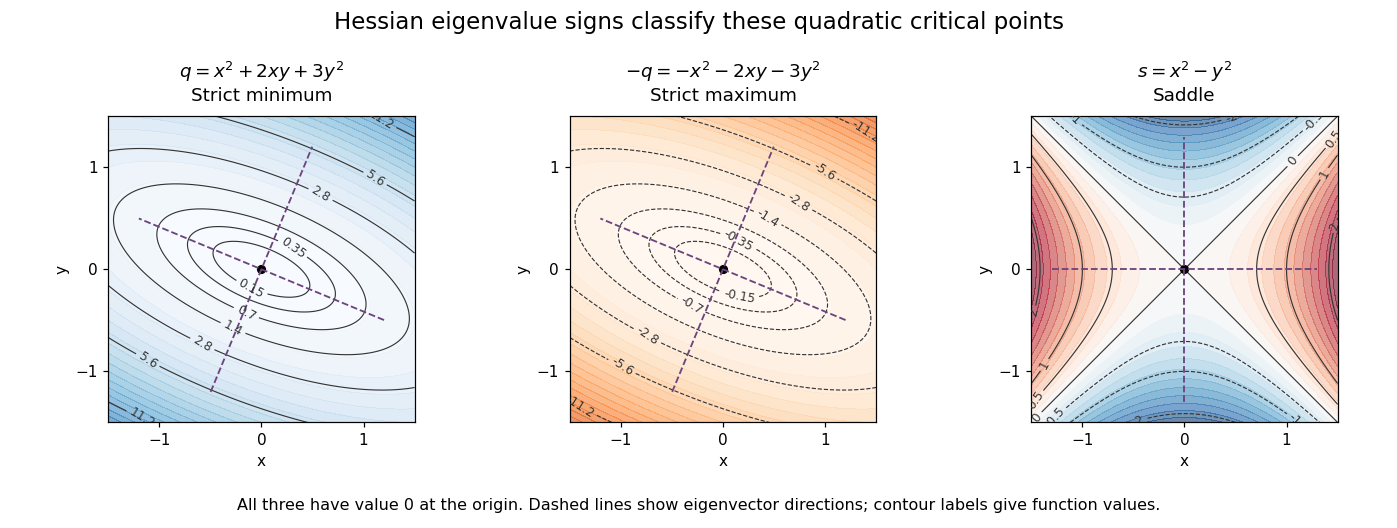
For a fixed vector , restriction to a straight line gives the directional interpretationThis is the quadratic form associated with the Hessian matrix. For a unit eigenvector , it equals the corresponding eigenvalue. Opposite signs therefore mean that some directions bend upwards and others downwards. The second-derivative test turns this information into a classification when the gradient vanishes.
The same object is useful for computation. Newton's method in optimization chooses a displacement by solving when the Hessian matrix is an invertible matrix; this makes the gradient of the local quadratic model vanish. For the displayed , the equation gives , so one exact step reaches the minimum from any starting point. For a general function, a Hessian with opposite-sign eigenvalues or a large condition number need not give a useful minimizing step, and the local minimum need not be a global minimum.
The name honors Otto Hesse. [ref]
https://web.mit.edu/course/other/wwmath/vectorc/minmax/hessian.html. MIT World Web Math: the Hessian and its namesake
An older geometric use is the Hessian criterion for flexes of a plane cubic, connecting a determinant of second partial derivatives with inflection points of an algebraic curve. Hesse's 1844 paper Über die Wendepuncte der Curven dritter Ordnung is an early source on that geometric problem. [ref]https://www.degruyterbrill.com/document/doi/10.1515/crll.1844.28.97/html. Hesse (1844), Journal für die reine und angewandte Mathematik 28, pp. 97–107: publisher's bibliographic record


The Hessian matrix is a square matrix of second-order partial derivatives of a scalar-valued function. It provides important information about the local curvature of the function and is widely used in optimization problems, economics, and many areas of mathematics and engineering.
New to topics? Read the docs here!