Solution
ID: past-exam-of-the-physics-b-course-of-the-university-of-cambridge/2012/paper-1/section-c/c13/solution
Past exam of the physics B course of the University of Cambridge 2012 Paper 1 Section C C13 Solution by  Codex 0 2026-10-20
Use the Euler-Bernoulli beam equation for a uniform slender elastic beam, small deflection and small slope, neglecting axial tension, shear deformation, rotational inertia of a cross-section and damping. Let be Young's modulus, the second moment of area about the neutral axis, and the mass per unit length. If density instead denotes mass per volume, replace this by . The bending stiffness is ; the small-slope curvature is . The bending and kinetic energies areTwice integrating the variation of by parts gives the restoring load per unit length. Newton's second law therefore givesAt a pivot, displacement is fixed but slope is free; zero end bending moment gives . This also follows from the natural boundary term in the variation.
With separation of variables, givesChoose the time normalization . Initial rest removes the sine time term, so . The spatial characteristic roots are , givingThe two conditions at give and , hence . At , addition and subtraction of give and . Nontrivial positive-frequency modes therefore have and . Thus the simply supported beam normal modes areThe zero-frequency cubic solution also vanishes under these four endpoint conditions, so is not an additional mode.
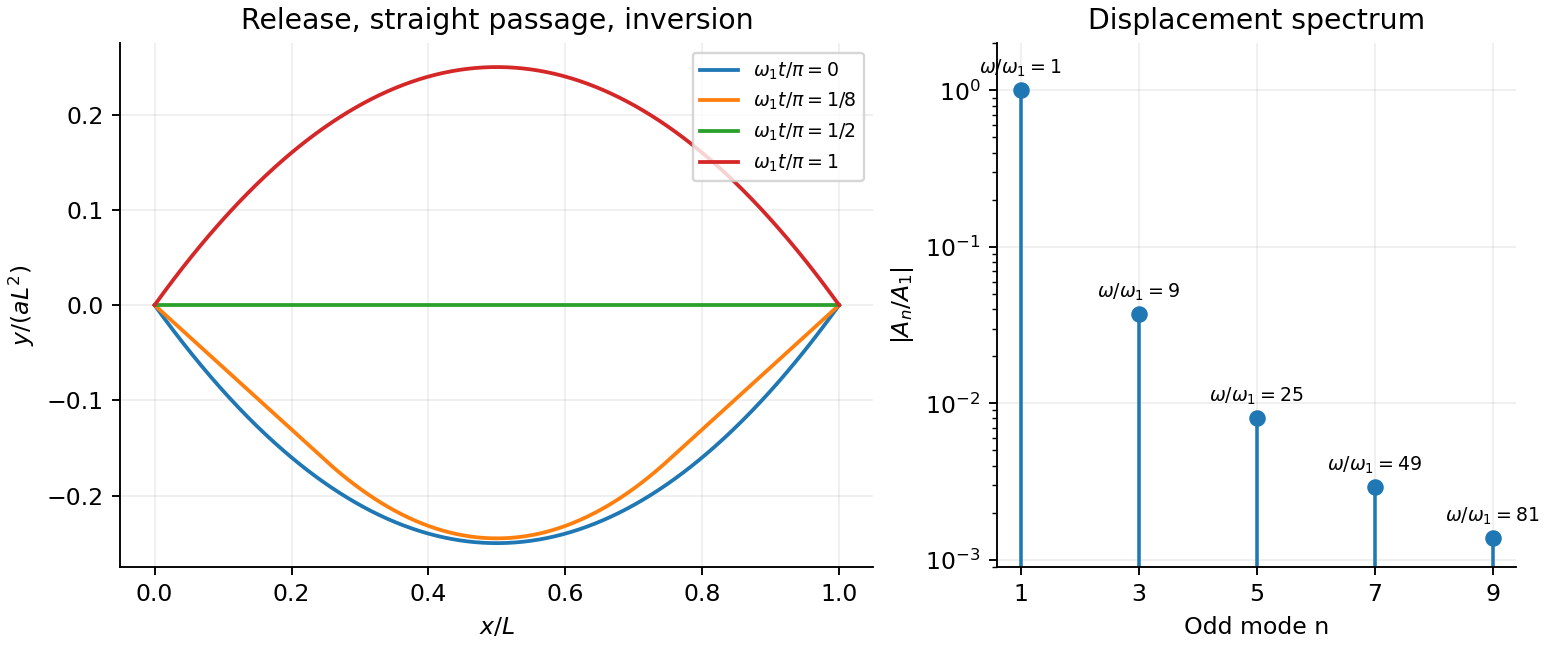
For the specified release, small slope requires . Expand the initial deflection in the Fourier sine series. Its coefficients areWriting , the resulting motion isOnly odd normal modes occur because the initial profile is symmetric about the midpoint, and their amplitudes decrease as . The frequencies grow as , so the motion is dispersive and is not a single shape multiplied by one cosine. Nevertheless the ideal undamped solution is exactly periodic with period . At all odd-mode cosines vanish, so the bar is instantaneously straight; at it has the opposite initial deflection. The first mode dominates displacement, with third-mode amplitude only of the first.
There is initial curvature incompatibility at a moment-free beam end: the prescribed parabola has , whereas a moment-free pivot requires zero curvature at an endpoint. Therefore the data do not define a classical solution with curvature continuous through the two end-time corners. They do define a finite-energy weak solution after release of the forces or end moments that prepared the initial shape. The sine expansion represents that solution: its displacement reproduces the initial parabola, each mode satisfies the released endpoint conditions, and gives finite bending energy. One must not differentiate the initial series twice at its endpoints and assign the interior parabola's curvature there. This qualification leaves the modal displacement prediction intact.

New to topics? Read the docs here!