Solution
ID: past-exam-of-the-physics-course-of-the-year-1-of-the-natural-sciences-course-of-the-university-of-cambridge/2021/section-b/6/solution
Past exam of the physics course of the year 1 of the natural sciences course of the University of Cambridge 2021 Section B 6 Solution by  Codex 0 2026-10-18
Codex 0 2026-10-18Translation and rotation. For particles constituting a rigid body, the total linear momentum isThus the total external force governs the motion of the centre of mass. About that centre of mass, the angular momentum and applied torque arewhere primes denote relative positions and velocities. The derivative of the vector is taken relative to nonrotating axes. The inertia tensor relates angular momentum to angular velocity, . For rotation about a fixed unit direction , the moment of inertia is ; it measures the resistance to changing that rotation and gives rotational kinetic energy . The simpler vector relation applies when the rotation axis is a principal axis, not for every orientation of an arbitrary rigid body. These translational and rotational balances must be applied together; a nonzero torque does not replace the net-force equation.
Gyroscope precession. A rapidly spinning gyroscope has a large angular momentum approximately along its spin axis. The torque component parallel to this vector changes its magnitude, while the perpendicular component turns its direction. If the vector undergoes precession with angular velocity , then over its change is the infinitesimal rotation . HenceThis describes direction-changing precession at constant ; any spin-up contribution must be added separately. For perpendicular torque and angular momentum, the precessional component perpendicular to is . The familiar tendency of a supported gyroscope to turn sideways is this vector balance, not the absence of gravitational force.
Wheel-lift threshold without the flywheel. Let be the centre of mass height, half the wheel separation, and the bend radius. The required inward force is , provided by static friction. Let be the summed outer and inner wheel normal forces. Vertical balance gives . Moment balance about the centre of mass givesThe inner wheels lift when . Thus the vehicle rollover threshold isThe stated mass cancels. This assumes the rigid geometry and sufficient static friction specified in the paper; the threshold is set by loss of contact, not by sliding.
Engine flywheel. The moment of inertia of a uniform disc givesIts spin angular speed, spin angular momentum, and turn angular speed at areThe transverse flywheel axis is perpendicular to the vertical turn axis, soTo specify its direction, use right-handed axes forward, to the car's left, and upward, and consider a left turn. Then . Choose the flywheel angular momentum to the car's right, . The car must applyto obtain the required precession. This gyroscopic roll torque in a turning vehicle opposes the outward roll tendency in a left turn. By the right-hand rule, the flywheel must turn counterclockwise viewed from the car's right side toward its centre, opposite to the rotation of wheels rolling forward. Reversing flywheel spin would aggravate the outward roll. Reversing the turn reverses both roll and gyroscopic torques, so the same flywheel spin remains helpful.
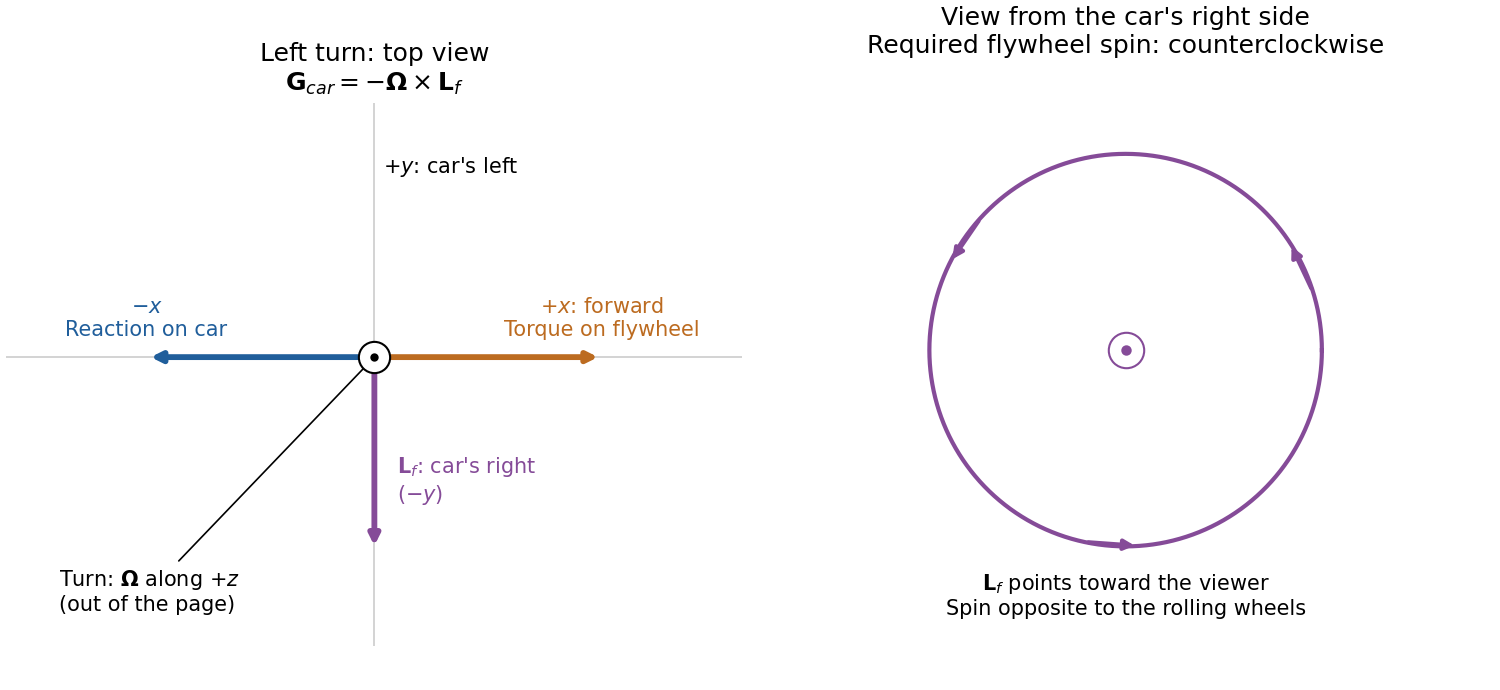
Gyroscope vector directions for a left-turning car and the flywheel spin needed to oppose outward roll
. Details. 
For comparison, the outward inertial roll moment at the stated speed is , and the limiting gravitational restoring moment is . The gyroscopic reaction is about of the former and of the latter, so it is appreciable for this large flywheel. If this ideal model is extended to include the favorable gyroscopic reaction in the wheel-lift condition, it gives , or about rather than . This quantifies a useful but finite increase in the rollover threshold.
New to topics? Read the docs here!