
Signaling adaptation is a decline of a response toward its earlier level while the initiating signal remains present. Specify which response is measured and its baseline: complete signaling adaptation means eventual return to that baseline; partial signaling adaptation leaves a lasting displacement. The continuing signal distinguishes signaling adaptation from simply switching off the stimulus. Signaling adaptation describes behavior, while signaling feedback describes a causal arrangement, so neither implies the other.
By reducing a persistent response to background ligand concentration, signaling adaptation can make a biological cell sensitive to changes rather than only to absolute levels. Resetting the response helps leave room for another change over a useful range of ligand concentrations. This is valuable in chemotaxis: swimming bacteria encounter changing chemical conditions, and their signal transduction influences whether a run continues or a tumble occurs. Signaling adaptation helps separate a change encountered during motion from a lasting background. This usefulness does not imply exact return or equal sensitivity at every possible concentration. [ref] [ref]
https://groups.csail.mit.edu/mac/projects/amorphous/6.978/papers/doyle-PNAS-2000.pdf. Yi, Huang, Simon and Doyle, PNAS 97 (2000), pp. 4649–4653: chemotaxis and adaptation
Here is a solvable incoherent feedforward loop toy that exhibits complete signaling adaptation without signaling feedback. The input jumps from to at and remains , a Heaviside step function. Let be a fast activating branch, a slower inhibitory branch, and a readout. The activities are dimensionless variables; physical time is in seconds. Choose time constants second and seconds, with initial conditions :Both branches read directly. Neither branch depends on , and does not change : the subtraction only defines the readout. Thus the slow opposing influence is feedforward, with no closed feedback control loop.
For , solving the two ordinary differential equations givesWriting for the numerical time in seconds, these are , and . Initially , then rises faster than , producing a pulse. At long times and both approach , so returns to despite sustained . For this upward step , hence . The striking feature of this signaling adaptation toy is that both branches remain active while the readout becomes quiet: the continuing background and the response to its arrival are separable.
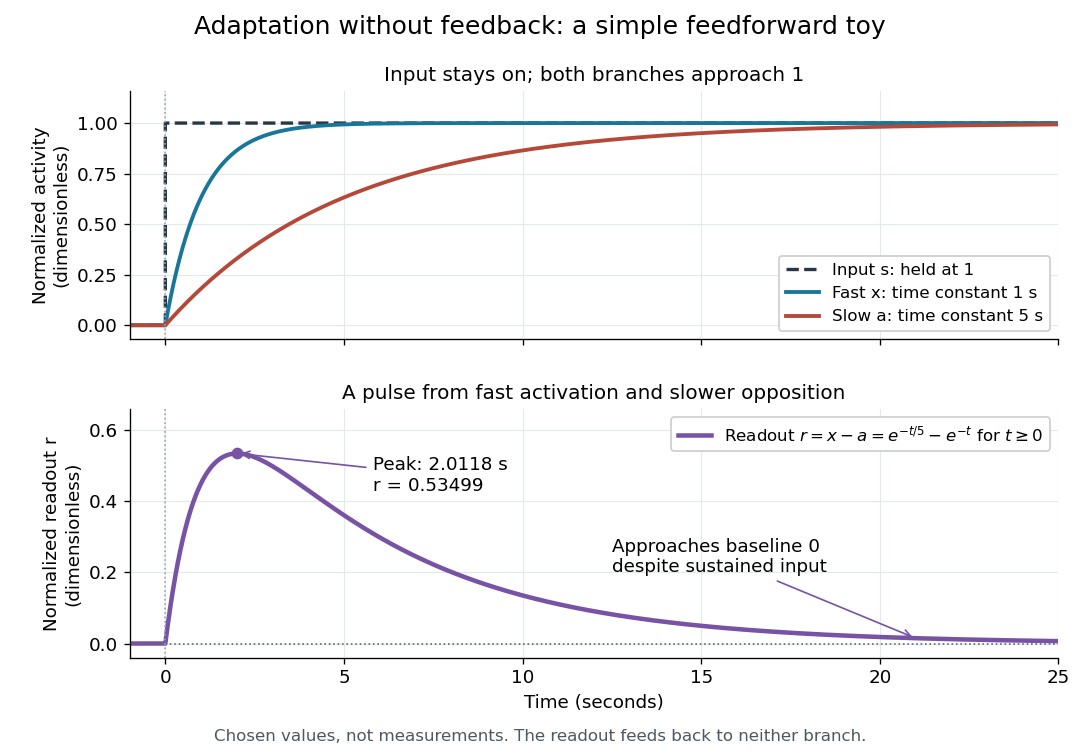

Find the pulse maximum by differentiating the exponential functions. With numerical time in seconds, the derivative isThe stationary condition is , so the natural logarithm givesBefore this time the derivative is positive; afterwards it is negative. Together with and , this proves that it is the unique pulse maximum. As another numerical check, at seconds , and : the slow branch is still catching up.
The subtraction is a mathematical readout, not a claim that an actual chemical concentration equals this difference for arbitrary inputs. Nonnegativity was established only for the specified upward step; other input histories can give a negative signed readout. Complete signaling adaptation here also relies on equal eventual branch gains: changing the readout to leaves for . This toy illustrates cancellation and different time constants; it does not establish molecular implementation or robustness to arbitrary parameter changes. Ma and colleagues' 2009 study separately analyzed biochemical mathematical models with negative feedback and incoherent feedforward loops, identifying additional conditions for signaling adaptation in those models. [ref]
https://cqb.pku.edu.cn/tanglab/pdf/78.pdf. Ma et al., Cell 138 (2009): adaptive architectures and their kinetic conditions
A historical connection to feedback control comes from Yi, Huang, Simon and Doyle's 2000 analysis of a bacterial chemotaxis model. They identified integral action in its regulation of receptor activity: accumulated deviations alter a slower adjustment, which in turn changes the measured activity. At a stationary state, an adjustment that integrates a nonzero error cannot remain constant, explaining how zero error can follow. Their conclusion depended on stated biochemical assumptions and stable behavior; it was not a claim that every biological cell uses that mechanism. A transient pulse alone, as the incoherent feedforward loop toy shows, cannot identify the underlying signaling feedback architecture. [ref]
https://groups.csail.mit.edu/mac/projects/amorphous/6.978/papers/doyle-PNAS-2000.pdf. Yi et al., Robust perfect adaptation in bacterial chemotaxis through integral feedback control, PNAS 97 (2000): Results and Discussion
New to topics? Read the docs here!