
Past exam of the mathematics course of the University of Cambridge 2015 ia Paper 4 8E b Created 2026-09-24 Updated 2026-09-24
Past exam of the mathematics course of the University of Cambridge 2015 ia Paper 4 8E a Created 2026-09-24 Updated 2026-09-24
Past exam of the mathematics course of the University of Cambridge 2015 ia Paper 4 7E Solution Created 2026-09-24 Updated 2026-10-06
For a finite family of subsets of a finite set , the inclusion-exclusion principle statesLet be the set of permutations with the two-cycle in their cycle decomposition of a permutation. Two distinct specified pairs sharing a label cannot both occur, so their intersection is empty. An intersection containing pairwise disjoint specified pairs fixes those labels and leaves choices for the other labels.
The number of ways to choose disjoint unordered pairs is : first order the selected labels, then divide by the two orders within each pair, by the orders of the pairs, and by the orders of the unused labels. Applying inclusion-exclusion to the complement of the union yields the count of permutations without two-cycles:The term is . Fixed points and cycles of length at least three are allowed; the restriction concerns two-cycles, not whether a permutation can be expressed as a product of transpositions.
Past exam of the mathematics course of the University of Cambridge 2015 ia Paper 4 6E iii Created 2026-09-24 Updated 2026-09-24
Past exam of the mathematics course of the University of Cambridge 2015 ia Paper 4 6E ii Created 2026-09-24 Updated 2026-09-24
Past exam of the mathematics course of the University of Cambridge 2015 ia Paper 4 6E i Created 2026-09-24 Updated 2026-09-24
Past exam of the mathematics course of the University of Cambridge 2015 ia Paper 4 5E ii Created 2026-09-24 Updated 2026-09-24
Past exam of the mathematics course of the University of Cambridge 2015 ia Paper 4 5E i Created 2026-09-24 Updated 2026-09-24
Past exam of the mathematics course of the University of Cambridge 2015 ia Paper 4 4C Solution Created 2026-09-24 Updated 2026-10-06
Use the Minkowski metric convention . A particle's four-momentum is , with for rest mass . For a photon, its energy and wavelength obey , and its four-momentum is null. Here is the Planck constant.
The initially stationary electron has . Choose the scattering plane as the plane. The incoming and outgoing photon four-momenta areBy four-momentum conservation, the final electron has . Its rest mass is unchanged, so the relativistic energy-momentum relation gives . Since , expansion yieldsorMultiplying through gives the Compton scattering shift:It is nonnegative and vanishes for forward scattering, consistent with the recoil energy being supplied by the photon.
Past exam of the mathematics course of the University of Cambridge 2015 ia Paper 4 3C Solution Created 2026-09-24 Updated 2026-10-06
Let the uniform mass density be . In spherical polar coordinates about the rotation axis, the perpendicular distance is and the volume element is . The moment of inertia is thereforeIn the given rigid body kinetic energy decomposition, is the translational kinetic energy of the whole mass moving at its center of mass velocity. The term is the rotational kinetic energy about the center of mass. The mixed term vanishes because the mass-weighted relative positions sum to zero.
For rolling without slipping, the point of contact has zero instantaneous velocity relative to the stationary surface. Its rotational velocity is opposite the center of mass velocity and has magnitude . Hence . Substituting this and the moment of inertia of a uniform solid sphere givesThe rotational axis is through the center of mass and parallel to the surface, perpendicular to the direction of rolling.
Past exam of the mathematics course of the University of Cambridge 2015 ia Paper 4 2E Solution Created 2026-09-24 Updated 2026-10-06
The Chinese remainder theorem says that for pairwise coprime integers , any prescribed residue modulo each is realized by exactly one residue class modulo . The Fermat little theorem says that for a prime number and an integer not divisible by , ; equivalently, for every integer .
For the given prime number, write . Its square is for some integer , since one of two consecutive integers is even. Therefore . The Fermat little theorem applied modulo gives , hence ; applied modulo it gives . These applications are valid because .
Past exam of the mathematics course of the University of Cambridge 2015 ia Paper 4 1E b Created 2026-09-24 Updated 2026-09-24
Past exam of the mathematics course of the University of Cambridge 2015 ia Paper 4 1E a Created 2026-09-24 Updated 2026-09-24
Past exam of the mathematics course of the University of Cambridge 2015 ia Paper 4 12C Solution Created 2026-09-24 Updated 2026-10-06
For a Lorentz transformation to an inertial frame moving at speed in the positive direction, write and . Any four-vector transforms asThis convention applies to and uses the same Minkowski metric as the four-momentum calculation.
The definition of proper time gives for . Hence the four-velocity isSince , differentiating with respect to proper time givesHere simplifies the spatial component of the four-acceleration.
At each event, boost with to the instantaneous rest inertial frame. Then and . Thus the signed proper acceleration for one-dimensional motion isThe last equality follows by differentiating ; its magnitude is the usual scalar proper acceleration.
If this signed proper acceleration is constant and the particle starts from rest, integration gives , soIntegrating once more and imposing yields the hyperbolic motion worldlineFor the continuous limiting solution is . Finally, the Taylor series of the square root givesThis recovers constant-acceleration Newtonian mechanics at low speed while the exact relativistic speed remains less than .
Past exam of the mathematics course of the University of Cambridge 2015 ia Paper 4 11C Solution Created 2026-09-24 Updated 2026-10-14
In plane polar coordinates, use and . Their derivatives are and . Differentiating gives the velocity and acceleration in polar coordinates:Both the electrostatic inverse-square force and the drag point radially, so the torque about the origin is zero even though the force depends on radial velocity. The vector angular momentum is constant. For , every position lies in the fixed plane perpendicular to it; if , the trajectory is radial and still lies in a plane. In the nonzero case the transverse equation is , givingThe signed depends on the plane orientation. The stipulated ratio requires .
Set and use primes for differentiation with respect to . Then , and . The radial equation is , soThis damped Binet equation has the general solution, for ,It is used on the physical interval where . For either sign of , introduce the forward angular distance ; then the exponential is . Thus damping acts forward in time for both orientations, not just when .
For unit mass, the kinetic energy is and the electrostatic potential energy is . ThereforeUsing the damped Binet equation,and multiplication by givesThis is also the drag force times the radial speed. Energy is nonincreasing in time, strictly decreasing while radial motion occurs; a circular trajectory already has constant energy. The sign of alone would be misleading for negative .
To justify circularization under radial inverse-square drag, suppose the forward trajectory remains bounded, . Since and the effective radial potential energy tends to as , the radius is also bounded away from zero. Velocity then stays bounded, so the solution continues for all forward time without collision. Moreover , so . The decaying general solution gives and . ConsequentlyThe tangential motion remains, so the limiting orbit is circular. The convergence is asymptotic; boundedness is needed because a physical solution could otherwise reach and escape rather than complete indefinitely many turns.
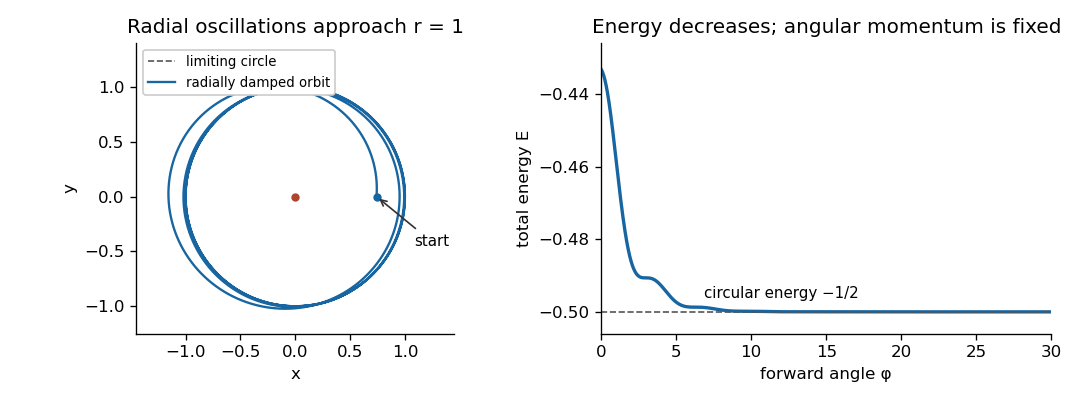
Bounded inverse-square orbit with radial drag approaching a circular orbit, with nonincreasing energy converging to the circular-orbit value
. Details. 
The example uses , and , which stays positive. Radial oscillations decay while angular momentum stays fixed.
Past exam of the mathematics course of the University of Cambridge 2015 ia Paper 4 10C Solution Created 2026-09-24 Updated 2026-10-06
The Lorentz force in the uniform magnetic field giveswhere the last step is the vector triple product identity. HenceOn the other hand, , soThe derivatives cancel, proving the magnetic angular-momentum invariantThe magnetic Lorentz force is perpendicular to velocity, so its power is zero:Thus the kinetic energy is constant.
For the alternative kinetic energy expression, work on an interval where so that the radial unit vector is defined. Differentiating once and twice givesSince , it follows that and . Therefore the unit-direction kinetic-energy identity isThis identity holds for any twice differentiable trajectory away from the origin, not only for motion in a magnetic field.
Past exam of the mathematics course of the University of Cambridge 2015 ia Paper 3 9A Solution Created 2026-09-24 Updated 2026-10-14
In cylindrical coordinates, and . The chain rule gives and . ThereforeThis is cylindrically radial divergence, valid for .
The bounded domain is outside the unit cylinder, below the inverse-square surface and above the lower plane:The upper plane touches only the rim ; it is not an extra positive-area top face. Revolving the shaded meridional region below around the axis gives the three-dimensional domain.
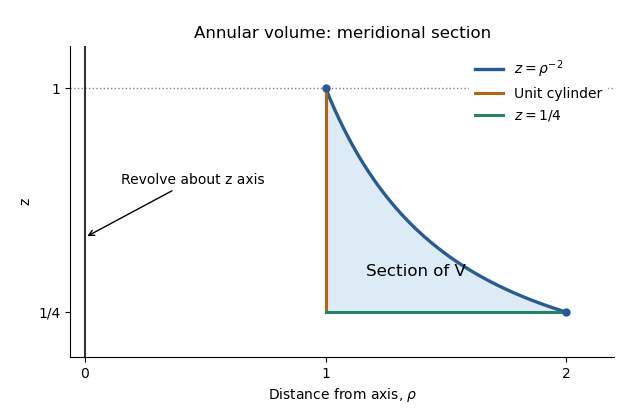
Meridional section of the annular volume between the unit cylinder, inverse-square surface and lower plane
. Details. 
With the Jacobian determinant of cylindrical coordinates,Zero divergence gives , hence the most general solution on the positive radial interval isAlthough this vector field is singular on the axis if , the entire closure of lies at , so it is smooth on a neighbourhood of and the divergence theorem applies.
Its volume integral of divergence is zero. Compute the outward surface integral directly. On the inner cylinder, , , and the flux is . On the curved roof , the outward vector surface element of a graph isTherefore its flux isThe horizontal bottom has zero flux and the top rim has zero surface area. Summing giveswhich verifies the divergence theorem with every boundary contribution accounted for.
Past exam of the mathematics course of the University of Cambridge 2015 ia Paper 3 8D c Created 2026-09-24 Updated 2026-09-24
Past exam of the mathematics course of the University of Cambridge 2015 ia Paper 3 8D b Created 2026-09-24 Updated 2026-09-24
Past exam of the mathematics course of the University of Cambridge 2015 ia Paper 3 8D a Created 2026-09-24 Updated 2026-09-24
There are unlisted articles, also show them or only show them.