
Past exam of the mathematics course of the University of Cambridge 2011 ii Paper 4 9C i Created 2026-09-24 Updated 2026-09-24
Past exam of the mathematics course of the University of Cambridge 2011 ii Paper 4 8E Solution Created 2026-09-24 Updated 2026-10-14
In the common sector , rotate the positive real contour clockwise to the negative imaginary axis. The large quarter-circle contributes zero because there. The rotated ray passes through the simple pole , whose residue isTake a small semicircular indentation into the right half-plane, excluding the pole from the clockwise contour. The downward ray traverses this semicircle clockwise, contributing in the limit. Thus the deformed downward integral is , and it equals the original integral. ConsequentlyThis half-residue, rather than a full residue, results from a pole lying on the rotated integration ray.
Parametrizing givesFor its tail decays exponentially. Near , subtract the pole coefficient before integrating; the remaining integrand is regular, and the principal-value pole term is explicit. This proves holomorphic dependence on throughout the upper half-plane, locally uniformly on compact subsets. Agreement in the overlap and the identity theorem therefore give the requested analytic continuation:
Past exam of the mathematics course of the University of Cambridge 2011 ii Paper 4 7C ii Created 2026-09-24 Updated 2026-09-24
Past exam of the mathematics course of the University of Cambridge 2011 ii Paper 4 7C i Created 2026-09-24 Updated 2026-09-24
Past exam of the mathematics course of the University of Cambridge 2011 ii Paper 4 6B Solution Created 2026-09-24 Updated 2026-10-14
The preceding summer supplies new seeds. After one winter, survive and the fraction germinates. Seeds from summer must survive two winters and fail to germinate after the first, so their germinating contribution is . Older seeds cannot contribute. Applying the density-dependent maturation function givesThis is a seed-bank population recurrence. Put . Its fixed points satisfy . The zero solution always exists. If , the graph of leaves the origin with slope , is concave because decreases, and is bounded above by ; it therefore crosses the straight line again at a positive value. Concavity makes this positive crossing unique: the ratio is nonincreasing, starts at one, tends to zero, and is strictly decreasing at any level below one that it attains after the initial slope has dropped. Thus there are exactly two nonnegative steady states when .
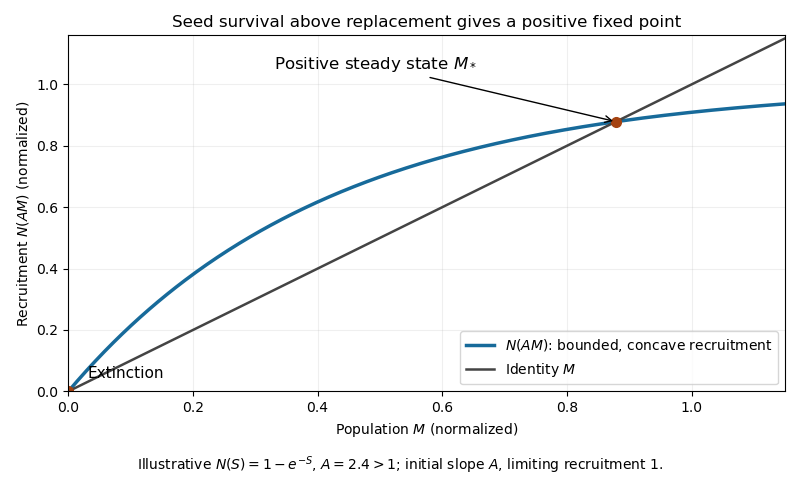

Linearization at extinction uses :The positive root is . Since the polynomial at is , and tends to positive infinity, . Its associated two-component perturbation can be chosen nonnegative, so the growing mode is physically admissible. Extinction is unstable whenever .
Past exam of the mathematics course of the University of Cambridge 2011 ii Paper 4 5J Solution Created 2026-09-24 Updated 2026-10-14
Model each person's infections over the fixed exposure period as an independent Poisson random variable with mean , conditional on the explanatory variables. The sum over people is then Poisson distributed with mean , because independent Poisson counts add. This is reasonable for repeatable events occurring at an approximately constant rate without substantial clustering; the count need not be at most , so a binomial model would not describe repeated infections.
The Poisson regression uses a log link and the known offset . The omitted factor levels are the reference categories under treatment contrasts: their effects are absorbed into the intercept. Including all levels together with an intercept would make the design matrix linearly dependent. For the proposed new group, the relevant predictor uses the intercept, the infrequent-swimmer coefficient and the age-20–24 coefficient; beach and female are reference levels. HenceTo add the age-by-sex interaction, one possible R command iswhere
glm(count ~ freq + loc + age * sex, family = poisson, offset = log(n), data = swimmers)swimmers denotes the data frame. The product expands to both main effects and their interaction. There are two additional interaction coefficients because age has three levels and sex has two.The nested-model comparison is a likelihood-ratio test. The reduction in Poisson deviance is , asymptotically under the null hypothesis that both interaction coefficients are zero. Its reported -value gives evidence for an age-by-sex interaction at the five-percent level, though not at the one-percent level.
Neither fitted Poisson model fits well in an absolute sense. Comparing residual deviances with and respectively gives small tail probabilities: the deviance-to-degree-of-freedom ratios are about and . Improvement relative to the simpler model does not establish goodness of fit. Omitted structure, dependence or overdispersion could account for the remaining lack of fit; if the Poisson variance assumption is false, the nominal interaction-test calibration also needs reconsideration. The age label in the introductory legend is inconsistent with the actual model levels; the prediction uses the unambiguous age-20–24 row.
Past exam of the mathematics course of the University of Cambridge 2011 ii Paper 4 4G Solution Created 2026-09-24 Updated 2026-10-14
Use the BB84 protocol to establish a secret random key, then encrypt the actual message with a one-time pad. Alice chooses independent random bits and independently chooses between the computational orthonormal basis and the diagonal basis , where . She sends one photon or other qubit in each corresponding state. Bob independently chooses one of the two bases for each measurement.
Over an authenticated public classical channel, they announce their bases but not their bit values. They retain only positions where their bases match; absent disturbance these sifted bits agree. They disclose and discard a randomly selected test sample to estimate the error rate. If it is too large they abort. Otherwise they perform information reconciliation and privacy amplification to produce a shared key about which an eavesdropper has negligible information. Authentication is essential: without it, an active attacker can impersonate the two parties. It may use a previously shared short authentication key, subsequently replenished from the new secret key.
The no-cloning theorem prevents an attacker from copying an unknown nonorthogonal state perfectly: preservation of inner products would require , impossible when its modulus is strictly between zero and one. In a simple intercept-and-resend attack, Eve chooses the wrong basis with probability , and then introduces a wrong sifted bit with probability . Thus the test error rate is , and the probability that independent tested bits show no error is . More general attacks are handled by bounding Eve's information from the observed statistics and shortening the reconciled key through privacy amplification.
Finally Alice sends , using a uniform independent key of the message's length exactly once. The one-time pad makes the ciphertext independent of the message. The security claim is secrecy with arbitrarily small failure probability after testing and privacy amplification, not that a finite quantum transmission can never be disturbed or intercepted. The scheme assumes trusted devices and an authenticated classical channel; it does not rely on a computational hardness assumption.
Past exam of the mathematics course of the University of Cambridge 2011 ii Paper 4 3G Solution Created 2026-09-24 Updated 2026-10-14
An inversion in a circle on the Riemann sphere is the anti-Möbius involution fixing that generalized circle pointwise. For a Euclidean circle with centre and radius , it isIt reverses the argument relative to the centre and sends radius to , so exactly the points of the circle are fixed. For a straight line, regarded as a circle through infinity, inversion is the ordinary reflection in that line. These formulas prove existence. For uniqueness, the composition of two anti-Möbius transformations fixing the same circle pointwise is a Möbius transformation fixing at least three distinct points, hence the identity. Therefore the two inversions agree.
Every inversion has the form with . Composing two conjugate-linear fractional expressions cancels the complex conjugations and gives with nonzero determinant. Induction proves that an even number of inversions gives a Möbius transformation.
Conversely translations are compositions of reflections in parallel lines, rotations are compositions of reflections in two lines through their centre, and positive dilations are compositions of two concentric circle inversions: . Thus every nonconstant affine map is an even composition. The map is composed with reflection in the real axis, also an even composition. If , factor a general Möbius transformation asThis is a composition of affine maps and . If , it is already affine. Every Möbius transformation is therefore a composition of an even number of inversions, with the identity represented by zero inversions or by any inversion repeated twice.
Past exam of the mathematics course of the University of Cambridge 2011 ii Paper 4 39A ii Created 2026-09-24 Updated 2026-09-24
Past exam of the mathematics course of the University of Cambridge 2011 ii Paper 4 39A i Created 2026-09-24 Updated 2026-09-24
Past exam of the mathematics course of the University of Cambridge 2011 ii Paper 4 38B Solution Created 2026-09-24 Updated 2026-10-14
For smooth isentropic flow with , , the continuity and momentum equations givewhere . Adding and subtracting these equations showsThese are the Riemann invariants on the two characteristic families.
Before any shock, the incoming characteristics originate in the initially uniform gas, so their invariant is zero. Thus throughout the disturbed simple wave. A characteristic leaving the piston at time has constant and speed . ThereforeThis parametrization applies for in as long as the characteristics remain ordered. The gas for is still at rest. The values and give the piston and leading disturbance respectively.
Characteristic crossing first occurs when the derivative of the displayed with respect to vanishes. With this givesFor the printed , , soIts minimum over occurs at and satisfies . Hence the first shock forms atThe characteristic formula is restricted to earlier times; crossing afterwards must be replaced by a shock satisfying the conservation laws.
Past exam of the mathematics course of the University of Cambridge 2011 ii Paper 4 37B Solution Created 2026-09-24 Updated 2026-10-14
In lubrication theory, the gap scale is small compared with the axial scale , so and wall slopes are small. Incompressibility makes the transverse velocity scale . The reduced Reynolds number is , and must be small to neglect convection; the transverse viscous diffusion time must also be short compared with the wall-motion time to neglect unsteady inertia. For a Newtonian incompressible fluid with no axial wall motion, the leading equations are and .
No slip gives . Integrating twice and then across the gap givesIntegrate and differentiate the moving-limit flux. The lower wall has , and the upper kinematic condition is . These terms cancel to giveFor a travelling gap , this becomes , so with independent of position. Zero mean pressure gradient givesthereforeThe positivity of is assumed so these averages exist. The wall pattern travels without an imposed mean pressure difference; the changing gap and its inverse-cubic hydraulic resistance produce the pumping.
Past exam of the mathematics course of the University of Cambridge 2011 ii Paper 4 36D Solution Created 2026-09-24 Updated 2026-10-18
Put . An incoming radial null ray has . The tortoise coordinate obeys , so is constant along such a ray. For this is exactly the printed logarithm. Substituting gives the metric in ingoing Eddington-Finkelstein coordinatesThe radial null directions satisfy either or . Future-directed ingoing rays have decreasing on the first family. Outgoing rays increase outside the horizon, stay at on its generators, and decrease inside. Thus inside the horizon every future timelike trajectory also moves toward smaller .
The metric block has determinant minus one and is nonsingular at . The horizon is a null surface, not a curvature singularity. For example the Kretschmann scalar is finite there and diverges at .
Inside, set . For radial timelike motion, the Schwarzschild expression becomes , henceAngular motion would only reduce the available proper time further. Integrating from the horizon to zero, with , givesThe bound is sharp for the zero-energy radial geodesic with constant Schwarzschild in the interior. For a geodesic arriving from the exterior with strictly positive conserved energy, the proper time is strictly smaller; is the supremum as that energy tends to zero. Thus the universally available horizon-to-singularity upper bound is , rather than a time attainable by every exterior infaller. Restoring units gives .
Past exam of the mathematics course of the University of Cambridge 2011 ii Paper 4 35C Solution Created 2026-09-24 Updated 2026-10-14
For a localized charge distribution and a field point outside it, expand the Coulomb kernel:Integrating against the charge density gives the electrostatic multipole expansionwhere , is the electric dipole moment, and the symmetric trace-free electric quadrupole moment is . This states the tensor normalization explicitly.
For the tetrahedral point charges, the total charge is zero and the three other vertex vectors sum to minus . HenceEvery vertex has and each , so each diagonal quadrupole entry vanishes. For each distinct coordinate pair the charge-weighted sum of is , yieldingThe tensor is trace-free as required. If the alternative raw second-moment convention is used, its off-diagonal entries are and the kernel contraction has the corresponding factor of three; the physical potential is unchanged.
Past exam of the mathematics course of the University of Cambridge 2011 ii Paper 4 34D iv Created 2026-09-24 Updated 2026-09-24
Past exam of the mathematics course of the University of Cambridge 2011 ii Paper 4 34D iii Created 2026-09-24 Updated 2026-09-24
Past exam of the mathematics course of the University of Cambridge 2011 ii Paper 4 34D ii Created 2026-09-24 Updated 2026-09-24
Past exam of the mathematics course of the University of Cambridge 2011 ii Paper 4 34D i Created 2026-09-24 Updated 2026-09-24
Past exam of the mathematics course of the University of Cambridge 2011 ii Paper 4 33E Solution Created 2026-09-24 Updated 2026-10-14
For charge , the required gauge transformation of the wavefunction isDefine and . With the stated transformed potentials, differentiating the phase gives and . Applying the spatial identity twice shows that both sides of the Schrödinger equation acquire the same phase, proving invariance. The magnetic field and electric field are unchanged because mixed derivatives commute.
Take , as in the stated energy formula. In the specified gauge, the time-independent Hamiltonian isIt commutes with , so choose simultaneous generalized eigenstates and attach . The remaining equation isIt is a harmonic oscillator of frequency , centred at . Therefore the Landau levels areThey are independent of the continuously variable on the infinite plane, giving infinite degeneracy. Plane waves may be normalized in a finite box and the infinite-area limit then taken. For signed , replace the oscillator frequency by .
With , the additional potential energy is . Completing the square preserves the oscillator frequency but shifts its centre toThe constant term after completing the square givesWhen , different at fixed have different energies: the guiding-centre degeneracy of each Landau level is lifted. Accidental coincidences between different are not excluded; what disappears is the flat -independent level.
Past exam of the mathematics course of the University of Cambridge 2011 ii Paper 4 32D Solution Created 2026-09-24 Updated 2026-10-14
In the original eigenbasis, . Insert the proposed first-order state for eigenvalue near minus one. The first component gives ; the second gives , hence . Similarly for the eigenvalue near one, and . Normalization gives , with their phases freely selectable. Choosing the original-state phase conventions,The states are orthogonal through first order because the two cross terms cancel.
Exactly, , so putting givesFor an eigenvalue , the first row requires the component ratio , so the coefficient in the printed parametrization is . With , smooth normalized choices areThey have unit norm and zero inner product, and direct multiplication gives the two eigenvalue equations. For , the printed scalar factors can be chosen and ; the second is allowed a complex phase. The displayed ratio form is singular at zero, but the normalized vectors have the correct continuous limits there.
Expanding and gives and , while the eigenvalues have no first-order shift. This recovers all six perturbative coefficients with the same phase convention.
There are unlisted articles, also show them or only show them.