
Past exam of the mathematics course of the University of Cambridge 2012 ia Paper 4 7D i Created 2026-09-24 Updated 2026-09-24
Past exam of the mathematics course of the University of Cambridge 2012 ia Paper 4 6D Solution Created 2026-09-24 Updated 2026-10-07
Fermat's little theorem says that for a prime and , ; equivalently for every integer . The Wilson theorem says for a prime (and, conversely, this congruence characterizes primes among integers greater than one).
For , is a square root of minus one modulo a prime. If is odd and , Fermat's little theorem givesso is even and . Conversely, put . Pairing with in the factorial gives . For , is even, so the Wilson theorem yields . Thusand in the latter case supplies a solution.
For the multiplicative order assertion, divide by : , . Since and , it follows that . Minimality of the positive order excludes , hence andIn particular by Fermat's little theorem. Negative , if included, are handled by the same division using the modular inverse of .
A Fermat number in the paper has . If a prime divides , it is odd and . Squaring gives , so the order divides . It does not divide , since modulo an odd prime. Every divisor of is a power of two, so the only possibility isIf two different Fermat numbers shared a prime factor, the same element modulo that prime would have two different orders. This is impossible, proving pairwise coprimality. Also , so for every such prime is modulo . No prime modulo can occur.
A prime modulo need not occur: take . It is prime, , and . Since the order divides , the first congruence excludes every divisor of and the second excludes ; hence the order is . This is not a power of two, so is not a prime divisor of a Fermat number. The index restriction matters: the conventional extra number is outside the paper's positive- family.
Past exam of the mathematics course of the University of Cambridge 2012 ia Paper 4 5D iii Created 2026-09-24 Updated 2026-09-24
Past exam of the mathematics course of the University of Cambridge 2012 ia Paper 4 5D ii Created 2026-09-24 Updated 2026-09-24
Past exam of the mathematics course of the University of Cambridge 2012 ia Paper 4 5D i Created 2026-09-24 Updated 2026-09-24
Past exam of the mathematics course of the University of Cambridge 2012 ia Paper 4 4B Solution Created 2026-09-24 Updated 2026-10-07
For , the Lorentz transformation with coincident origins isFor two simultaneous events in , , so . Distinct spatial positions therefore generally give different times in the boosted frame: this is relativity of simultaneity.
Choose the emission events at and . After emission, the photon world lines are and . Applying the Lorentz transformation to either givesThus the two photons move at speed in on parallel lines whose intercepts differ by . Measuring their positions at the same after both emissions gives the photon separation under a collinear Lorentz boost:This separation is constant. It is not the contracted distance between the stationary sources: the two emission events are not simultaneous in , and one photon has already moved when the other is emitted.
Past exam of the mathematics course of the University of Cambridge 2012 ia Paper 4 3B Solution Created 2026-09-24 Updated 2026-10-07
By Newton's third law, the force on the second particle is . For and centre of mass , Newton's second law gives . ThusThe centre moves on a straight line with constant velocity; zero velocity is allowed. For the relative position , subtraction of the two equations givesHence the two-body problem reduces to a single particle of reduced mass , together with the elementary centre motion. Reconstruct the positions as , .
Yes: the two equal masses can follow the same fixed circle in diametrically opposite positions. Put the stationary centre of mass at the circle's center and choose tangential velocities with the same sense of rotation. If the circle has radius , the separation is and the mutual gravitational force is directed toward that center, with magnitude . The circular orbit condition is , so an equal-mass circular binary hasThese initial data maintain the opposite positions and give the same constant angular speed for both particles.
Past exam of the mathematics course of the University of Cambridge 2012 ia Paper 4 2D ii Created 2026-09-24 Updated 2026-09-24
Past exam of the mathematics course of the University of Cambridge 2012 ia Paper 4 2D i Created 2026-09-24 Updated 2026-10-07
Past exam of the mathematics course of the University of Cambridge 2012 ia Paper 4 1D ii Created 2026-09-24 Updated 2026-09-24
Past exam of the mathematics course of the University of Cambridge 2012 ia Paper 4 1D i Created 2026-09-24 Updated 2026-09-24
Past exam of the mathematics course of the University of Cambridge 2012 ia Paper 4 12B b Created 2026-09-24 Updated 2026-09-24
Past exam of the mathematics course of the University of Cambridge 2012 ia Paper 4 12B a Created 2026-09-24 Updated 2026-09-24
Past exam of the mathematics course of the University of Cambridge 2012 ia Paper 4 11B c Created 2026-09-24 Updated 2026-09-24
Past exam of the mathematics course of the University of Cambridge 2012 ia Paper 4 11B b Created 2026-09-24 Updated 2026-09-24
Past exam of the mathematics course of the University of Cambridge 2012 ia Paper 4 11B a Created 2026-09-24 Updated 2026-09-24
Past exam of the mathematics course of the University of Cambridge 2012 ia Paper 4 10B b Created 2026-09-24 Updated 2026-09-24
Past exam of the mathematics course of the University of Cambridge 2012 ia Paper 4 10B a Created 2026-09-24 Updated 2026-09-24
Past exam of the mathematics course of the University of Cambridge 2012 ia Paper 3 9C Solution Created 2026-09-24 Updated 2026-10-14
For an oriented smooth surface with piecewise smooth, consistently oriented boundary, Stokes theorem givesfor a continuously differentiable vector field defined on a neighborhood of . Choose the upward normal vector here. The surface is an annular band of an elliptic paraboloid, parametrized byUsing as the oriented vector area element givesThe sketch below shows the open band, not a capped solid. Its upper circle has radius one and its lower circle radius one third.
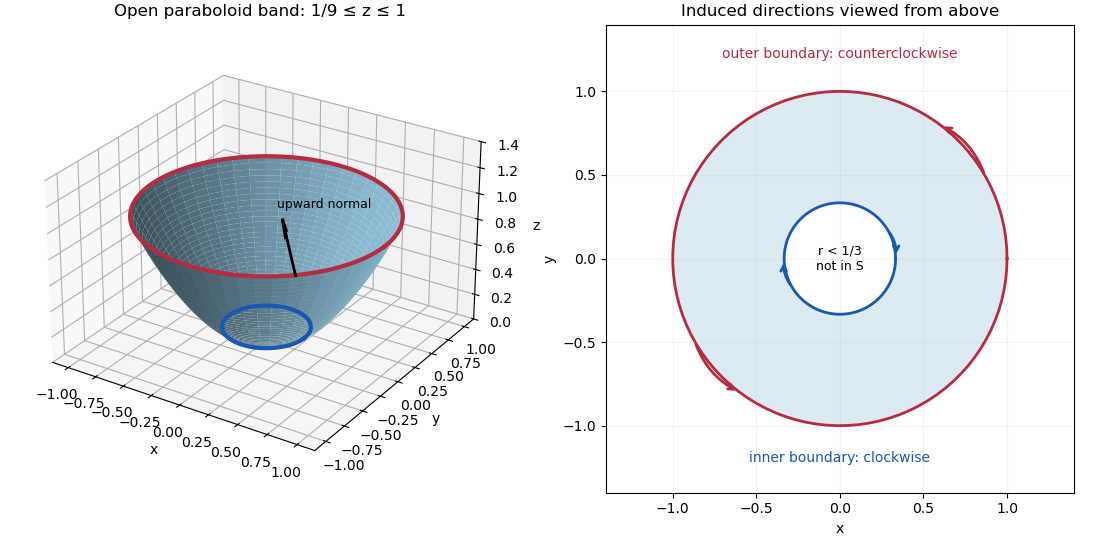
Annular paraboloid with upward normal and opposite induced orientations on the outer and inner boundary circles
. Details. 
Differentiating the given vector field yieldsThe surface integral is thereforeFor the boundary line integral, the upward normal vector induces counterclockwise traversal of the outer circle and clockwise traversal of the inner circle, as viewed from above. On a circle of radius , parametrized counterclockwise, is constant andSince each fourth power integrates to , the two-circle line integral isconfirming Stokes theorem and the Stokes flux through an annular paraboloid. Reversing the chosen orientation changes both integrals to .
Past exam of the mathematics course of the University of Cambridge 2012 ia Paper 3 8E Solution Created 2026-09-24 Updated 2026-10-07
Work with modulo and modulo . By Fermat's little theorem, in , so the factor is independent of the chosen representative of . The proposed multiplication is therefore well defined on the stated Cartesian product. Its two associative bracketings have the same second component:and both have first component . The identity element is , and the two-sided inverse element isThus the multiplication defines the twisted cyclic pair group, of order .
If , multiplication is coordinatewise addition, so the group is abelian. If , then and both and are available; their products in opposite orders are and . They differ. HenceBoth and contain the identity element and are closed under the multiplication and inverses: they are the cyclic groups of orders and respectively. Conjugation gives, with all coordinates reduced in the appropriate modulus,so is a normal subgroup. For , the corresponding calculation isWhen this lies in . Conversely, for , take , , : the second coordinate is , so is not normal. Thus is normal precisely when .
Finally, the projectionis a surjective group homomorphism because the first coordinates add. Its kernel of a group homomorphism is exactly . At , is the only possibility and the first factor is trivial, consistent with every conclusion. No assumption that generates the multiplicative group of the finite field is needed.
There are unlisted articles, also show them or only show them.