
Past exam of the mathematics course of the University of Cambridge 2009 ia Paper 2 8C a Created 2026-09-24 Updated 2026-09-24
Past exam of the mathematics course of the University of Cambridge 2009 ia Paper 2 7C Solution Created 2026-09-24 Updated 2026-10-14
The origin is a regular singular point of this Kummer differential equation. Apply the Frobenius method, writing with . The lowest power gives the indicial equationFor , comparison of the coefficient of givesSince , both roots give valid independent branches. Normalize :Here is the rising factorial, and the first series is the confluent hypergeometric function of the first kind . The two leading powers are distinct, proving linear independence. We describe real solutions on , with their one-sided behavior at zero.
For the inhomogeneous equation a particular solution is , verified by direct substitution. Thus . Since , a finite derivative at zero forces . Then forces , and the required solution isIn particular . The singular homogeneous branch cannot be added without violating the derivative condition.
Past exam of the mathematics course of the University of Cambridge 2009 ia Paper 2 6C Solution Created 2026-09-24 Updated 2026-10-14
Assume . The characteristic roots of the damped harmonic oscillator are . Its general homogeneous solution isThese are respectively the underdamped, critically damped and overdamped regimes.
For the velocity-switched driven oscillator, the initial acceleration is . Its velocity is therefore negative on the first half-cycle, and the forcing is zero:Indeed in that open interval. Set ; at the first turning point, and .
Put . On the second half-cycle the velocity is positive, so the particular solution is . Matching position and velocity givesIts derivative is positive for . At the next turning point,The turning-point return map therefore repeats the initial state exactly whenThis value exceeds , so the subsequent acceleration initiates the required negative-velocity half-cycle again. The switched solution is continuous with continuous velocity, and is piecewise twice differentiable; acceleration has one-sided jumps where the forcing switches.
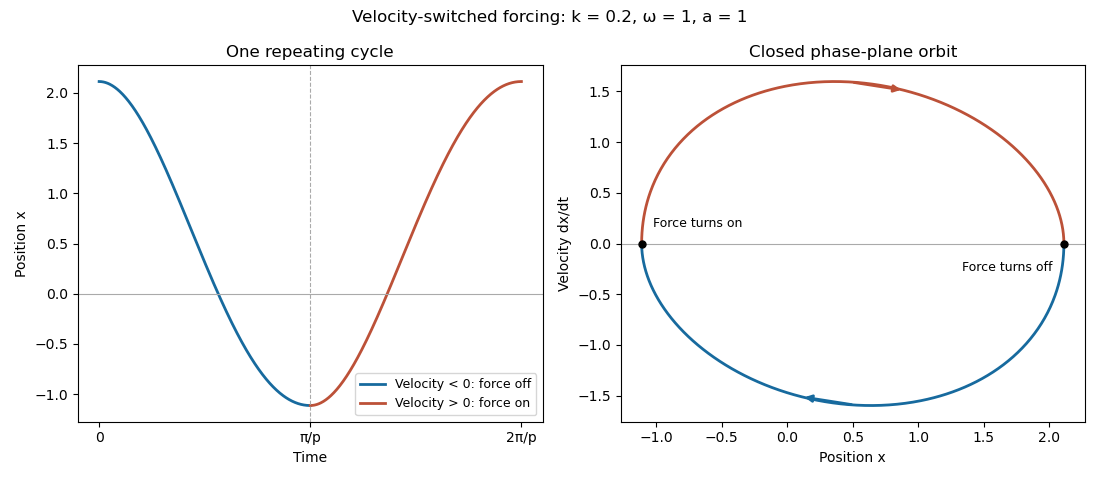

For , the specified positive initial value givesThere is no next turning point: the forcing stays zero and approaches zero monotonically. The motion from the specified initial state cannot be periodic. More generally, a solution started at any positive maximum has this same obstruction; a nonconstant periodic orbit would require such a maximum. The zero equilibrium is a separate constant solution.
Past exam of the mathematics course of the University of Cambridge 2009 ia Paper 2 5C Solution Created 2026-09-24 Updated 2026-10-14
On an interval where , the Bernoulli differential equation is transformed by :For , , put . An integrating factor solves , giving . Thus the positive branches areon intervals where the expression in parentheses is positive. The transformation omits the separate solution . For , the right-hand side need not be locally Lipschitz continuous at zero, so nonnegative solutions can also join zero and positive branches where the original equation permits; the formula describes every strictly positive segment.
For the autonomous case, . Its two nonnegative equilibrium points areAt the positive equilibrium point, . If , below and above it; hence is unstable and is asymptotically stable. Every strictly positive solution tends to forward in time.
If , those signs reverse: is stable from the nonnegative side and is unstable. The stability at zero follows from the phase-line signs, not a finite derivative there. For initial value , the transformed equation is with . The solution reaches zero atand remains zero thereafter as a nonnegative forward solution. This is finite-time extinction in a sublinear Bernoulli equation. Initial values above increase without bound; the sublinear negative term prevents neither that growth nor the instability of .
Past exam of the mathematics course of the University of Cambridge 2009 ia Paper 2 4F Solution Created 2026-09-24 Updated 2026-10-14
The events are pairwise disjoint and their union is . Finite additivity and the definition of conditional probability therefore give the law of total probability:For the birthday problem, let mean that all birthdays differ. For , sequential conditioning on previous distinct birthdays and independence of random variables giveHere each factor uses the stated bound . For , , soFor a match is certain by the pigeonhole principle. The threshold from the exponential bound is , so suffices.
Past exam of the mathematics course of the University of Cambridge 2009 ia Paper 2 3F b Created 2026-09-24 Updated 2026-09-24
Past exam of the mathematics course of the University of Cambridge 2009 ia Paper 2 3F a Created 2026-09-24 Updated 2026-09-24
Past exam of the mathematics course of the University of Cambridge 2009 ia Paper 2 2C Solution Created 2026-09-24 Updated 2026-10-14
The characteristic roots of the homogeneous linear ordinary differential equation are and . The forcing is resonant with the solution, so the method of undetermined coefficients uses the particular solution . Thus . The two initial conditions are and , giving
Past exam of the mathematics course of the University of Cambridge 2009 ia Paper 2 1C Solution Created 2026-09-24 Updated 2026-10-14
This is a logistic equation, with positive equilibrium point and initial population above that value. On the positive branch, put . It satisfies the linear ordinary differential equation , so . The initial condition gives , henceThe population decreases monotonically toward the stable equilibrium point; it never reaches it at a finite time.
Past exam of the mathematics course of the University of Cambridge 2009 ia Paper 2 12F Solution Created 2026-09-24 Updated 2026-10-14
The law of total probability and the definition of conditional probability give Bayes' theorem:The denominator is positive because .
For the observed cargo, set , , . The binomial likelihood under origin isEqual prior probabilities and Bayes' theorem make the posterior proportional to these likelihoods. The binomial coefficient cancels in the likelihood ratios:Thus and , givingEven the permitted approximation gives log ratios about and , which already show overwhelming posterior preference for B. The exact logarithms are preferable because multiplication by magnifies the approximation error. An observed contamination fraction halfway between two hypothesized rates does not give equal likelihoods: the binomial distribution assigns asymmetric probabilities to those deviations, especially at this large sample size.
Past exam of the mathematics course of the University of Cambridge 2009 ia Paper 2 11F Solution Created 2026-09-24 Updated 2026-10-14
Integrating the uniform density gives . By independence of random variables, . For the remaining expected value, integrate first in :The value at is supplied by continuity. Therefore, with the harmonic number ,
Conditional on one sample point being , it is a maximal external point precisely when none of the other points falls in the upper-right rectangle . Its area is , so its conditional probability of being maximal is . Both and are independent uniform random variables, hence a given point is maximal with probability . Summing their indicator random variables and applying linearity of expectation gives the expected number of coordinatewise maxima:This grows only logarithmically with the sample size, even though all points are potential candidates.
Past exam of the mathematics course of the University of Cambridge 2009 ia Paper 2 10F b Created 2026-09-24 Updated 2026-09-24
Past exam of the mathematics course of the University of Cambridge 2009 ia Paper 2 10F a Created 2026-09-24 Updated 2026-09-24
Past exam of the mathematics course of the University of Cambridge 2009 ia Paper 1 9F c Created 2026-09-24 Updated 2026-09-24
Past exam of the mathematics course of the University of Cambridge 2009 ia Paper 1 9F b Created 2026-09-24 Updated 2026-09-24
Past exam of the mathematics course of the University of Cambridge 2009 ia Paper 1 9F a Created 2026-09-24 Updated 2026-09-24
Past exam of the mathematics course of the University of Cambridge 2009 ia Paper 1 8A c Created 2026-09-24 Updated 2026-09-24
Past exam of the mathematics course of the University of Cambridge 2009 ia Paper 1 8A b Created 2026-09-24 Updated 2026-09-24
Past exam of the mathematics course of the University of Cambridge 2009 ia Paper 1 8A a Created 2026-09-24 Updated 2026-09-24
Past exam of the mathematics course of the University of Cambridge 2009 ia Paper 1 7A d Created 2026-09-24 Updated 2026-09-24
There are unlisted articles, also show them or only show them.