
Past exam of the mathematics course of the University of Cambridge 2009 ib Paper 1 12F iii Created 2026-09-24 Updated 2026-09-24
Past exam of the mathematics course of the University of Cambridge 2009 ib Paper 1 12F ii Created 2026-09-24 Updated 2026-09-24
Past exam of the mathematics course of the University of Cambridge 2009 ib Paper 1 12F i Created 2026-09-24 Updated 2026-09-24
Past exam of the mathematics course of the University of Cambridge 2009 ib Paper 1 11E Solution Created 2026-09-24 Updated 2026-10-14
Let . It is continuous and takes values in . The finite sums are continuous and their tails obeyfor every real . To prove continuity without invoking an unproved uniform-limit theorem, fix and . Choose with , then use continuity of to make near . The triangle inequality then gives . Thus is continuous; it is the scaled Takagi function .
For the general secant claim, differentiability gives , where for sufficiently small , with . Since the two endpoints straddle ,Hence the secant limit is , including cases where an endpoint equals . This proves secants straddling a differentiability point.
Now take the nested dyadic intervals , . They straddle and shrink to it. For every , and are integers, so the corresponding summand vanishes at both endpoints. For , all corners of that summand lie on the dyadic grid of mesh ; on the chosen open interval it is linear with slope . Therefore its total secant slope isRefining to the nested interval preserves the slopes of all old terms and adds exactly one new term of slope or . Thus for every , so cannot converge. This contradicts the secant consequence of differentiability at any . Therefore is nowhere differentiable. At dyadic the intervals chosen on its right satisfy the same argument. The printed reference to a denominator is naturally read as mesh , or denominator , as used here.
Past exam of the mathematics course of the University of Cambridge 2009 ib Paper 1 10F Solution Created 2026-09-24 Updated 2026-10-14
In a principal ideal domain, an ascending chain of ideals stabilizes: its union is an ideal , and its generator belongs to one member, which then contains the union. This proves the needed ascending chain condition. If a nonzero nonunit had no finite irreducible factorization, split it into two nonunits and select a factor that still has no such factorization. Continuing would give a strictly ascending chain of principal ideals, because with a nonunit implies . This contradicts the chain condition, so factorization exists.
An irreducible element generates a maximal ideal: any intermediate ideal is with , and irreducibility forces or to be a unit. Therefore is a prime element. In any two irreducible factorizations, the first prime factor divides a factor of the other, hence is associate to it. Cancel and continue. This proves every principal ideal domain is a unique factorization domain.
In , the multiplicative field norm is . The only units are . There is no element of norm two, so every element of norm four is irreducible: a factorization into nonunits would require norms two and two. Consequentlyis a pair of genuinely different irreducible factorizations. Neither nor is associate to .
Take the Eisenstein integers , where and . Since , the embedded subring is , whose additive index in is two. Its larger ring has Eisenstein-integer norm and is Euclidean. Indeed, write a complex quotient in the real basis and round both coordinates to integers. The coordinate errors satisfy , giving . Thus division leaves a remainder of smaller norm. A Euclidean domain is a principal ideal domain, because division by a nonzero element of least norm in an ideal leaves zero remainder. This gives the requested index-two embedding into a principal ideal domain.
Past exam of the mathematics course of the University of Cambridge 2009 ia Paper 4 9A Solution Created 2026-09-24 Updated 2026-10-14
Use signed velocities in Skaro's inertial frame; the returning velocity must be negative. For the first two rockets, the Lorentz transformation of infinitesimal separations is , . Dividing with gives the relativistic velocity-addition formulaFor the third rocket, its signed velocity in the second frame is , so another application givesSince and , the denominator is positive. The third rocket returns from positive to Skaro if and only if , henceEquality leaves it stationary in Skaro's frame, so it never returns from ; a smaller leaves it travelling outward.
Let denote departure, boarding the second rocket, boarding the third, and reunion with Skaro. In coordinates , their positions on the worldline areIndeed, the first two coordinate durations are and , and the returning leg has duration . Equivalently, their coordinates are obtained by multiplying each displayed time by ; these are the coordinates used for the spacetime diagram.
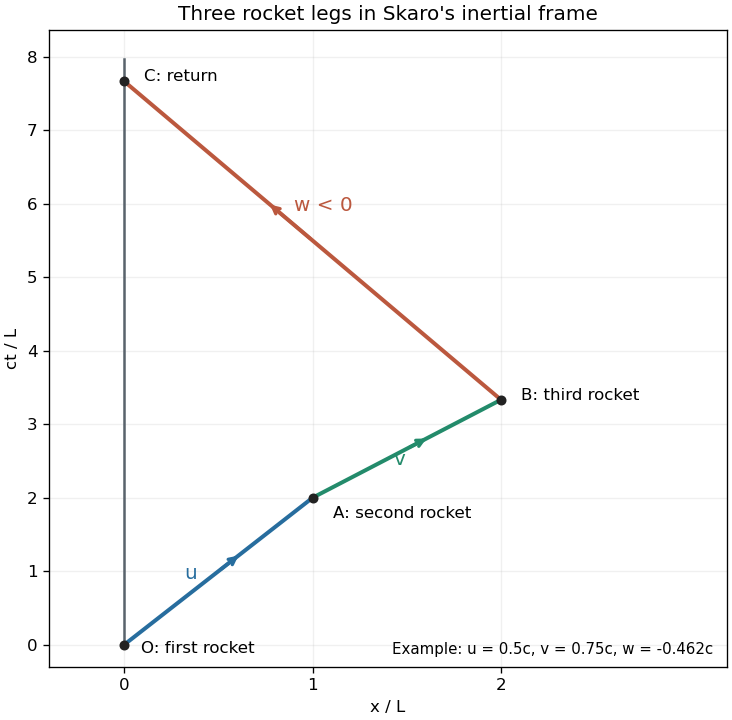

The diagram uses representative velocities satisfying the return condition; its event labels apply to the general formulas above. Skaro's elapsed time isOn a constant-velocity leg the traveller's proper time is , by time dilation. Neglecting the specified brief accelerations, Davros therefore ages byEvery contribution is positive because . Each square-root factor is smaller than one, so : Davros returns younger than a companion who remained on Skaro. The elapsed times compare the same departure and reunion events; they cannot be obtained by applying one time-dilation factor to the whole journey, whose worldline has three different velocities.
Past exam of the mathematics course of the University of Cambridge 2009 ia Paper 4 8E Solution Created 2026-09-24 Updated 2026-10-14
Suppose all infinite binary sequences could be listed as , where . Define another binary sequence by . It differs from the th listed sequence at its th entry, so it is absent from the list. This contradiction is Cantor's diagonal argument, proving thatTo transfer this result to , map a binary sequence toThis lies in because . If two sequences first differ at index , with and , thenThus is an injection, avoiding the ambiguous expansions that would arise from unrestricted binary digits in base two. An injection from an uncountable set into proves that .
For , a nondecreasing sequence bounded above can take only finitely many integer values, all lying between its first term and an integer upper bound. Every strict increase raises its value by at least one, so only finitely many strict increases occur. It is therefore eventually constant. Every such sequence has the formfor some finite list of integers. The set of finite integer lists is a countable set: at stage , list the tuples of length at most whose entries have absolute value at most , omitting earlier duplicates. Each stage is finite and every finite tuple occurs at some stage. Constant sequences give an injection of into the collection, soThis is the discrete-order phenomenon that bounded nondecreasing integer sequences are eventually constant.
For , use a different encoding, into rational partial sums:Each is a rational number, the sequence is nondecreasing, and . If two binary inputs first differ at , their th partial sums differ by , so their output sequences differ. This defines an injection of the uncountable binary-sequence set into . Thus bounded nondecreasing rational sequences are uncountable. Finally, every such rational sequence is also an admissible real sequence, so inclusion into is injective. ConsequentlyBoundedness and monotonicity force eventual constancy for integer values, but not for rational or real values; countability of the set of possible individual terms does not imply countability of all infinite sequences of those terms.
Past exam of the mathematics course of the University of Cambridge 2009 ia Paper 4 7E Solution Created 2026-09-24 Updated 2026-10-14
If is nonempty, take . The stated implication repeatedly gives for . These residues are all distinct: equality of two would give in the prime field , and the nonzero can be cancelled. They therefore exhaust the field. ThusEquivalently, a nonzero element generates the additive cyclic group of prime order.
Now assume . If with , translating by gives , contradicting the preceding result. Hence all translates are distinct. Translation defines equivalence classes on the collection of all -element subsets: two subsets are equivalent if one is a translate of the other, and each class contains exactly subsets. Since there are such subsets, their partition into classes givesThis is the free translation action on nontrivial subsets of a prime cyclic group.
The binomial theorem now gives, in the prime field,Starting with and applying this identity successively to the representatives proves for every residue . For nonzero , cancellation giveswhich is Fermat's little theorem, or for every integer and when .
The same vanishing of intermediate binomial coefficients proves for any commuting elements in a ring whose ring characteristic is , in particular for polynomials over . Applying this repeatedly to the terms of , and applying Fermat's little theorem to each coefficient, gives the Frobenius endomorphism identityThis is an equality of formal polynomials. It does not assert as a polynomial; that latter equality holds only after evaluating at elements of .
Past exam of the mathematics course of the University of Cambridge 2009 ia Paper 4 6E b Created 2026-09-24 Updated 2026-09-24
Past exam of the mathematics course of the University of Cambridge 2009 ia Paper 4 6E a Created 2026-09-24 Updated 2026-09-24
Past exam of the mathematics course of the University of Cambridge 2009 ia Paper 4 5E b Created 2026-09-24 Updated 2026-09-24
Past exam of the mathematics course of the University of Cambridge 2009 ia Paper 4 5E a Created 2026-09-24 Updated 2026-09-24
Past exam of the mathematics course of the University of Cambridge 2009 ia Paper 4 4A c Created 2026-09-24 Updated 2026-09-24
Past exam of the mathematics course of the University of Cambridge 2009 ia Paper 4 4A b Created 2026-09-24 Updated 2026-09-24
Past exam of the mathematics course of the University of Cambridge 2009 ia Paper 4 4A a Created 2026-09-24 Updated 2026-09-24
Past exam of the mathematics course of the University of Cambridge 2009 ia Paper 4 3A Solution Created 2026-09-24 Updated 2026-10-14
Take upward as positive and let be the change in rocket mass during . The exhaust emitted has mass and, to first order, upward velocity . The linear momentum of the rocket and just-emitted gas changes byThe external gravitational impulse is to first order. Applying the momentum balance to this material system, rather than applying a fixed-mass formula to the rocket alone, gives the rocket equationThe term is the upward thrust.
For the specified mass loss and exhaust law, andThus the condition for strictly positive upward acceleration at launch isAt equality the initial thrust just balances the weight; under this particular exhaust law the acceleration becomes positive immediately afterwards. If the initial thrust is smaller than the weight and the rocket initially rests on a launch surface, a nonzero supporting force persists until a later lift-off, so the free-flight equation does not describe its earlier supported motion.
For immediate free flight, integrate the rocket equation with :This applies while and the nonrelativistic approximation remains valid. The formal divergence as the model's remaining mass approaches zero is not a prediction within that approximation.
For dimensional analysis, write the mass, length and time dimensions as . Then , , , , and . Both and have mass dimension, so is dimensionless; both terms in the boxed velocity have dimension . The launch inequality compares two forces, each of dimension .
Past exam of the mathematics course of the University of Cambridge 2009 ia Paper 4 2E b Created 2026-09-24 Updated 2026-09-24
Past exam of the mathematics course of the University of Cambridge 2009 ia Paper 4 2E a Created 2026-09-24 Updated 2026-09-24
Past exam of the mathematics course of the University of Cambridge 2009 ia Paper 4 1E Solution Created 2026-09-24 Updated 2026-10-14
Write and regard each binary relation as a subset of . Then is the reflexive closure of : every satisfies because . The relation is its symmetric closure. It is a reflexive relation since it contains , and means either or , either of which also gives .
For , a one-step chain is allowed because , so . If witnesses , the reversed chain witnesses , since is a symmetric relation. Finally, concatenate a chain from to with a chain from to to obtain a positive-length chain from to . Hence is a transitive relation as well, andThus is the transitive closure of a relation applied to .
Now suppose is an equivalence relation containing . Its reflexivity implies , hence . Its symmetry then implies , hence . Along a chain witnessing , every consecutive pair is -related. Induction on the chain length using transitivity gives : the one-step case is , and the last step joins to . ThereforeTogether with , this proves that is exactly the equivalence closure of . The reasoning also covers an empty , where all assertions about elements are vacuous.
Past exam of the mathematics course of the University of Cambridge 2009 ia Paper 4 12A b Created 2026-09-24 Updated 2026-09-24
There are unlisted articles, also show them or only show them.