
Past exam of the mathematics course of the University of Cambridge 2008 ii Paper 3 23H b Created 2026-09-24 Updated 2026-09-24
Past exam of the mathematics course of the University of Cambridge 2008 ii Paper 3 23H a Created 2026-09-24 Updated 2026-09-24
Past exam of the mathematics course of the University of Cambridge 2008 ii Paper 3 22H Solution Created 2026-09-24 Updated 2026-10-14
A nonconstant holomorphic map between compact connected Riemann surfaces has degree equal to the number of points in a fiber counted with local multiplicities. This number is independent of the target point. The Riemann-Hurwitz formula iswhere is the local degree at .
Choose a polynomial of degree with distinct roots and take the smooth compactification of . The affine curve is nonsingular, since simultaneous vanishing of the partial derivatives would require and a repeated root of . At infinity use , ; the equation becomes , which has two smooth points above with nonzero . These charts give a compact hyperelliptic curve, connected by the permitted path-connectedness result for the affine curve.
Past exam of the mathematics course of the University of Cambridge 2008 ii Paper 3 21F Solution Created 2026-09-24 Updated 2026-10-14
The real Stone-Weierstrass theorem states that a subalgebra on a compact Hausdorff space , containing constants and separating points, is dense in the uniform norm. Let be its uniform closure. Polynomial approximation to on a bounded interval shows that implies . Therefore is closed under pointwise maximum and minimum, since and .
Fix and . Point separation and constants supply, for each pair , a function agreeing with at both points. For fixed , finitely many open sets where cover ; their corresponding maximum satisfies everywhere and . The open sets where , as varies, cover . Choose finitely many and take their minimum . Then throughout . Approximating by members of proves the theorem.
Now let be the uniform closure of integer-coefficient polynomials on . It is a closed ring. Since , the integer-coefficient polynomials converge uniformly to , with error at most . Thus . Ring operations give every dyadic rational constant, and closure gives every real constant. Since , all real polynomials lie in . The Stone-Weierstrass theorem now yields , as in integer polynomial approximation away from zero and one.
On the answer is no. The constant function cannot be uniformly approximated by integer-coefficient polynomials: at zero every such polynomial has an integer value and therefore error at least .
Past exam of the mathematics course of the University of Cambridge 2008 ii Paper 3 20F Solution Created 2026-09-24 Updated 2026-10-14
Let identify the two points to . Take disjoint small open disks around the original points and let be their image; is a contractible wedge of two disks. Let , which is homeomorphic to a sphere with two punctures and retracts onto a circle. Then consists of two punctured disks, each retracting onto a circle.
In the Mayer–Vietoris sequence, the map has rank one and is surjective: both annular loops map to generators, with a possible orientation sign. Its kernel is , so . At degree zero the map is , with rank-one kernel. The preceding degree-one map is surjective, so exactness gives . Since is connected and both pieces have no higher homology,This illustrates homology after identifying two points on a sphere.
Past exam of the mathematics course of the University of Cambridge 2008 ii Paper 3 1H Solution Created 2026-09-24 Updated 2026-10-14
Put . Comparing the harmonic number with an integral gives . By the fundamental theorem of arithmetic, the finite Euler product expands as the sum of over positive integers whose prime factors are at most . It therefore includes every term of , andThe first strict inequality is the geometric-series bound for the logarithmic remainder; the last uses the telescoping series . Thus the prime reciprocal lower bound is
Past exam of the mathematics course of the University of Cambridge 2008 ii Paper 3 19G Solution Created 2026-09-24 Updated 2026-10-14
On a maximal torus element , the SU(2) representation has weights . A monomial with respective multiplicities has weight , givingFor , its weight- multiplicity is , and multiplicities are symmetric in . An irreducible contributes one at each weight , so subtracting adjacent multiplicities yields the symmetric powers of the three-dimensional SU2 representation decompositionIt contains the trivial representation once when is even, and never when is odd. ThereforeThe double cover identifies with the complexified standard three-dimensional representation. It is self-dual, so the same invariant dimensions apply to homogeneous polynomials. The quadratic form is invariant, and its powers give nonzero invariants in every even degree. Since each such degree has dimension one and each odd degree has dimension zero, every invariant is a polynomial in . There is no polynomial relation on , as seen by setting . Thus
Past exam of the mathematics course of the University of Cambridge 2008 ii Paper 3 18H b Created 2026-09-24 Updated 2026-09-24
Past exam of the mathematics course of the University of Cambridge 2008 ii Paper 3 18H a Created 2026-09-24 Updated 2026-09-24
Past exam of the mathematics course of the University of Cambridge 2008 ii Paper 3 17F Solution Created 2026-09-24 Updated 2026-10-14
The chromatic polynomial counts proper vertex colorings with labeled colors at positive integer . For an edge , the deletion-contraction recurrence for the chromatic polynomial is , where parallel edges in the contracted graph are merged. Induction on edges, starting from the edgeless polynomial , shows that the coefficients have alternating signs: the contracted graph has one fewer vertex, so subtracting its alternating polynomial reinforces the same signs. The leading coefficient stays one. The coefficient of decreases by one per added edge, hence it is . Thus , with , and all .
For a tree, choose a root, give it any of colors, and give every other vertex any of the colors different from its parent. This gives . Conversely, a graph with this polynomial has . The chromatic polynomial of a disjoint union is the product of those of its connected components, each divisible by . The given polynomial has a simple zero at zero, forcing a single connected component. A connected graph with edges is a tree. The converse holds.
Finally the polynomial determines the number of vertices, the number of edges and the chromatic number. If it equals that of the Turán graph , with , then has chromatic number , so has no , and has the maximum possible number of edges for such a graph. The equality case in Turán's theorem makes isomorphic to . This is the chromatic polynomial determines a Turán graph property. If , the graph is simply complete and its edge count already determines it.
Past exam of the mathematics course of the University of Cambridge 2008 ii Paper 3 16G Solution Created 2026-09-24 Updated 2026-10-14
A transitive set satisfies , equivalently . If is transitive and , choose with . Transitivity gives , so . Thus is transitive. If , then and transitivity implies , whence . Thus the power set is transitive as well.
The converse for the union is false: take . Then is transitive but is not. The power-set converse is true: if , then implies , so .
Define , and . This is a set by replacement and union, contains as a subset, and is transitive because taking a member advances one stage. Induction shows it is contained in every transitive set containing , proving the transitive closure property.
If the rank of a set is , thenEvery subset of has rank at most , and itself is an element of , proving the first formula. The second is transitive closure preserves set-theoretic rank. Here the convention is , not .
Past exam of the mathematics course of the University of Cambridge 2008 ii Paper 3 15E ii Created 2026-09-24 Updated 2026-09-24
Past exam of the mathematics course of the University of Cambridge 2008 ii Paper 3 15E i Created 2026-09-24 Updated 2026-09-24
Past exam of the mathematics course of the University of Cambridge 2008 ii Paper 3 14A c Created 2026-09-24 Updated 2026-09-24
Past exam of the mathematics course of the University of Cambridge 2008 ii Paper 3 14A b Created 2026-09-24 Updated 2026-09-24
Past exam of the mathematics course of the University of Cambridge 2008 ii Paper 3 14A a Created 2026-09-24 Updated 2026-10-14
Past exam of the mathematics course of the University of Cambridge 2008 ii Paper 3 13B Solution Created 2026-09-24 Updated 2026-10-14
For a small Fourier mode , , the inhibitor equation gives . The linearization of the cubic reaction at zero is . Thus the fast-inhibitor cubic activator growth rate isIt is an even function of , starts at , and tends to as . In terms of , its derivative is . If , the maxima occur at , withIf , the maximum is at and all modes decay. For , the zero state is unstable when , and the stability boundary iswhere this curve lies in the allowed parameter region.
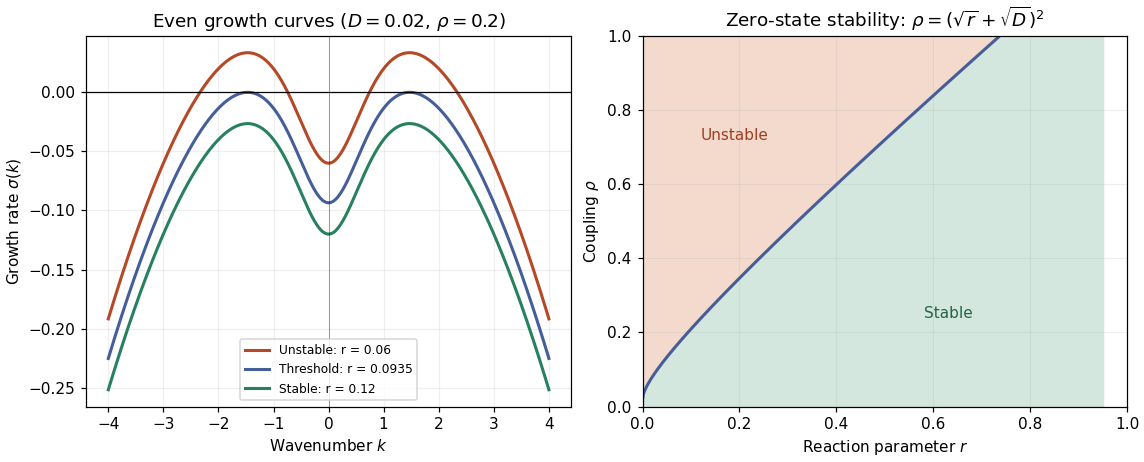

Putting , and negates both original equations and restores precisely the same form, because . Therefore the state has the corresponding boundary .
Past exam of the mathematics course of the University of Cambridge 2008 ii Paper 3 12F b Created 2026-09-24 Updated 2026-09-24
Past exam of the mathematics course of the University of Cambridge 2008 ii Paper 3 12F a Created 2026-09-24 Updated 2026-09-24
Past exam of the mathematics course of the University of Cambridge 2008 ii Paper 3 11H Solution Created 2026-09-24 Updated 2026-10-14
For positive odd coprime integers , the Jacobi reciprocity law isFactor . Since is not a square, some is odd. Choose a quadratic nonresidue modulo that , and choose residue one modulo each other . The Chinese remainder theorem provides a positive with these residues and with . Multiplicativity of the Jacobi symbol then gives .
Suppose only finitely many primes satisfy . They are coprime to . Repeat the preceding Chinese remainder theorem construction, additionally imposing at every odd and taking to avoid two. Since , Jacobi reciprocity gives . Factoring this Jacobi symbol over the prime factors of shows that at least one such prime has . But none of the listed primes divides , a contradiction. This proves the infinitely many prime quadratic nonresidues of a nonsquare integer assertion.
There are unlisted articles, also show them or only show them.