
Past exam of the mathematics course of the University of Cambridge 2007 ia Paper 4 4C Solution Created 2026-09-24 Updated 2026-10-14
The potential factors as , so its zeros are and , with a double zero at the origin. Its derivatives are and . Thus there is a local minimum , a local maximum and an inflection at . The potential tends to on the far left and on the far right. These features determine the left-hand sketch.
Put . Newton's second law gives the phase plane system , . Its conserved mechanical energy and trajectories areThe linearization at has eigenvalues , and the surrounding energy curves are closed, so it is a center equilibrium. At the eigenvalues are , giving a saddle equilibrium. The figure shows the cubic potential barrier phase portrait; arrows point right when and left when .
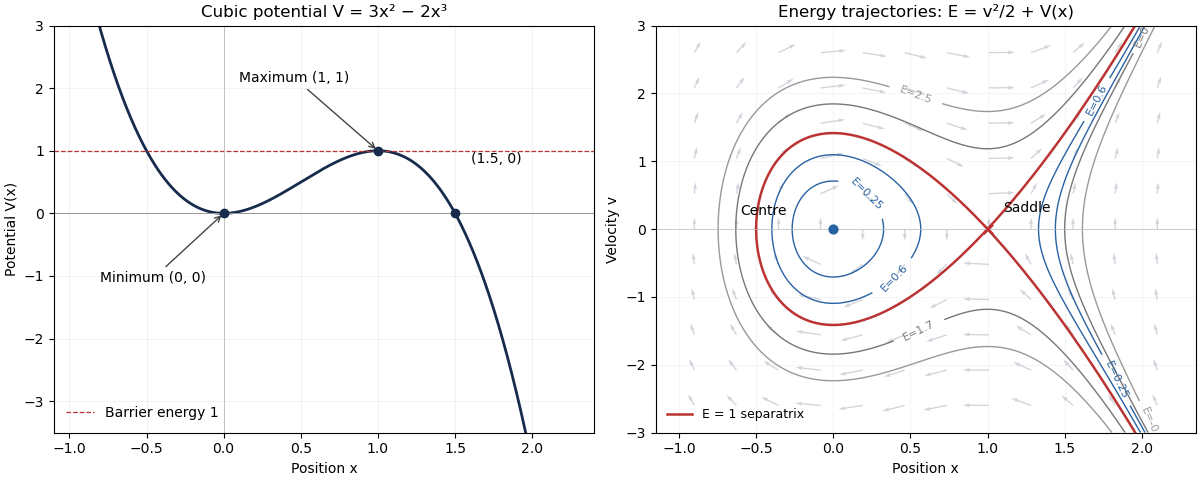

For , there are three turning-point roots of . The two leftmost enclose a closed orbit around the origin: the particle oscillates between them. There is also a separate open component to the right of the third root, where an incoming particle turns and escapes to . The closed orbits run clockwise in the plane.
For , the factorization gives the separatrixThe branch with is a homoclinic orbit: it leaves the saddle asymptotically, turns at and returns asymptotically. On , one branch approaches the saddle and the other departs towards infinity. Approaching the saddle takes infinite time. The saddle itself is also an equilibrium trajectory.
For , the particle can cross the barrier. There is one left turning point below ; an incoming particle passes through the well, turns on the left and escapes to the right. For , only a right-hand open component exists, with its turning point beyond . At , the stationary centre coexists with a right-hand open trajectory turning at . Thus negative energy does not imply trapping here: the cubic potential is unbounded below on the right.
Past exam of the mathematics course of the University of Cambridge 2007 ia Paper 4 3C Solution Created 2026-09-24 Updated 2026-10-14
Take upward velocity as positive, and consider the closed material system consisting of the rocket and the fuel it ejects during a short interval . Initially its mass and momentum are and . Let be the ejected mass, so the rocket's mass change is . At the end its velocity is , while the ejected gas has inertial velocity to first order; its downward relative velocity need not be downward in the inertial frame.
The final total momentum, to first order, isNeglect air resistance and take the gravitational acceleration constant. The external gravitational impulse on this material system is to first order. Newton's second law therefore gives , orThe positive thrust is because fuel loss makes . Applying to the rocket alone without accounting for the escaping momentum would give the wrong equation.
For constant and positive mass, divide by and integrate from release at :Thus the gravity-corrected rocket equation is equivalent to
Past exam of the mathematics course of the University of Cambridge 2007 ia Paper 4 2E Solution Created 2026-09-24 Updated 2026-10-14
Define the binomial coefficient as the number of -element subsets of an -element set. Equivalently it is : there are ordered lists of distinct elements, and each subset gives such lists. The empty subset gives .
Distinguish one element of the set. A -element subset either omits it, giving possibilities, or contains it and chooses its other elements from the remaining set, giving possibilities. These cases are disjoint and exhaustive, proving Pascal's identity:For the requested sum, fix and use mathematical induction on . At , both sides equal one. If the assertion holds at , adding the next summand giveswhere the last equality is Pascal's identity. Thus the induction proves the hockey-stick identity for all nonnegative :
Past exam of the mathematics course of the University of Cambridge 2007 ia Paper 4 1E ii Created 2026-09-24 Updated 2026-09-24
Past exam of the mathematics course of the University of Cambridge 2007 ia Paper 4 1E i Created 2026-09-24 Updated 2026-09-24
Past exam of the mathematics course of the University of Cambridge 2007 ia Paper 4 12C iv Created 2026-09-24 Updated 2026-09-24
Past exam of the mathematics course of the University of Cambridge 2007 ia Paper 4 12C iii Created 2026-09-24 Updated 2026-09-24
Past exam of the mathematics course of the University of Cambridge 2007 ia Paper 4 12C ii Created 2026-09-24 Updated 2026-09-24
Past exam of the mathematics course of the University of Cambridge 2007 ia Paper 4 12C i Created 2026-09-24 Updated 2026-09-24
Past exam of the mathematics course of the University of Cambridge 2007 ia Paper 4 11C Solution Created 2026-09-24 Updated 2026-10-14
For a fixed central gravitational source, the radial and transverse components of Newton's second law in polar coordinates areThe second equation gives , the constant specific angular momentum. Take by choosing the orientation of , and put . Writing and for derivatives with respect to ,Substituting into the radial equation and dividing by proves the Binet equationAt perihelion the velocity is tangential. The escape velocity is , so and . Consequently . The initial conditions are and . Solving the linear ordinary differential equation gives the parabolic Kepler orbitUsing angular momentum conservation again,On the outgoing branch is first reached at . Integrate from release at perihelion, using :More generally the same integral gives , the Barker equation for this parabolic orbit.
Past exam of the mathematics course of the University of Cambridge 2007 ia Paper 4 10C iii Created 2026-09-24 Updated 2026-09-24
Past exam of the mathematics course of the University of Cambridge 2007 ia Paper 4 10C ii Created 2026-09-24 Updated 2026-09-24
Past exam of the mathematics course of the University of Cambridge 2007 ia Paper 4 10C i Created 2026-09-24 Updated 2026-09-24
Past exam of the mathematics course of the University of Cambridge 2007 ia Paper 3 9A ii Created 2026-09-24 Updated 2026-09-24
Past exam of the mathematics course of the University of Cambridge 2007 ia Paper 3 9A i Created 2026-09-24 Updated 2026-09-24
Past exam of the mathematics course of the University of Cambridge 2007 ia Paper 3 8D Solution Created 2026-09-24 Updated 2026-10-14
Work on the Riemann sphere, including zero and infinity. For , two iterations give the identity and one does not, so . For , direct composition givesNeither nor is the identity; in particular . Thus
To prove the Möbius conjugacy normal forms, write a Möbius transformation as with . A finite fixed point satisfies . If , this quadratic has two roots counting multiplicity, and infinity is not fixed. If , the transformation is affine, infinity is fixed, and there is one further finite fixed point unless its slope is one. A nonidentity slope-one affine map is a nonzero translation with only infinity fixed. Thus any nonidentity Möbius transformation has one or two distinct fixed points.
If there are two, say , choose a Möbius transformation taking them to zero and infinity. For finite one can use ; the cases involving infinity use an affine map or reciprocal. The conjugate fixes zero and infinity. Fixing infinity sets its denominator's linear coefficient to zero, and fixing zero sets its numerator's constant term to zero; hence it is with .
If there is only one fixed point, send it to infinity. The conjugate has the affine form . If , would be another fixed point, which is impossible; therefore . Conjugating this translation by yields . The identity is already the scaling . This proves the classification, and invertibility excludes .
Conjugation carries fixed-point sets bijectively. The translation has exactly one fixed point, infinity. A nonidentity scaling has the two fixed points zero and infinity, while the identity fixes every point. Therefore is not conjugate to any scaling.
Finally let have finite positive order . A nonzero translation has infinite order, since its th iterate is after normalization. Thus is conjugate to , where has multiplicative order exactly . For , zero and infinity each form a singleton orbit. At a finite nonzero , an iterate returns precisely when , equivalently ; the least positive return time is . Conjugacy preserves orbit sizes. Hence the finite-order Möbius orbit sizes areFor exactly two points have size-one orbits; every other point has orbit size .
Past exam of the mathematics course of the University of Cambridge 2007 ia Paper 3 7D iv Created 2026-09-24 Updated 2026-09-24
Past exam of the mathematics course of the University of Cambridge 2007 ia Paper 3 7D iii Created 2026-09-24 Updated 2026-09-24
Past exam of the mathematics course of the University of Cambridge 2007 ia Paper 3 7D ii Created 2026-09-24 Updated 2026-09-24
Past exam of the mathematics course of the University of Cambridge 2007 ia Paper 3 7D i Created 2026-09-24 Updated 2026-10-14
There are unlisted articles, also show them or only show them.