
Past exam of the mathematics course of the University of Cambridge 2006 ia Paper 1 7B i Created 2026-09-24 Updated 2026-09-24
Past exam of the mathematics course of the University of Cambridge 2006 ia Paper 1 6C Solution Created 2026-09-24 Updated 2026-10-14
A positively oriented planar rotation matrix acts byFor a unit vector in three dimensions, the parallel and perpendicular orthogonal projections areOn the plane perpendicular to , the map preserves lengths and turns vectors through a positive right angle about . It squares to minus the identity there. Thus rotates that component, while the parallel component remains fixed. This proves the Rodrigues rotation formulaIts component form uses the Levi-Civita symbol:Since and , its matrix trace is .
For the given matrix, the matrix trace is with , so . In the stated angular range, . The antisymmetric entries giveTherefore the two axis-angle pairs areReversing the axis and the angle leaves the Rodrigues rotation formula unchanged, so these describe the same rotation.
Past exam of the mathematics course of the University of Cambridge 2006 ia Paper 1 5C Solution Created 2026-09-24 Updated 2026-10-14
For , the squared Euclidean norm of the orthogonal projection residual is nonnegative:This proves the Cauchy-Schwarz inequality . Equality holds exactly when is a scalar multiple of . If , equality is automatic. Equivalently, equality means the two vectors are linearly dependent, including the cases with a zero vector.
For a point equidistant from the coordinate vertices,must be independent of . Thus all are equal, and their sum is one. The centroid is thereforeFor every in the base probability simplex, the Cauchy-Schwarz inequality gives . Equality forces the same coordinates as . Thus is the unique closest point of a probability simplex to the origin.
Past exam of the mathematics course of the University of Cambridge 2006 ia Paper 1 4D Solution Created 2026-09-24 Updated 2026-10-14
Use these standard facts about a power series: it is absolutely convergent at every point strictly inside its radius of convergence and divergent at every point strictly outside it. Also, the triangle inequality implies that a sum or difference of two absolutely convergent series is absolutely convergent.
Suppose . If , choose a finite with and choose of complex modulus . The sum series and the series both converge absolutely there, socontradicting . Thus . Interchanging the series covers , proving the sum of power series with unequal radii of convergence rule:The argument also covers a zero radius or an infinite larger radius. When the two radii are equal, cancellation can enlarge the radius, so the inequality of the radii matters.
Past exam of the mathematics course of the University of Cambridge 2006 ia Paper 1 3F Solution Created 2026-09-24 Updated 2026-10-14
The series converges to when its partial sums have limit of a sequence : for every , there is such that for all .
Its averages are the Cesàro means of the sequence of partial sums. To prove their convergence, choose with for . ThenThe finite first sum divided by tends to zero. This proves the Cesàro theorem for convergent sequences in this setting, andThe converse fails. Take , so for odd and for even . The partial sums do not converge, butThus the alternating series is Cesàro summable without having an ordinary sum.
Past exam of the mathematics course of the University of Cambridge 2006 ia Paper 1 2A Solution Created 2026-09-24 Updated 2026-10-14
In the standard spherical coordinate system, is measured from the positive axis. The radial unit vector in spherical coordinates isThe coordinate forms of the elliptic paraboloid are given in the labelled parts below.
For the other surface, converts toFor , this is a two-sheeted hyperboloid, with two disconnected sheets starting at and opening along the axis. For , it is a one-sheet hyperboloid:Its waist is the circle , . Both are surfaces of revolution about the axis and approach the cone far from the origin.
The figure shows and ; scaling all coordinates by gives the other magnitudes.
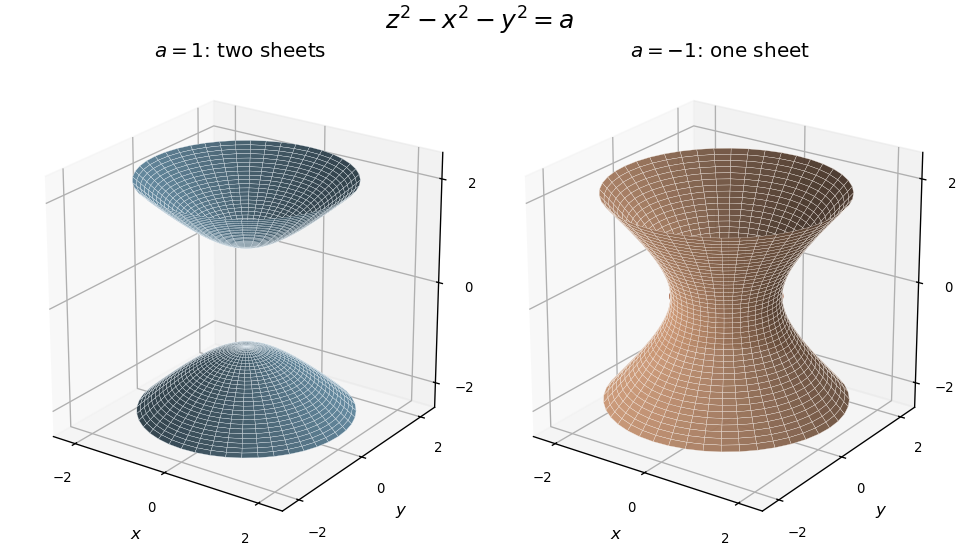
Two-sheeted and one-sheet hyperboloids for positive and negative values of a
. Details. 
Past exam of the mathematics course of the University of Cambridge 2006 ia Paper 1 1B Solution Created 2026-09-24 Updated 2026-10-14
The gradient of is . On the upper cone, its Euclidean norm is . Thus the upward unit normal to an upper circular cone isPut and . The hypotheses imply and . The Cauchy-Schwarz inequality therefore givesThis is also a direct instance of self-duality of a second-order cone: both and the chosen unit normal belong to the closed Lorentz cone.
Past exam of the mathematics course of the University of Cambridge 2006 ia Paper 1 12D Solution Created 2026-09-24 Updated 2026-10-14
For a bounded function on an interval , write for its oscillation of a function on an interval. For a partition , the difference between its upper Darboux sum and lower Darboux sum is . The Riemann integrability criterion says that this can be made arbitrarily small.
Since , choose good partitions for the two functions and take their common refinement. Darboux sum refinement monotonicity makes both oscillation sums small on this refinement, so their sum is Riemann integrable. The same argument handles differences and scalar multiples.
Both and are Lipschitz continuous with constant one. Thus and . This calculation shows that Lipschitz composition preserves Riemann integrability, so the positive part and the absolute value are integrable.
The converse for the absolute value is false. Define on rational numbers and on irrational numbers. Then is integrable, but every interval has supremum one and infimum minus one, so every Darboux difference for is . Hence is not Riemann integrable.
Finally,is integrable by the closure properties just proved. This establishes that Riemann integrability is closed under addition and maximum.
A countable supremum can fail, even for a uniformly bounded family. Enumerate the rational points of as and set . Each singleton indicator function is Riemann integrable with integral zero: isolate its single nonzero point in intervals of arbitrarily small total length. Butis the nonintegrable Dirichlet function. This proves that a pointwise supremum need not preserve Riemann integrability.
Past exam of the mathematics course of the University of Cambridge 2006 ia Paper 1 11F Solution Created 2026-09-24 Updated 2026-10-14
A real sequence has limit if, for every , there is such that for all . It tends to if, for every real , eventually ; it tends to if eventually for every real .
The Bolzano-Weierstrass theorem states that every bounded sequence of real numbers has a real convergent subsequence. This proves the claim for bounded sequences. If the sequence is unbounded above, every tail remains unbounded above because a finite prefix is bounded. Choose indices increasing with . This subsequence tends to . If it is unbounded below, choose to obtain a subsequence tending to . This proves the extended real subsequence theorem.
For the final example, a bounded sequence with vanishing increments need not converge. TakeThe mean value theorem givesNevertheless, along , the square-root rounding error tends to zero, so . Along , it tends to . These two subsequences have different limits, proving nonconvergence.
Past exam of the mathematics course of the University of Cambridge 2006 ia Paper 1 10E Solution Created 2026-09-24 Updated 2026-10-14
The Taylor formula with integral remainder isFor , this is the fundamental theorem of calculus. Integration by parts givesRearranging and applying mathematical induction proves the displayed expansion. The oriented integral also covers .
For , the chain rule and product rule giveThusBecause Gaussian decay dominates every power, as . Hence , and the derivative formula extends continuously to zero. Repeating the argument replaces by another polynomial at each step: . All derivative difference quotients at zero tend to zero, so the polynomial multiples of a Gaussian flat function are smooth functions withThe Taylor polynomial about zero is therefore identically zero for every degree, andA nonzero polynomial has only finitely many roots of a polynomial, so for every sufficiently small nonzero . At each such fixed , this remainder never tends to zero. The flat function is therefore smooth but not real analytic at zero.
Past exam of the mathematics course of the University of Cambridge 2005 ii Paper 4 9C ii Created 2026-09-24 Updated 2026-09-24
Past exam of the mathematics course of the University of Cambridge 2005 ii Paper 4 9C i Created 2026-09-24 Updated 2026-10-14
Past exam of the mathematics course of the University of Cambridge 2005 ii Paper 4 8A Solution Created 2026-09-24 Updated 2026-10-14
At zero an ordinary point requires to be analytic. A regular singular point requires and to extend analytically to zero, with at least one of failing to be analytic if “singular” excludes ordinary points.
Put and . Differentiation gives and , so the transformed equation isThe point at infinity is ordinary precisely when both transformed coefficients are analytic at . Solving these conditions for the original coefficients giveswith analytic near zero; the sign can be absorbed into the arbitrary analytic .
If the only singular point on the sphere is the regular singularity at zero, then and are entire. The condition at infinity makes the first tend to and the second to . By Liouville theorem they are respectively the constants and . Thus the unique equation iswith general solution . Zero is genuinely regular singular and infinity is ordinary. If “no other singular points” were restricted to finite points only, the general coefficients would instead be and with entire ; the preceding question about infinity indicates the spherical interpretation.
Past exam of the mathematics course of the University of Cambridge 2005 ii Paper 4 7B Solution Created 2026-09-24 Updated 2026-10-14
The fixed points are and . The Jacobian matrix isAt the origin its eigenvalues are , so it is a saddle with stable direction the y-axis. At either other fixed point, the characteristic polynomial is , giving eigenvalues . Thus both are stable foci. The nullclines are , and . In the right half-plane grows below and decreases above it; in the left half-plane these horizontal arrows reverse. Vertically, increases below and decreases above it.
A global argument determines the requested omega-limit sets, rather than guessing from the local phase portrait. For , use the quadratic-logarithmic Lyapunov function for a feedback systemIts sublevel sets are compact and bounded away from , so trajectories starting in either half-plane exist for all positive time and stay in such a set. Since decreases, it tends to a limit, and is constant on the omega-limit set. Every point of that set therefore has . Invariance then requires , so only the corresponding focus can occur. Also preserves its sign.
ConsequentlyOn , the exact solution is . The phase portrait below shows this stable axis, the nullclines and the spiral attraction in each half-plane.
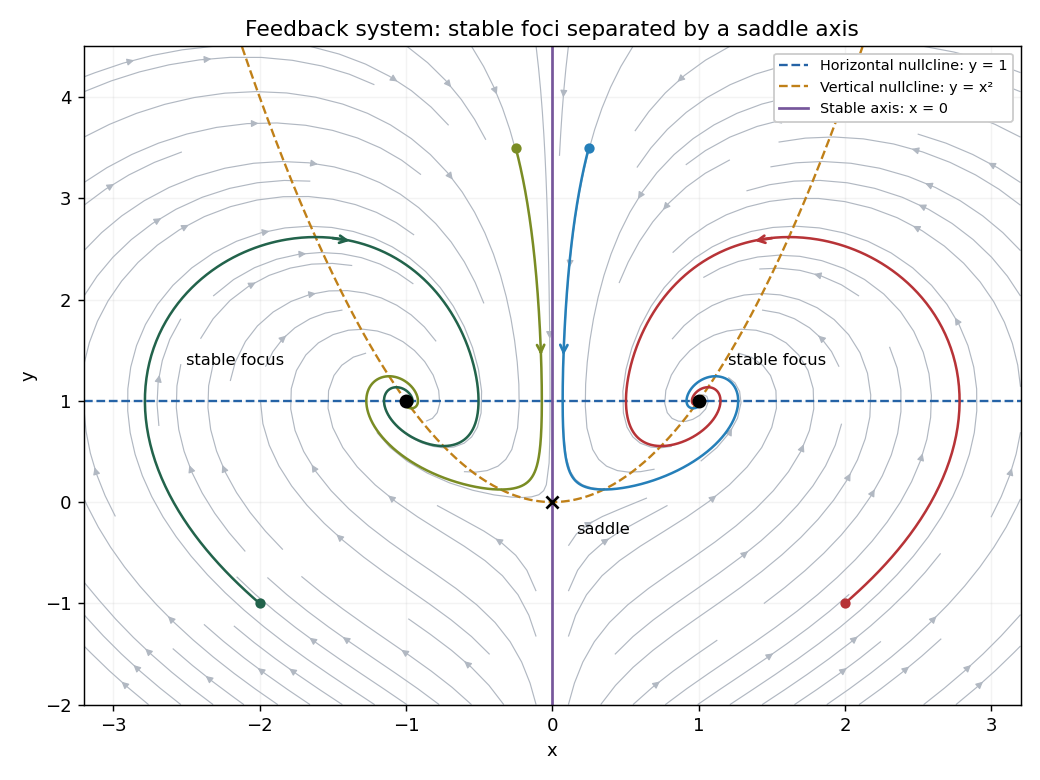
Phase portrait with a saddle at the origin and stable foci at plus or minus one, one
. Details. 
Past exam of the mathematics course of the University of Cambridge 2005 ii Paper 4 6E c Created 2026-09-24 Updated 2026-09-24
Past exam of the mathematics course of the University of Cambridge 2005 ii Paper 4 6E b Created 2026-09-24 Updated 2026-09-24
Past exam of the mathematics course of the University of Cambridge 2005 ii Paper 4 6E a Created 2026-09-24 Updated 2026-09-24
Past exam of the mathematics course of the University of Cambridge 2005 ii Paper 4 5I Solution Created 2026-09-24 Updated 2026-10-14
The first two commands create vectors of observed successes and corresponding numbers of trials. The next two create the class labels and convert them into an R factor, so the labels are treated categorically. The final command fits a grouped-binomial logistic regression, using the proportions as responses and trial totals as binomial weights, and prints its summary. The model is , with class a as reference.
The intercept estimates the log odds in class a. Its value corresponds to probability . The class-b coefficient is the estimated increase in log odds, about , so the fitted probability in class b is and the estimated odds ratio is . The printed standard errors measure uncertainty in these estimated coefficients. The z values are estimate divided by standard error: the intercept tests whether the class-a probability is , while the class-b z value tests equal class probabilities. The two-sided normal-reference P-value for the latter is about , so it is just above a conventional threshold; this is a borderline result rather than strong evidence of a class effect.
The residual deviance compares the fitted two-parameter model with the four-probability saturated model. Its value on residual degrees of freedom is small relative to a reference, with approximate tail probability . There is no evidence of lack of fit by that check. Four Fisher scoring iterations were needed for numerical fitting. These interpretations presume independent binomial counts and the usual large-sample approximations; weights here encode trial counts, not extra independent observations.
Past exam of the mathematics course of the University of Cambridge 2005 ii Paper 4 4J Solution Created 2026-09-24 Updated 2026-10-14
Reliable transmission at rate means that there is a sequence of binary block codes of lengths , message counts with , and decoding error probabilities tending to zero. The Shannon second coding theorem identifies the supremum of reliable rates with the channel capacity.
For a binary symmetric channel, the conditional entropy of the output given any input bit is . The output entropy is at most one bit and attains one for uniform input, so the maximum mutual information isAll rates strictly below are achievable, and rates above are not reliable; this states the supremum without claiming achievability of every boundary rate under every convention.
For very small , the capacity is close to one, with . At , the output is independent of the input and capacity is zero. For , flipping every received bit converts the channel to crossover probability ; its capacity is unchanged because . At the deterministic bit flip is perfectly reversible.
Past exam of the mathematics course of the University of Cambridge 2005 ii Paper 4 3G Solution Created 2026-09-24 Updated 2026-10-14
Suppose a connected subset contains distinct points . The distance function is -Lipschitz, and its image on is connected and contains and . It therefore contains the whole interval between those values. A Lipschitz map cannot increase Hausdorff dimension: taking images of arbitrarily fine covers multiplies their diameter powers by at most a fixed constant. Since a nondegenerate interval has Hausdorff dimension one, , contradicting . Thus every connected subset is a singleton, so is totally disconnected.
A Möbius transformation pairs two disks when it maps their boundary circles to one another and takes the exterior of the first disk onto the interior of the second. Two pairs of disks with disjoint interiors give the ping-pong lemma construction of a free two-generator group. Tangencies are allowed in the convention suggested by the question; this is often called a Tangent-disk Schottky group, rather than a strictly separated Schottky group.
Here is a concrete configuration that also makes the dimension argument precise. Take and . The first pairs the half-plane disks and , which are disks on the sphere tangent at infinity. The second pairs and , tangent at zero; their interiors are also disjoint from the half-plane disks. These pairings give a free discrete Kleinian group by ping-pong lemma, with a nonempty open fundamental region.
Set . Conjugating the subgroup generated by by gives matricesThe product of the second matrix with the first is . These are the standard parabolic generators of the principal level-two modular group, whose ideal-quadrilateral fundamental region tiles the upper half-plane and whose Kleinian limit set is the entire extended real line. Consequently the original group's Kleinian limit set contains the circle , as well as its image under , the distinct tangent circle .
It follows that the limit set has Hausdorff dimension at least one and is not homeomorphic to a circle. Indeed a proper subset of a circle cannot itself be a circle: after deleting a missing point it lies in a line, which cannot contain an embedded circle. A space containing two distinct complete circles thus cannot be homeomorphic to a single circle. This explains why dimension at least one does not force circle topology. The tangent-circle terminology is consistent with the primary discussion of T-Schottky configurations in arxiv.org/pdf/math/0701572 .
There are unlisted articles, also show them or only show them.