
Scalar Created 2026-09-24 Updated 2026-09-24
Vector Created 2026-09-24 Updated 2026-10-14
A vector is an element of a vector space. Its defining operations are vector addition and scalar multiplication. An arrow in a Euclidean space is one example; a polynomial or a function can also be a vector when the chosen vector space uses the corresponding addition and scalar multiplication.
For instance, the polynomials and belong to the real vector space of polynomials of degree at most two. Their vector addition gives , and scalar multiplication gives . In the monomial basis these are the coordinate vectors , , and respectively. The vectors are the polynomials; these tuples are their representations in a chosen basis.
A general vector space does not itself prescribe lengths or angles. A norm supplies a size, while an inner product also supplies angle information and orthogonality. The familiar arrow geometry below belongs to Euclidean vectors, where this extra structure is available.
Basis Created 2026-09-24 Updated 2026-10-14
A basis is a linearly independent spanning set of vectors in a vector space. Every vector is a unique finite linear combination of basis vectors. Independence supplies uniqueness, and spanning supplies existence. An ordered basis turns the coefficients into a coordinate vector.
For , the matrix with these vectors as columns isHence the coordinate vector of is , and recovers the usual coordinates. The determinant is nonzero, so this recovery works for every vector in . A basis need not have perpendicular or unit-length vectors; an orthonormal basis adds those geometric conveniences when an inner product is available.
The point of changing basis is to simplify the operation being studied. Diagonalization uses an eigenbasis to turn a coupled linear map into independent scalings. In a space of polynomials, the basis makes differentiation easy to encode, while orthogonal polynomials can make approximation errors easier to measure. Gilbert Strang's MIT lecture on independence, basis and dimension develops this connection between attainable columns, redundant columns and coordinates.[ref]
https://ocw.mit.edu/courses/18-06sc-linear-algebra-fall-2011/. Strang, MIT 18.06SC, Independence, Basis and Dimension
Linear independence Created 2026-09-24 Updated 2026-10-31
In a vector space over a specified field , a finite family of vectors is linearly independent when, for coefficients ,Here the left-hand zero is the zero vector, while the right-hand zeros belong to the field . Thus linear independence excludes every nontrivial linear relation. For an infinite family, require this condition for every finite subfamily.[ref]
https://ocw.mit.edu/courses/18-06sc-linear-algebra-fall-2011/0bbc30e3f1d7933ea07a2d2e9ab050d9_MIT18_06SCF11_Ses1.9sum.pdf. MIT 18.06SC, Strang lecture summary 9, p. 1: linear independence
For and over the real numbers, the linear relation gives and . Adding and subtracting yields , hence . This verifies linear independence directly and explains why the linear combination giving has exactly the coefficients .
A linearly independent family cannot contain the zero vector: a coefficient of on that entry and on every other entry would be a nontrivial linear relation. The empty family is linearly independent, because its empty sum is the zero vector and there are no coefficients that could be nonzero. Linear independence identifies a collection without redundant vectors; combined with a spanning set, it gives a basis. The uniqueness of linear combination coefficients makes its representations unambiguous.
Direct sum Created 2026-09-24 Updated 2026-10-14
The direct sum of two vector spaces consists of pairs with componentwise operations. A vector space is an internal direct sum of subspaces and exactly when every vector has a unique expression with and .
Scalar multiple Created 2026-09-24 Updated 2026-10-03
Linear combination Created 2026-09-24 Updated 2026-10-14
Let be a vector space over a specified field , and let . A linear combination is a finite sumThe coefficients are scalars from that same field; each term uses scalar multiplication, and the terms are joined by vector addition. For coefficients in the real numbers, negative values reverse arrows and fractional values scale them by fractional amounts. The collection of attainable vectors is the linear span. The column picture in Strang's MIT notes interprets solving a linear system as choosing coefficients to reach a target vector.[ref]
https://ocw.mit.edu/courses/18-06sc-linear-algebra-fall-2011/6913aa2f37dada8fdda334168b30339b_MIT18_06SCF11_Ses1.1sum.pdf. MIT 18.06SC, Strang lecture summary 1, pp. 2–3: the column picture
For a concrete calculation over the real numbers, takeThen . More generally, solving and givesEvery vector in the Euclidean plane is therefore a linear combination of , so their linear span is all of . The target has coefficients ; the target has coefficients , since . The displayed formula also makes the coefficients unique. Consequently is an ordered basis, with coordinate vector .
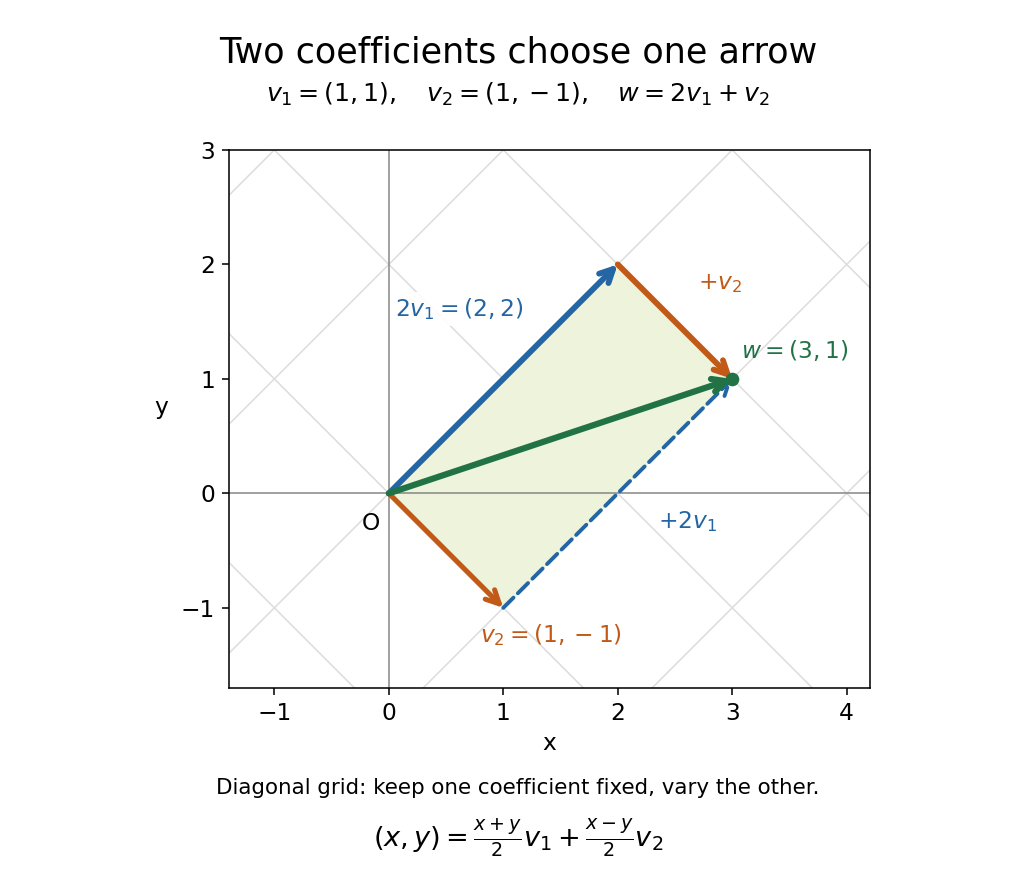

The payoff is a reusable language for synthesis: linear combinations build vectors from chosen ingredients, linear span decides which targets are reachable, and linear independence decides whether the coefficients are unique. The ingredients can also be polynomials or functions, as long as they belong to a vector space over the specified field.
Tensor power Created 2026-09-24 Updated 2026-10-14
Vector subspace Created 2026-09-24 Updated 2026-10-14
A vector subspace is a nonempty subset of a vector space closed under vector addition and scalar multiplication, and is therefore itself a vector space. Equivalently, whenever belong to the subset, so does for all allowed scalars . In particular it contains the zero vector.
For example, the plane is a vector subspace, with basis . Indeed every element is . The parallel plane misses the zero vector and is an affine subspace instead. Homogeneous constraints produce vector subspaces: is the kernel of the linear map . This lets us describe all solutions of a homogeneous linear equation through a basis of its kernel.
Linear span Created 2026-09-24 Updated 2026-10-14
The linear span of a subset of a vector space is the set of all finite linear combinations of elements of . It is the smallest vector subspace containing : every vector subspace containing the original vectors must contain their sums and scalar multiples.
In , the linear span of is a line, the linear span of is the plane , and adding gives all of . Adding to the first set changes none of its attainable vectors, because it is already a scalar multiple of . Thus a spanning set can contain redundant generators; linear independence identifies when this redundancy is absent. In an infinite-dimensional space, an algebraic linear span still uses finite sums; a closed linear span can also include limits in a specified norm.
Vector space over a finite field Created 2026-09-24 Updated 2026-10-05
If is a finite field, a vector space of finite dimension over has elements. Every infinite-dimensional vector space over is an infinite elementary abelian -group under addition.
Tautological bundle Created 2026-09-24 Updated 2026-10-14
The tautological bundle over a projective space has as its fiber over a line precisely that line. The real tautological line bundle over has first Stiefel-Whitney class equal to the degree-one generator.
Orientation of a vector bundle Created 2026-09-24 Updated 2026-10-14
This is a fiberwise orientation compatible with local trivializations of a vector bundle. An -orientation of a rank- vector bundle is a coherent choice of generator of for every fiber, equivalently a Thom class with the corresponding fiberwise restriction.
Tensor product of vector bundles Created 2026-09-24 Updated 2026-09-28
The tensor product of vector bundles is formed fiberwise. Tensor products of local trivializations have transition functions given by tensor products of the original transition matrices.
Growth bound for homogeneous linear classifiers Created 2026-09-24 Updated 2026-09-24
The signs of homogeneous linear forms on have VC dimension at most . The Sauer-Shelah growth bound therefore gives
Quadratic feature map Created 2026-09-24 Updated 2026-09-24
VC dimension upper bound for Euclidean balls Created 2026-09-24 Updated 2026-09-24
The indicators of closed Euclidean balls in have VC dimension at most . Indeed,wherebelongs to the span of .
Hamiltonian field equation Created 2026-09-24 Updated 2026-09-24
For a complex field , the canonical Hamiltonian evolution conventionis accompanied by its complex conjugate equation.
Color-focused arithmetic progression Created 2026-09-24 Updated 2026-09-24
Several monochromatic arithmetic progressions are color-focused when they have different colors and extend by one further term to the same point. Such focused families give an elementary induction proof of the length-three case of the Van der Waerden theorem.
Strengthened Van der Waerden theorem Created 2026-09-24 Updated 2026-10-05
For all positive integers , some has the following property: every -coloring of contains for whichis monochromatic. Thus the common difference has the same color as the progression.
There are unlisted articles, also show them or only show them.