
Atmospheric escape Created 2026-09-24 Updated 2026-09-24
Atmospheric escape removes gas from a planet through thermal motion, hydrodynamic outflow, photochemistry, and interactions with stellar radiation and plasma.
Exoplanet emission spectrum Created 2026-09-24 Updated 2026-10-06
An exoplanet emission spectrum is the wavelength-dependent thermal radiation emerging from the planet. Vertical temperature gradients turn opacity differences into absorption or emission features.
Exoplanet transmission spectrum Created 2026-09-24 Updated 2026-10-06
An exoplanet transmission spectrum measures the wavelength-dependent area blocked as starlight passes tangentially through the atmosphere during transit.
Exoplanet secondary eclipse Created 2026-09-24 Updated 2026-10-14
Irradiated planetary atmosphere Created 2026-09-24 Updated 2026-09-28
An irradiated planetary atmosphere receives stellar energy from above while internal heat emerges from below. Their competition creates radiative, convective, and sometimes thermally inverted regions.
First excited state Created 2026-09-24 Updated 2026-10-14
Level repulsion in a two-level Hamiltonian Created 2026-09-24 Updated 2026-09-24
Resonant two-to-one oscillator coupling Created 2026-09-24 Updated 2026-09-24
For oscillators of frequencies and , the perturbationpreserves . On the energy- basis , it is the matrixso the symmetric and antisymmetric combinations are exact eigenstates with shifts .
Added mass of an evanescent fluid layer Created 2026-09-24 Updated 2026-09-24
Spring-supported acoustic membrane wave Created 2026-09-24 Updated 2026-09-29
Euler circuit criterion Created 2026-09-24 Updated 2026-10-14
Let be a finite undirected multigraph, allowing self-loops and distinct parallel edges, with . Thenwhere is the edge support of a graph, and vertex degrees count each self-loop twice. There is no lower bound of three on the number of vertices. If , the zero-length convention gives an Euler circuit exactly when .[ref]
The two requirements are independent: two separate vertices, each carrying a self-loop, have even vertex degrees but disconnected edge support of a graph, so no Euler circuit can cover both edges.
Necessity follows because a single trail cannot cover edges in different connected components of a graph, while a closed trail pairs all arriving and departing incidences, including those at its starting vertex. For sufficiency, extend a trail using unused edges until no extension is possible. Even vertex degree parity prevents it from stopping anywhere except its starting vertex: a different stopping vertex would have an odd number of used incidences and hence at least one unused incidence. The result is a closed trail.
If unused edges remain, connectivity of the edge support of a graph supplies a vertex on the current closed trail with an unused incident edge. Removing a closed trail leaves even unused vertex degrees, so the same argument constructs another closed trail from that vertex. Splice it into the existing record. The two trails use disjoint edge identities, so the splice repeats no edge. Each splice uses more edges; finiteness ensures termination with an Euler circuit. This is the constructive idea of Hierholzer's algorithm.
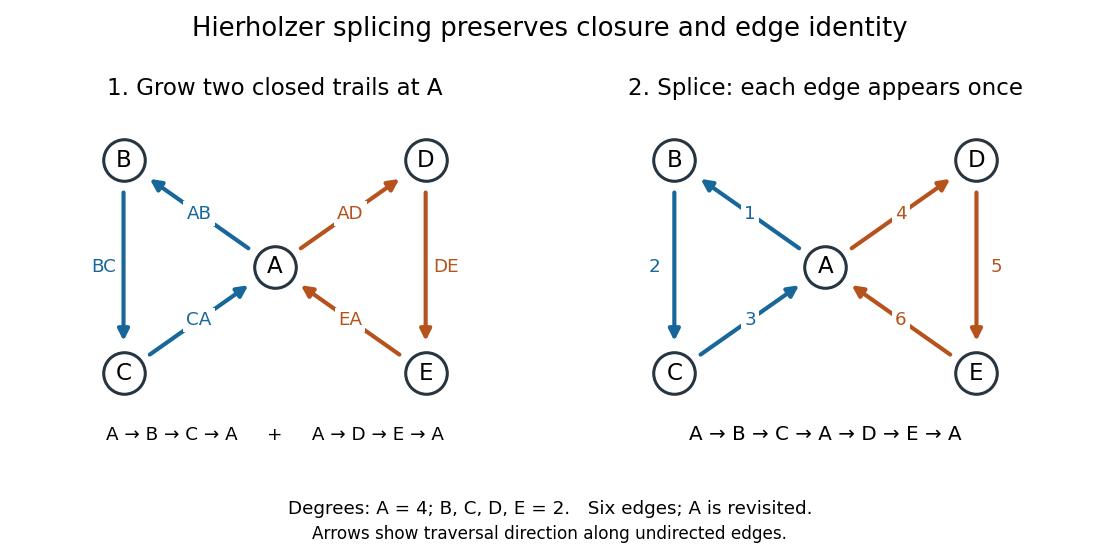
Hierholzer's algorithm inserts one closed trail into another at their shared vertex, using each of six edges exactly once
. Details. 
In the drawing, arrows indicate the chosen traversal direction along undirected edges. The first closed trail uses and the second uses . Insert the second at the final occurrence of in , giving . A reader can check consecutive endpoints, closure, and the six distinct edges directly. With multigraphs, perform the same check on edge identities, since endpoint pairs alone cannot distinguish parallel edges.
Gibbs-Duhem equation Created 2026-09-24 Updated 2026-10-18
The Gibbs-Duhem equation constrains changes of the intensive quantities describing one uniform thermodynamic phase. For a mixture with independently specified component amounts, its molar form isHere is entropy, is volume, is temperature, is pressure, is the amount of substance of component , and is its molar chemical potential. This assumes a simple compressible system whose bulk internal energy is an extensive quantity; additional work coordinates require additional terms.[ref]
Thermodynamics and Chemistry by Howard DeVoe. Howard DeVoe, Thermodynamics and Chemistry, second edition, version 10, §9.2.8, printed p. 240, equations 9.2.42–9.2.44
The proof exposes the source of the constraint. For internal energy , replication of the whole thermodynamic phase by a factor gives . The Euler theorem for homogeneous functions and the fundamental differential of internal energy therefore giveTaking the differential of the first equation produces all the terms in the second, plus . Subtraction proves the Gibbs-Duhem equation. Thus the constraint comes from two descriptions of the same state function, rather than an assumed microscopic interaction model.
At fixed temperature and pressure, divide by and introduce the mole fractions :The chemical potentials cannot be varied independently. In a two-component mixture, put and . Within a smooth single-thermodynamic phase region with ,One chemical potential fixes the other's change, but determining its absolute value still requires a reference value. This does not say : equality at phase coexistence concerns the same chemical species in different thermodynamic phases. Nor does the constraint say whenever temperature and pressure are fixed; changing composition still contributes to the Gibbs free energy.
Intermediate axis theorem Created 2026-09-24 Updated 2026-10-14
For a rigid body with three distinct positive principal moments of inertia and zero external torque about its centre of mass, steady rotation about the first or third principal axis is Lyapunov stable in angular velocity, while rotation about the intermediate principal axis is unstable. Here steady rotation means in the principal body frame, with constant . A small sideways perturbation remains small about the extreme principal moments of inertia, but generically grows about the intermediate one. Stable does not mean that the wobble decays: without damping, there is no asymptotic stability. Coincident principal moments of inertia and a stationary body are excluded.[ref]
3. The Motion of Rigid Bodies. Classical Dynamics by David Tong, §3.4.3, The Asymmetric Top: Stability, printed pp. 57–58, equations (3.40)–(3.45)
No external torque is needed for a body to tumble. Conservation of angular momentum fixes in the fixed space frame, but the body can turn relative to , so its angular velocity components in the principal body frame change. The torque-free rigid-body invariants constrain this motion. A supported gyroscope with gravitational torque has different governing assumptions.
Coplanarity in a torque-free axisymmetric rigid body Created 2026-09-24 Updated 2026-09-24
For principal moments and symmetry-axis unit vector , angular momentum and angular velocity obeyThus , , and the symmetry axis are coplanar at every instant.
Torque-free rigid-body invariants Created 2026-09-24 Updated 2026-09-24
The Euler equations for a torque-free rigid body conserve rotational kinetic energy and squared angular momentum,Their common level sets are the intersection of two ellipsoids in angular-velocity space.
Thermal rounding of a buckling transition Created 2026-09-24 Updated 2026-10-14
Thermal fluctuations smooth the zero-temperature pitchfork in filament buckling: the mean compression remains analytic and nonzero below the mechanical threshold, with rounding controlled by .
Heavy symmetric top Lagrangian Created 2026-09-24 Updated 2026-10-14
For a fixed point a distance from the centre of mass and inclination measured from the upward vertical,The spin and precession angles are cyclic.
Cyclic transitive point set Created 2026-09-24 Updated 2026-09-24
Edge Ramsey set Created 2026-09-24 Updated 2026-09-28
A finite Euclidean configuration is edge Ramsey when every finite edge coloring of a suitable finite Euclidean set contains a monochromatic isometric copy. The edge Ramsey configurations are exactly the equidistant sets, equivalently the vertex sets of regular simplices.
Regular polygon is a Euclidean Ramsey set Created 2026-09-24 Updated 2026-09-28
Every regular polygon is a Euclidean Ramsey set. Its cyclic rotation acts transitively on the vertices, so this is a special case of the Kriz theorem for cyclic transitive point sets.
There are unlisted articles, also show them or only show them.