
For , the derivatives are and . Substituting gives . The independent solutions have Wronskian on , so they form a fundamental system of solutions.
Divide the inhomogeneous linear differential equation by and use variation of parameters. Choosing integrals from one gives the particular solutionThus . The first boundary condition gives . The integral endpoint terms cancel when differentiating , so the second givesConsequentlyCollect the coefficient of on either side of . A suitable Green function isThe two pieces agree at , , and for . For an interior source point its derivative jump isThus multiplication by the leading coefficient gives unit in a ring source strength. Away from , both pieces solve the homogeneous linear differential equation. With continuous , the integral representation has the required second derivative and solves the equation pointwise in .
For uniqueness, the difference of two solutions is . Its boundary conditions give and , forcing . Hence the solution is unique. This is the mixed Green function for an Euler operator with exponents one and two.
A function on the open set is holomorphic if at every the complex limitexists. The limit is independent of the direction of approach.
A pole of order at means that in a punctured neighborhood, where extends holomorphically across and . Equivalently has a nonzero finite limit at .
For the given quotient, is equivalent, on putting , to , or . Thus all possible poles are , , with no additional nonreal solutions. At such a point,At the numerator does not vanish, so the pole has order two. At zero the numerator cancels one order:ThereforeThe numerator's cancellation at zero is why not every denominator zero produces the same pole order.
For , let denote the algebraic conjugate, not necessarily ordinary complex conjugation when . Conjugation respects multiplication, and . ThereforeIf is a unit in a ring, choose its inverse in the same ring. Then , and both norms are nonnegative integers, forcing . Conversely, if , then , so belongs to the ring. Thus is a unit in a ring exactly when .
For negative , the equation becomes . If , its integer solutions give the four units . If , the term forces , leaving . HenceFor , the element has field norm . Its powers , , are all units by multiplicative function and are distinct, since their positive real values strictly increase with . Thus has infinitely many units. This argument concerns the stated integer-coefficient ring; it does not replace it by a larger ring of algebraic integers.
Use the monomial basis , . Direct differentiation giveswith the endpoint terms zero. Repeated application therefore gives , while and . Each nilpotency index is exactly , soNextand hence . These real eigenvalues are distinct. A polynomial annihilates this operator exactly when it vanishes at all of them, givingThe commutator is diagonal in the displayed monomial basis. Since , are nonzero nilpotent linear map; a diagonalizable nilpotent map would have a diagonal matrix with all eigenvalues zero and thus be the zero map. Therefore only is diagonalizable. The calculation realizes raising and lowering on binary homogeneous polynomials.
The weight is strictly positive and all its polynomial moments are finite. Thus the given integral is a inner product: for a nonzero polynomial, its square is positive on a nonempty interval, so its weighted integral is strictly positive.
In the finite-dimensional vector space , subtract the orthogonal projection onto a finite-dimensional subspace of onto :This is monic, since the subtracted polynomial has lower degree, and is orthogonal to every lower-degree polynomial. If were two such monic polynomials, their difference would lie in and be orthogonal to that space. Taking its inner product with itself gives zero, hence the difference vanishes. This proves existence and uniqueness for every , with .
Odd moments vanish because the weight is even; the even moments areConsequently , while a monic quadratic orthogonal to has no linear term, and orthogonality to one gives its constant term . ThusFinally is also monic and orthogonal to every lower-degree polynomial, by the change of variable . Uniqueness implies . In particular is odd andThis is parity of monic orthogonal polynomials for an even weight.
The characteristic equation of a partial differential equation for is . Thus the two characteristic curve families are . Set and . The chain rule gives and , reducing the equation toIntegrating in the two independent characteristic coordinates gives , or . At , the value condition gives , while the derivative condition gives . Hence and , soDirect differentiation gives , and , verifying both the equation and the two data. The additive constants cancel in , so they do not create different solutions.
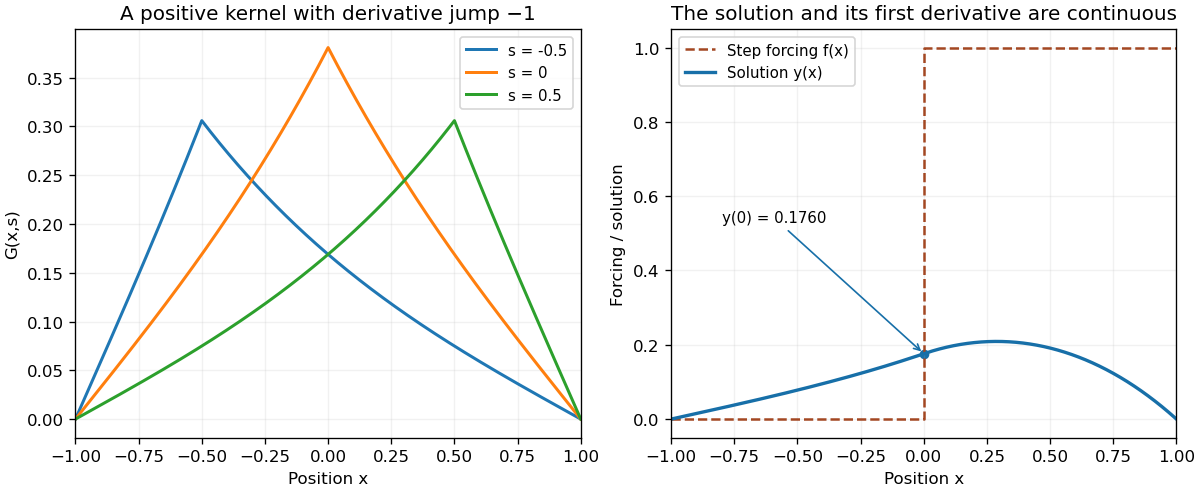
Write the equation as with . Homogeneous solutions vanishing at the left and right endpoints are and . Their Wronskian is . The Dirichlet Green kernel for minus second derivative plus one is thereforeIt vanishes at , is continuous at , and its first derivative has jump . Thus in the distributional derivative sense, with the sign appropriate to . Integration against gives the required boundary-value solution. The kernel is positive and symmetric, as is also apparent in the figure.
For the specified step forcing only contributes at , givingThe discontinuity in gives a piecewise twice-differentiable solution with continuous value and first derivative, rather than a jump in itself.

The fundamental theorem of calculus first gives . Integrating again, or differentiating the proposed expression twice and checking its initial values, yields the Volterra integral equationFor , the initial value problem is solved by . Its Picard iteration constructs the sine series directly. The base approximation is . Ifthen elementary integration givesSubstituting this finite sum in the next update, then shifting its index, proves the same formula with in place of . This is the required mathematical induction. The resulting partial sums converge to for every real , and uniformly on every bounded interval: the absolute terms on are bounded by the convergent series .
The printed update lists , which would leave unspecified if read literally. The usual Picard iteration, and the requested induction from , use the update starting at ; that intended convention is used here.
A holomorphic function with at every point is locally a conformal map. Write . Since and , , andThus the specified Möbius transformation is conformal throughout the disk. Expanding the two squared absolute values givesso maps the open unit disk into itself. Solving gives . Equivalently . Hence is its own inverse, proving both injectivity and surjectivity on the disk. Nonvanishing derivative establishes the local angle-preserving property; the explicit inverse supplies the separate global bijection claim.
Apply the residue theorem to on the upper semicircle of radius , traversed counterclockwise. Its sole enclosed pole is the double pole at , andOn the semicircular arc, , so the ML inequality bounds its contribution by . The real integral is absolutely convergent, since its integrand is at infinity. Taking in the contour identity yields
A closed curve has . A simple curve has no repeated points apart from the permitted equality of its two endpoints when it is closed. A smooth curve, in the regular contour-integration convention, has a continuous nonzero tangent ; piecewise smooth contours are treated by adding the integrals over their smooth pieces. For a continuous integrand, its contour integral is defined byFor the positively oriented circle, and . Direct parameter integration therefore givesFor , an elementary antiderivative is and its endpoint values agree because is an integer. For , the integrand of the parameter integral is the constant . No integral theorem is needed.
There are unlisted articles, also show them or only show them.