
Construct the vectors inductively by the Gram-Schmidt process, proving its needed properties directly. Suppose form an orthonormal basis of , and putFor every , taking an inner product with gives . Also , because otherwise would lie in the linear span of its predecessors, contrary to linear independence. DefineIt lies in , has unit norm, and is orthogonal to every with , since those vectors lie in . Writing gives . The same identity shows that span , completing the induction, including the empty sum at .
For uniqueness, any candidate expands in the basis . Orthogonality to every earlier , hence to every earlier , makes its first coefficients zero. Thus . Unit norm forces , and forces the positive sign. This proves uniqueness in the Gram-Schmidt process with positive normalization without assuming a projection theorem or any other major orthogonalization result.
Integrating , or taking the imaginary part of , givesThe Laplace transform convolution theorem states whenever the transforms and convolution are defined. Applying it to the Volterra integral equation gives , soSince , a second application of the convolution theorem yields the sine-kernel Volterra resolventThe transform argument assumes suitable growth for the transforms to exist. The resulting causal resolvent formula also applies to locally integrable forcing on finite intervals, as can be checked by substitution and exchanging integrals over a finite triangle.
The characteristic equations for a first-order quasilinear equation are , , , with characteristic parameter . Through the prescribed point they giveFor a nonzero projected initial point, the characteristic projections are rays from the origin, not trajectories crossing through the origin to the opposite ray. If , a classical solution graph requires , because the original equation reduces there to .
Parameterize the initial line by . Along its characteristic, , and . ThereforeDifferentiation verifies the equation, and substitution of verifies the initial data. Characteristic reachability for radial transport shows why the domain is this positive half-plane: each point there lies on precisely one characteristic from the data line. Rays in never meet that line, so their values are not determined by these data. Allowing a negative scaling factor would incorrectly join two different characteristic rays through a degenerate origin.
Since the exponential factor is positive, equilibria must have and . Thus . At either point the Jacobian matrix is . At its eigenvalues are , so this is a saddle point. At they are : the linearization has a centre equilibrium.
The requested first-order approximation follows by putting , : and . The linearized system conserves , giving the approximate ellipsesHowever, the printed nonlinear system has a weak repelling focus at , rather than a centre. A centre in the linearization need not be a nonlinear centre. Here that distinction can be proved explicitly, without relying on the numerical drift in the figure.
Put , , and . The weak focus of an exponential polynomial planar system has the local positive functionExpanding the vector field through cubic order and differentiating givesThe cubic correction cancels the cubic terms in the derivative of , and the quartic correction leaves the positive radial term . Since is positive and the angular velocity stays near , small nonzero trajectories spiral outward. Equivalently the reversed system has a strict local Lyapunov function and an asymptotically stable equilibrium. In particular, a periodic orbit sufficiently near the equilibrium is impossible, because would have to increase strictly and return to its starting value. This proves the failure of the printed centre assertion while retaining its correct linearized ellipse calculation.
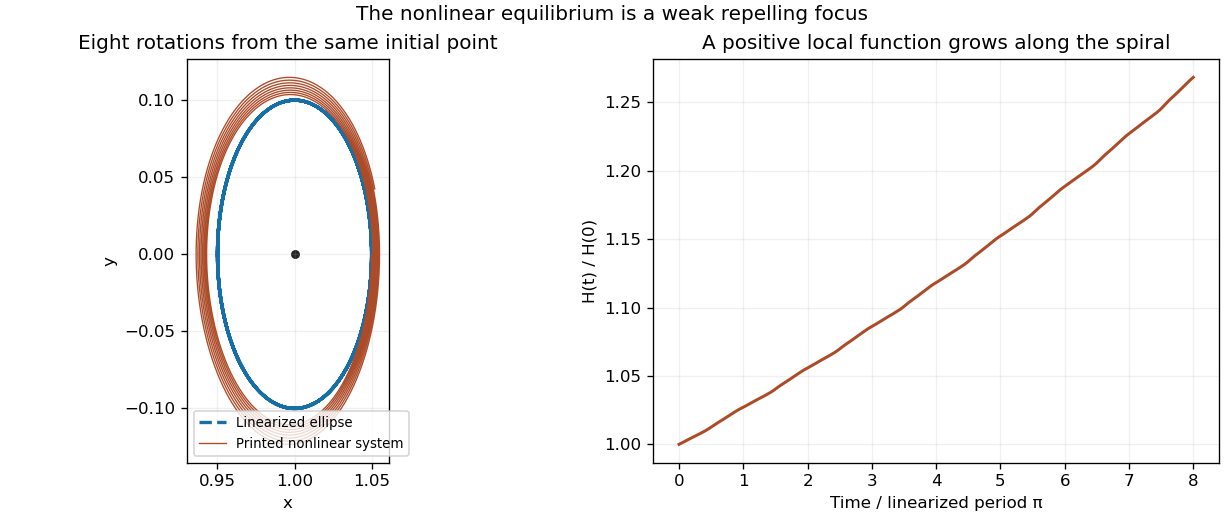
The linearized ellipses hide the nonlinear outward spiral
. Original fourth-order Runge-Kutta integration of the printed vector field, compared with its linearization from the same initial point. The local polynomial calculation, rather than the plot, proves the weak instability. Details.
A pole of order at means that near , where is holomorphic and . Equivalently its Laurent series has a finite principal part with leading nonzero term . The residue is the coefficient . For a simple pole, , this coefficient is , soFor , the zeros of the denominator are exactly , : this follows from . Each is simple, because . ThereforeThere are no other finite singularities. If infinity is included, it is an accumulation point of these poles, so it is not an isolated singularity to which the usual removable/pole/essential classification could be applied.
An ideal is an additive subgroup of a ring closed under multiplication by arbitrary ring elements; in a potentially noncommutative ring, a two-sided ideal must absorb multiplication on both sides. For a ring homomorphism , its kernel of a ring homomorphism contains zero, is closed under subtraction, and satisfies and . Thus is an ideal.
Define by . It is well-defined because two representatives differ by an element of , preserves addition and multiplication, is surjective by hypothesis, and is injective because its zero class is precisely . Therefore , the first isomorphism theorem for rings.
Apply this to the evaluation homomorphism , . Constants prove surjectivity, and division by shows that its kernel of a ring homomorphism is . Hence .
For affine polynomials and , direct integration gives . This is bilinear and symmetric, and for every nonzero . Thus it is an inner product.
The adjoint of differentiation on affine polynomials is determined by . Since , the left side is . Writing , the right side is . Equality for every forces , , henceThis is not simply negative differentiation: there are no endpoint conditions here that would remove the boundary term in an integration by parts argument.
Let be the minimal polynomial. If with , then , so . Conversely, if , write . If were invertible, the identity would imply , contradicting minimality of the degree. Thus has a nonzero kernel of a linear map, and is an eigenvalue. This proves the eigenvalue criterion using the minimal polynomial for roots in the field under consideration.
For the given matrix, direct expansion givesPut . Direct multiplication givesBy the Cayley-Hamilton theorem, divides ; the nonzero square rules out every smaller power. Therefore . Its sole eigenvalue is , but the size of the nilpotent part makes the minimum polynomial cubic rather than linear.
There are unlisted articles, also show them or only show them.