
A self-adjoint operator satisfies for every . The finite-dimensional finite-dimensional spectral theorem gives an orthonormal basis of eigenvectors and real eigenvalues; eigenvectors for distinct eigenvalues are orthogonal. Consequently a matrix represents a self-adjoint transformation in some, possibly nonorthonormal, basis exactly when it is diagonalizable with real eigenvalues.
For , the eigenvalues are , all distinct and real. Eigenvectors are , , and . Thus can represent a self-adjoint transformation after choosing a suitable basis.
For , the eigenvalue one has algebraic multiplicity two but its eigenspace has dimension one. The lower block is a nontrivial Jordan block, so the matrix is not diagonalizable. Hence cannot represent a self-adjoint transformation in any basis.
For , the eigenspace for two is spanned by and , and the eigenvalue-one eigenspace is spanned by . These three vectors form an eigenbasis. Therefore can represent a self-adjoint transformation. To see sufficiency on the given inner product space, first define the real diagonal transformation in an orthonormal basis and then apply the inverse of a diagonalizing basis change to obtain the requested matrix. Symmetry of the displayed matrix itself would be required only for an orthonormal representing basis.
The zero polynomial belongs to . If , linearity gives . If and , polynomial evaluation obeys , so . Thus is an ideal of the polynomial ring .
The vectors are linearly dependent in the -dimensional vector space. Their dependence supplies a nonzero polynomial of degree at most in . Hence this ideal is nonzero. A polynomial ring over a field is a Euclidean domain under degree, and every ideal in a Euclidean domain is principal. It follows that for a nonzero polynomial , which can be scaled uniquely to be monic.
For completeness, uniqueness follows because any two generators divide each other and hence differ by a nonzero constant; the monic normalization forces that constant to be one. Since divides the polynomial of degree at most constructed above, its degree is at most . The generator characterization givesThis is the minimal polynomial of a vector under a linear operator. If , the ideal is the whole ring and the unique monic generator is the constant polynomial one.
Write the principal part as . The characteristic curves satisfyor . Integration gives and . Thus take , . Their Jacobian determinant is , and their image is .
For , the chain rule givesThe first-derivative terms cancel exactly. The canonical form of a second-order partial differential equation isOn , . Differentiating this condition in and using givesHence and . Substitution into the value condition fixes their combined constant and yieldsDirect substitution verifies the PDE and both initial data. The cancellation illustrates a hyperbolic equation reduced by an exponential characteristic coordinate.
Rewrite the linear equation as . The initial value gives the unique solutionThe Picard iteration is its integral equationThe proposed formula holds for . If it holds at , termwise integration of the finite sum and giveThis proves the expression by induction. The exponential series then gives . Convergence is also uniform on every compact subinterval of , since is bounded there and the exponential majorant series converges. This is Picard iteration for a simple-pole linear differential equation.
Let . For , close the interval by the upper semicircle, counterclockwise. Its only enclosed pole is , with residue . The residue theorem givesOn , and . Hence the arc is bounded byby the supplied estimate, with parameter .
For , close below, with clockwise orientation. The pole at lies outside, and the exponential decays there. Parametrizing the lower arc yields the same bound with in place of . Its contribution again tends to zero, and no residue remains. Therefore
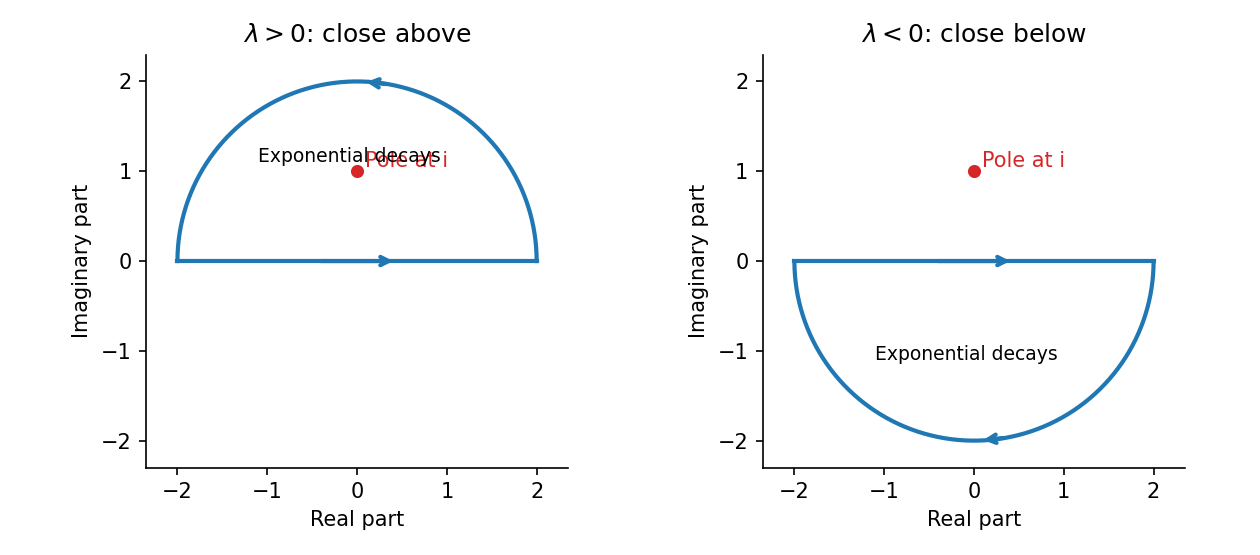
The exponential selects the half-plane in which the closing arc decays
. Details. This is the contour-decay mechanism behind Jordan's lemma; the pole contributes only when the decaying closure encloses it.
The hyperbolic cosine is entire and . Continuity makes it nonzero in a neighborhood of zero, so its reciprocal is holomorphic there and has a convergent Taylor series. Since and its reciprocal are even, all odd coefficients vanish.
Multiply the proposed expansion by :Coefficient comparison gives and , henceThe zeros of solve , so they are , . The nearest ones are , and they are simple because is nonzero there. The hyperbolic secant has genuine poles at these points and is holomorphic in the disk of radius . The radius of convergence of its Taylor series is therefore
Reduction modulo the prime preserves integer addition, multiplication, and one:Every congruence class has an integer representative, so the ring homomorphism is onto. Its kernel is exactly . The quotient is a field because every class not divisible by has a multiplicative inverse by Bézout's identity.
For the coefficientwise extension to the polynomial ring, addition is preserved term by term. If and , the coefficient of in their product is . Reducing it modulo gives , the coefficient in . Thus multiplication and one are preserved as well. Lift each coefficient of a polynomial over to an integer to prove surjectivity. The kernel isIndeed, its elements are precisely the polynomials whose coefficients are all divisible by .
In the binomial theorem expansion of , every intermediate coefficient is divisible by : the numerator contains the prime factor , while does not for . HenceFor , the last equality uses in characteristic two. This is an instance of the Frobenius endomorphism.
The minimal polynomial is the unique monic polynomial of least degree with . Existence follows from a linear dependence among powers of in the finite-dimensional vector space ; polynomial division proves uniqueness and that it divides every annihilating polynomial. The characteristic polynomial is , independent of basis because a change of basis conjugates the matrix.
WriteIn the cyclic basis, the companion matrix isFor , the displayed vector relation gives . Polynomial evaluation commutes with , so for every basis vector. Thus .
No nonzero polynomial of degree below can annihilate , since applying it to the cyclic vector would contradict independence of . Hence . Finally, direct expansion of , or induction along the last column, gives . ThereforeThe argument computes the determinant and annihilator directly and does not invoke the Cayley-Hamilton theorem.
The second equilibrium point equation gives . Substituting into the first gives , so . Put , with . ThenThe function is strictly increasing on , since . It starts at zero and tends to infinity, so it takes the value one exactly once. Moreover , so . This proves uniqueness of the stated equilibrium point.
At that point , and the Jacobian matrix isIts trace is and determinant . The characteristic discriminant is , so its two eigenvalues areThey are distinct and positive, with eigenvectors and respectively. Thus the linearized critical point is an unstable node. It is a hyperbolic equilibrium, so the original nonlinear equilibrium point is also locally repelling; this last observation is stronger than the requested linearized classification.
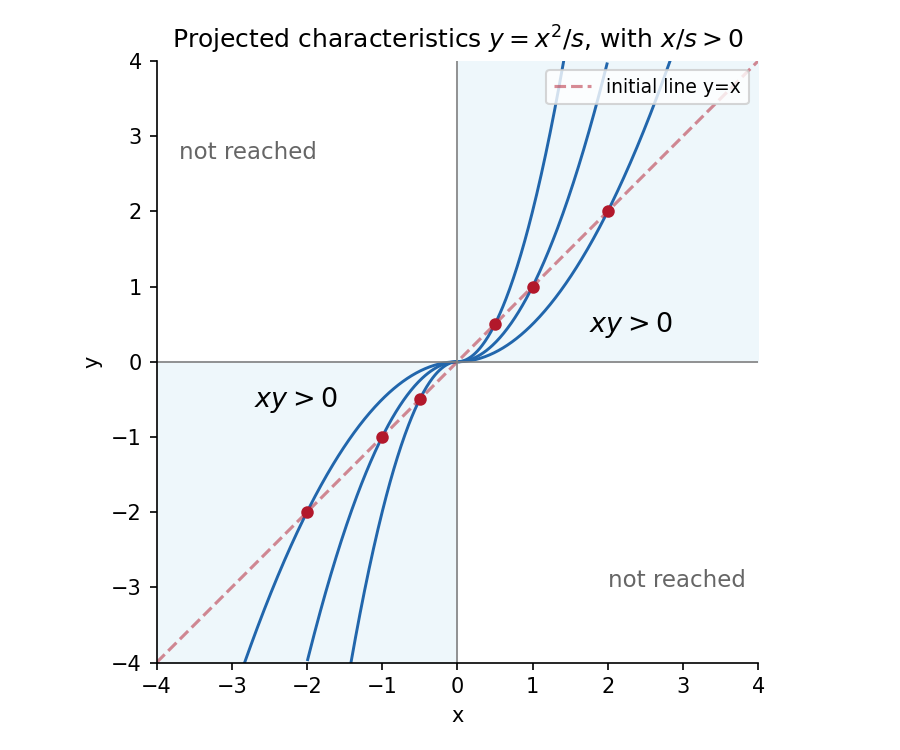
Choose characteristic parameter with initial value at . The characteristic equations areThe first two integrate immediately; substitution into the third givesEliminating gives the projected parabolaThe sign restriction selects the half-parabola actually reached from the initial point.
The projection map has Jacobian determinant , so the initial curve is noncharacteristic for every allowed . Its global inverse isdefined precisely when have the same nonzero sign. Every such point is reached by exactly one characteristic. Hence the region of unique determination from these initial data projects ontothe first and third quadrants. The axes are not reached for finite parameter from , and the other two quadrants have no method of characteristics issued from this initial curve.
As a direct check, substitution of the inverse parameters gives the solutionIt has , and differentiating gives . This is quadrant uniqueness for unequal dilation characteristics.


There are unlisted articles, also show them or only show them.