
If , then the dot product satisfiesConversely, the assumed dot product identity gives for every . Take and from the standard basis: every entry of is zero. Hence , proving the equivalence.
Split into its symmetric part and skew-symmetric part:Taking the transpose gives and . Thus is a symmetric matrix and a skew-symmetric matrix. These formulas also show uniqueness, since a real matrix that is both symmetric and skew-symmetric is zero.
Let denote a matrix unit, with its only nonzero entry equal to one in row , column . A basis for the vector space of real skew-symmetric matrices isEach upper-triangular entry is free, its reflected lower-triangular entry is its negative, and every diagonal entry is zero. This is the basis of the space of real skew-symmetric matrices.
The dimensions of the nested images of a linear mapcan strictly decrease at most times. If all the first inclusions are strict, and is stable. Otherwise an earlier equality occurs and (d) makes every subsequent image equal. Thus in all casesBy the rank-nullity theorem and inclusion of the null spaces, this also gives . If , write . Then , so and . Hence the intersection is zero. Finally the rank-nullity theorem givesZero intersection and this dimension sum proveThis is the finite-dimensional Fitting decomposition. It includes the zero-dimensional case, for which and the assertion is immediate.
Apply to both sides of . Because , we obtain . Repeating this argument proves equality at every later step. More formally, an induction on givesThe base case is ; the induction step follows from applying the linear map and then the assumed first equality. Thus one equality permanently stabilizes the descending sequence of images of a linear map.
For , choose with . Thus , provingThis is the decreasing-image part of stabilization of images of powers of a linear map. The convention includes and .
Take and the linear map . ThenTheir intersection is nonzero and their sum is only one-dimensional. Hence . This nilpotent linear map has , illustrating why taking sufficiently high powers changes the situation.
Take and the linear map . ThenThese two vector subspaces have zero intersection and together span , so as a direct sum of vector spaces.
Fix one common eigenvector , and write and . By (d),so and at least one of the two eigenvalues is zero.
To exclude both being zero, use the kernel of a Gram product identity:If both products annihilate , then . By (b), , and by (e), this is . On the other hand, makes orthogonal to every vector in . In particular is orthogonal to itself, so and , a contradiction.
Therefore each specified common eigenvector belongs to exactly one of and . Both eigenvalues are nonnegative by the displayed squared-norm identities, so the other eigenvalue is strictly positive. This is the spectral mechanism behind orthogonal null-space completion of a square matrix.
Both and have linearly independent columns. The Gram matrix is invertible becauseConsequently is a surjective linear map: for any , the choice satisfies . HenceThe latter image of a linear map has dimension , giving . If , and the conclusion is immediate. This argument explains why the product retains its full possible matrix rank; a general product of two matrices need not do so.
The analogous null space statement isHere the rank-nullity theorem and (a) ensure that also has dimension .
If , the vector belongs to the null space for which the columns of are a basis. It is therefore a linear combination of those columns, so for some . Conversely, each column is annihilated by , hence and implies . ThusThe coordinate vector is unique because the columns of are linearly independent.
The columns of form a basis of , so that null space has dimension . The rank-nullity theorem applied to gives . A matrix and its transpose have equal matrix rank, hence
Four state bits are necessary and sufficient. For each output value, distinguish three armed situations, remembering a trailing high run of length , and three disarmed situations, remembering a trailing low run of length . Thus a direct minimal behavioural description hasAll twelve situations are reachable. Different output values are immediately distinguishable. Within an armed group, a suitable number of high samples distinguishes the three run lengths by when the next toggle occurs. Within a disarmed group, a suitable number of low samples followed by three highs distinguishes the three rearming distances. An armed situation and a disarmed situation of the same output value are distinguished by an all-high continuation: the armed one eventually toggles and the disarmed one does not. Hence these twelve situations cannot be merged in a finite-state machine implementing the specification.
The shared-history design in (c) uses four bits, meeting this lower bound. Its sixteen encoded states have some behaviourally equivalent histories, so its encoding need not use only twelve combinations. Building two separate copies of (a) plus the two-bit module (b) would use six state-bearing elements; sharing the input history saves two.
Share the input-history bits of (a) between a high-run detector and a low-run detector. With the two preceding input samples, putThese detector outputs are mutually exclusive. Feed them into (b). An explicit four-bit synchronous sequential circuit, with initial state , isEvery right-hand side uses the old state and the current input. In particular, the run detectors' combinational outputs are sampled by the toggle module at that same edge; there is no extra pipeline stage.
The first three consecutive high samples make at the third edge, toggling and clearing . Continuing high input cannot toggle it again. Only three consecutive low samples can make and rearm it; interrupted low runs do not suffice. After rearming, a new three-sample high run produces the next toggle. This proves the debounced toggle switch behaviour, including rejection of short high and low disturbances.
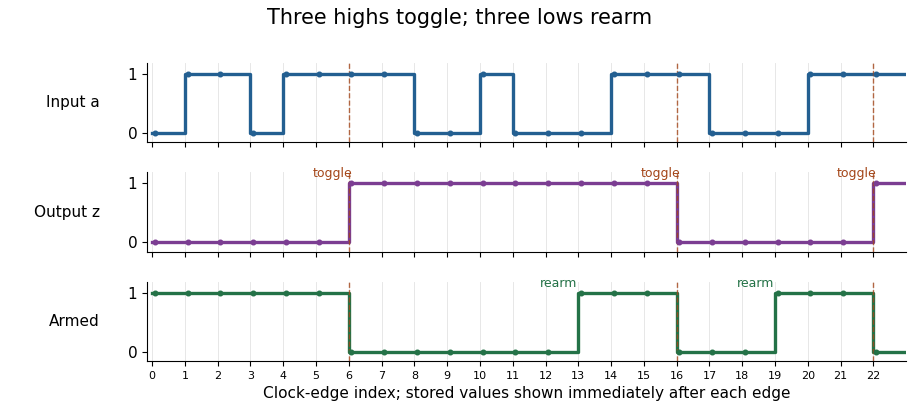
The debounced toggle switch rejects interrupted runs, toggles on the third consecutive high sample, and rearms only on the third consecutive low sample; stored outputs are shown just after each clock edge
. Details. 
Store two bits: the output , initially zero, and an
armed bit , initially one. Define the synchronous sequential circuit byHere is exclusive or, and the input restriction excludes conflicting commands. The output is the current stored .When armed, a sampled toggles and clears . Further samples leave the output unchanged. A sampled sets without changing , allowing a later to toggle it again. The same clock edge cannot both rearm and trigger because are never simultaneously high. Thus the first toggles from zero to one, and subsequent toggles each require a new followed by a later .
Use a three-sample run detector. Just before clock edge , let two stored bits and hold the input values at edges and . Initialise both to zero. With input , definePrimes denote the next stored state, with all assignments simultaneous at the clock edge. The output is the logical conjunction of the present input and its two preceding samples. By induction on clock edges, the stated interpretation of is maintained, proving the required behaviour. Two bits of state suffice.
There are unlisted articles, also show them or only show them.