
Monotone half-grid diffusion update 2026-10-14
For , the explicit conservative diffusion update has weights , , and . Under the displayed restriction they are nonnegative and sum to one. With zero Dirichlet boundary conditions, each new value is a convex combination of old interior and boundary values, proving contraction in the discrete maximum norm. The spatial matrix is also symmetric with . This puts its eigenvalues in , so the same restriction gives L2 norm contraction. A stable recurrence need not be consistent with a different proposed differential equation.
Transvectant of binary forms 2026-10-14
For forms of degrees , the th transvectant contracts pairs of indices using the invariant alternating form. Explicitly it is a scalar normalization of . These contractions realize the irreducible summands in the symmetric-power tensor-product decomposition.
Let be an elementary abelian -group and let , with soluble. In each Sylow basis of , is the unique Sylow -subgroup and the product of the remaining Sylow subgroups is a complement to . All complements are -conjugate, and the stabilizer of under this conjugation is its fixed-vector space . Each complement has Sylow bases, proving the formula. For the permutation module of , the fixed-vector space is the one-dimensional constant-coordinate subspace, so the number is .
Sphere spectrum 2026-10-14
The sphere spectrum is . It is the unit of the smash product of spectra. Its integer suspensions of spectra represent stable homotopy groups.
For an Erlang distribution claim density and , write . The survival integro-differential equation gives . The convolution satisfies , because . Applying to the first equation eliminates and gives the displayed third-order equation. The original integral equation also supplies and ; these conditions must not be lost when solving the higher-order equation.
For a geometric morphism, the characteristic map of induces a comparison whose adjoint transpose is . Composing with a characteristic map classifies the inverse-image subobject. Thus monicity of is equivalent to reflection of equality of subobjects under , and hence to faithfulness of the inverse image: apply reflection to equalizers of parallel arrows. Conversely faithfulness reflects when a pulled-back monomorphism is an isomorphism, by comparing its characteristic map with truth; intersections then reflect equality of arbitrary subobjects.
The time translation is normalized at infinity. For the roots , evaluate to get the signed horizon values. The outer Hawking temperature in natural units is . The extremal limit has zero surface gravity; the neutral case has only the outer positive-radius horizon and temperature .
Well-supported object 2026-10-14
An object of a regular category is well-supported when its support of an object in a regular category is the terminal object, equivalently when is a regular epimorphism. Finite products of well-supported objects are well-supported, by pullback and composition stability of regular epimorphisms. A regular epimorphism has the same support as its codomain, and an object with a point is well-supported.
Almost total support for a regular category 2026-10-14
A regular category is almost totally supported if every object is a well-supported object or a strict initial object. The case in which every object is well-supported is allowed. There can be at most one strict initial object up to isomorphism. In the Category of sets, these two cases distinguish nonempty sets from the empty set. A meet-semilattice regarded as a category satisfies the condition precisely when it has at most two objects up to isomorphism.
Supermembrane action 2026-10-14
The first term uses the induced worldvolume metric from the supervielbein; the second is the Wess-Zumino brane coupling to the super-three-form. Its fermionic dependence is retained before bosonic truncation. The relative charge magnitude equals the brane tension, while sets the orientation and matching kappa symmetry projector sign. In an on-shell eleven-dimensional supergravity superspace, this action has kappa symmetry.
Supercompact Sigma-two downward reflection 2026-10-14
If is a supercompact cardinal, each true statement, allowing parameters in , holds in . Write it as an existential witness followed by a assertion. Choose a supercompact elementary embedding whose transitive target contains the witness in . Downward absoluteness of the universal bounded-matrix assertion puts the witness in that rank segment, and elementarity reflects this to .
Cesàro summation 2026-10-14
Cesàro summation assigns a value to a series when the arithmetic means of its partial sums approach a finite limit of a sequence. Here we use the first-order method, often written . For a real or complex series beginning at index zero, defineIt is Cesàro summable to when . The averaging is applied to the partial sums , rather than to the original terms . This distinction is essential: the terms can average to zero while their accumulated sum keeps growing. [ref]
For Grandi's series , the partial sums alternate between one and zero. The series is not a convergent series, but the two values occupy asymptotically equal proportions of the averaging window. In the declared index convention,so its first-order Cesàro sum is . This names a particular summation method; it does not turn the oscillating partial sums into an ordinarily convergent sequence.
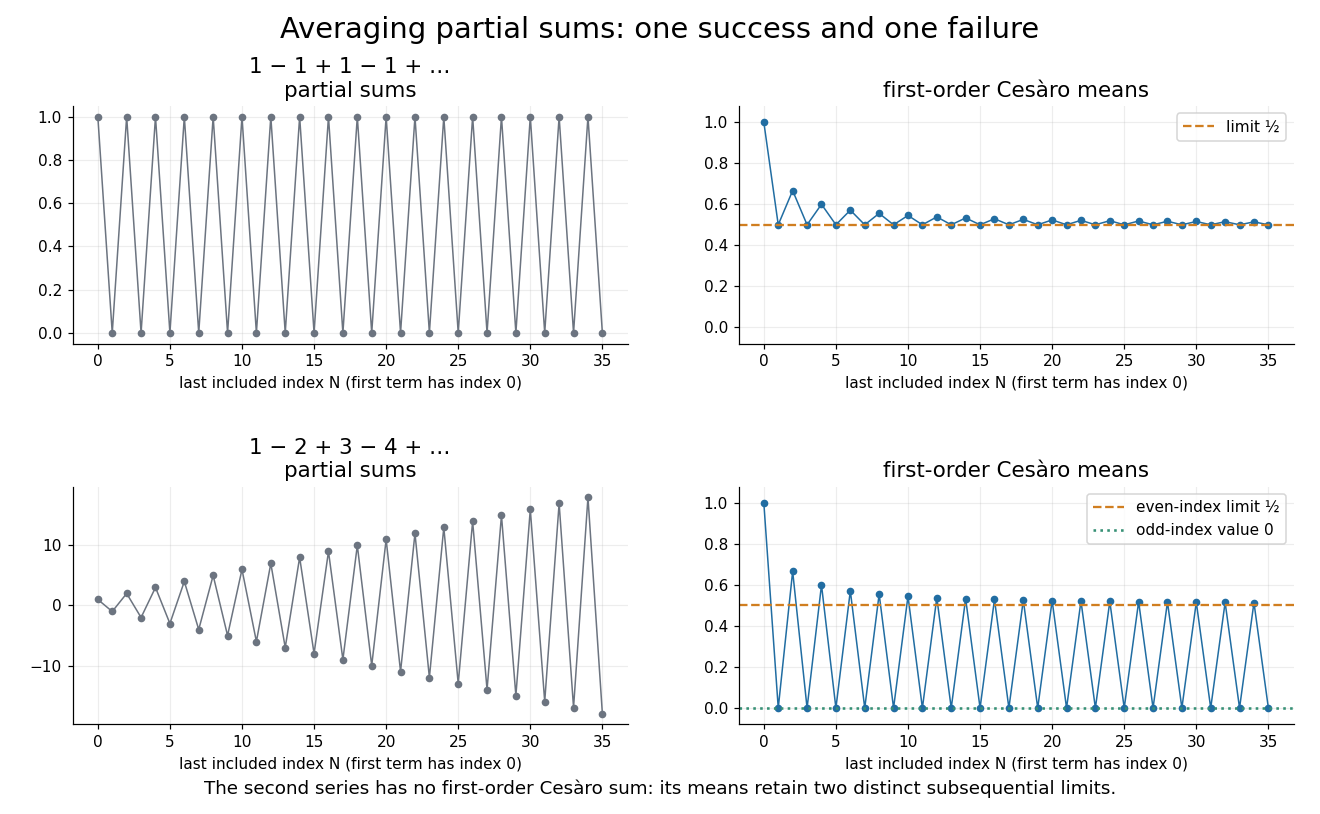

Why is this useful? An oscillating approximation can retain stable information when its cumulative average settles. Because the Cesàro theorem for convergent sequences preserves an existing limit of a sequence, this adds some new cases without changing the sum of any ordinarily convergent series. For Fourier series, averaging the Fourier partial sums gives a Fejér sum; the existing Fejér kernel and approximation articles explain its effect on reconstruction. Averaging does not guarantee success for every oscillating sequence, as the bounded partial sums need not be Cesàro summable example shows.
One historical motivation was the multiplication of series. In 1918, A. F. Andersen recalled Ernesto Cesàro's product theorem and cited his 1890 publication at the start of a study of products involving Cesàro summable series. This connects the theory with preserving useful operations on sums, as well as with assigning a value to an isolated example. His paper treats several orders of summability; the examples here use only .[ref]
Regular summation method 2026-10-14
A summation method that includes every ordinarily convergent series and assigns it its ordinary sum. The Cesàro theorem for convergent sequences makes first-order Cesàro summation regular. Regularity alone does not justify every rearrangement or multiplication of a divergent series.
Threshold decomposition between Lp spaces 2026-10-14
If , the displayed split of an function gives and . Weighted multiplication with cancels the threshold, yielding . Choosing also gives the continuous inclusion . The analogous split works if the larger endpoint is infinity.
Proper-divisor sum 2026-10-14
The proper-divisor sum, or aliquot sum, adds the positive proper divisors:In particular , an empty sum. Removing from the sum-of-divisors function is essential: , but its proper-divisor sum is .
Formal space 2026-10-14
A space is formal over if its rational cochain commutative differential graded algebra is joined to by quasi-isomorphisms. Equivalently in the usual simply connected Sullivan-model setting, its minimal model has a quasi-isomorphism to its cohomology algebra with zero differential. This says its rational homotopy type can be recovered from the cohomology algebra; zero cup products alone do not imply formality of a topological space without an additional argument.
For a finite wedge sum of spheres of dimensions , let with and zero differential. Its Chevalley–Eilenberg cochains of a graded Lie algebra are a minimal commutative differential graded algebra: one generator dual to each Lie basis word has degree one more than that word, and its differential is dual to the Lie bracket. Its cohomology is with all positive products zero. One way to compute this is ; the augmentation module has a length-one free resolution, so the corresponding Ext has only the unit and the dual generating classes.
The quotient is five-connected and has cohomology only in degrees , with positive products zero. Its minimal model therefore starts with closed ; no decomposable differential can occur below degree twelve. Sending these three generators to the cohomology basis and all later generators to zero is a chain map and a quasi-isomorphism. Thus its full minimal model is the same as that of . It starts with generators satisfying , followed by generators killing remaining products and syzygies.
For a degree-one map with , a minimal model of its homotopy fibre is with , , . Adjoin suspended sphere generators to the projective-space model to model the path pullback, then put ; the differential becomes the displayed decomposable one. The rational homotopy groups are one-dimensional in those four generator degrees and zero otherwise. At the map is a rational homotopy equivalence and the minimal fibre model is .
Rational polynomial differential forms 2026-10-14
For the standard -simplex use , with , , and . Compatible families of these forms on the simplices of a simplicial model of form the commutative differential graded algebra . Its cohomology is : polynomial contraction proves the simplex Poincaré lemma, and extension across faces gives the simplicial de Rham comparison. The contravariant functor takes simplicial pushouts to pullbacks of algebras.
There are unlisted articles, also show them or only show them.