
Witt space 2026-10-14
A rational Witt space is a stratified pseudomanifold such that the link of every stratum of odd codimension satisfies . This removes the only difference between lower and upper middle extensions and gives rational middle-perversity Poincare duality on closed oriented Witt spaces.
The link of an isolated stratum of a closed two-dimensional pseudomanifold is a finite disjoint union of circles. Separate these branches, replacing the cone on their union by separate disks. This produces a closed surface and a finite surjective map to the original space, a homeomorphism on the regular stratum. Orientations on the regular stratum extend over the disks.
Principal strain rates 2026-10-14
Principal strain rates are the eigenvalues of the symmetric rate-of-strain tensor. Positive values are local extension and negative values local compression. In incompressible flow , implying . Their eigenvectors describe the principal deformation directions.
Nonnegative isotropic elastic strain energy 2026-10-14
In three-dimensional isotropic linear elasticity, decompose the symmetric strain as with and . The stored energy is . Its nonnegativity for every strain is equivalent to the displayed inequalities: the traceless and purely volumetric test strains prove necessity, and the sum of squares proves sufficiency.
Strain-dominated mush temperature profile 2026-10-14
Set , and . In the regular limit , at fixed finite thermal strain number and bounded phase fraction, the heat equation reduces to . Integration gives the displayed error function profile. Matching the roof temperature gradient yieldsThe product composition is . The asymptotic reduction requires admissible phase fractions. If the thermal strain number grows singularly with , the two ordering inequalities alone do not control boundary-layer errors; the full strain-driven steady mush equations retain the latent-heat term.
For finite nonnegative adapted processes , set and . Stopping this one-step-lagged sum gives , with . The latter is nonpositive and measurable at time , so is a nonnegative supermartingale. The overshooting increment is excluded, which is essential to nonnegativity.
For an integrable discrete-time martingale, stop at the first time . For any deterministic , conditioning the terminal value on each event gives . Monotone convergence theorem therefore proves the displayed overshoot bound. The maximum of the stopped martingale is at most , an integrable variable. This permits a convergence proof without assuming bounded overshoots.
For a left-continuous locally bounded adapted process and a continuous semimartingale , the elementary predictable left-endpoint approximations tend pointwise to . Decompose into a continuous local martingale and a continuous finite-variation process. After localization, dominated convergence with respect to the variation measure handles the finite-variation integral. The Itô isometry and Doob L2 maximal inequality handle the martingale integral. The omitted partial last interval is bounded by the local bound on times the modulus of continuity of . This proves uniform convergence on compacts in probability and is the grid-sum foundation of the Itô product rule.
Stochastic dominated convergence theorem 2026-10-14
If uniformly bounded predictable processes converge pointwise to , then their integrals against a fixed semimartingale converge to uniformly on compact intervals in probability. Localized domination gives corresponding extensions. This continuity permits a functional monotone-class argument from elementary predictable integrands to all bounded predictable integrands.
// Target: probability-and-statistics.bigb
Semimartingale integration by parts 2026-10-14
For càdlàg semimartingales, the product rule uses left-limit integrands and quadratic covariation including jump products. For continuous semimartingales it reduces to the Itô product rule without left-limit notation. This rule permits an induction proof of the Itô formula for polynomial functions.
Square-root branching diffusion 2026-10-14
A nonnegative diffusion with zero absorbing, often called the critical Feller branching diffusion; other conventions multiply the coefficient by a fixed positive constant. Its diffusion coefficient is not Lipschitz at zero. Independent copies add according to the addition law for square-root branching diffusions, and a cutoff construction of an absorbed square-root diffusion gives strong existence without applying the global Lipschitz theorem to the original coefficient.
Stroock-Varadhan support theorem 2026-10-14
For smooth bounded vector fields, the support of a Stratonovich diffusion in uniform path topology is the closure of solutions to the controlled ordinary differential equation with the same drift and controls in the Cameron-Martin space of Wiener measure. The support of enhanced Brownian motion and the universal limit theorem prove this through continuity of the enhanced solution map. For an equation written in Itô form, the controlled drift is the Itô drift minus .
Brownian rotation in the plane 2026-10-14
The SDE , has the unique strong solution obtained by rotating through angle . Its coefficients are globally Lipschitz with linear growth, and . The origin is absorbing and every other solution remains on its initial circle.
Bernoulli stochastic differential equation 2026-10-14
On the positive half-line, divide by the stochastic exponential . The Itô product rule reduces the equation to the random Bernoulli differential equation . For this gives , until the bracket vanishes; for , .
For a zero-starting solution with , the Itô isometry gives , so is a true martingale on every finite horizon. The Itô formula represents the displayed process as , whose expected squared integrand integral is at most . Thus it too is a true square-integrable martingale. No continuity or Lipschitz condition on the coefficient is needed once a solution is given.
Gaussian peak behind Stirling's formula 2026-10-14
Repeated integration by parts gives the Gamma integralThe logarithm of its integrand is , whose unique maximum is at . Write . For fixed and large , a Taylor expansion givesThe Big O notation here is for a fixed , or uniformly for in a fixed bounded interval. It does not claim a uniform approximation over the entire growing integration domain. Consequently the peak, divided by its height, approaches .
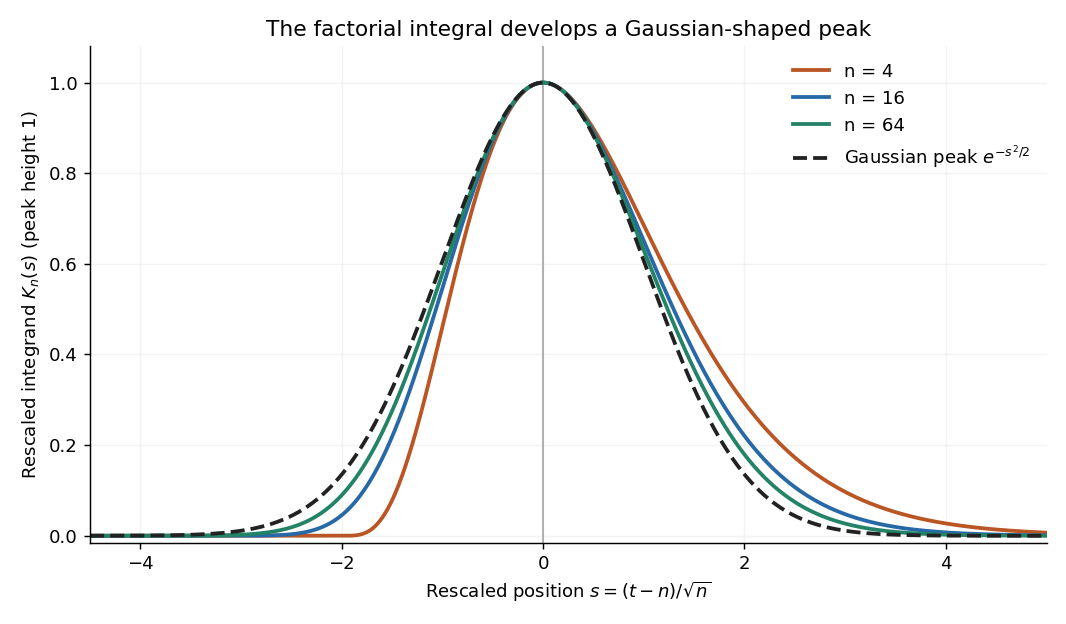

The exact substitution givesReplacing the integral by the Gaussian integral produces . Thus the estimate is peak height times width times the area of a standard Gaussian peak. This is Laplace's method in a concrete form; controlling the integral's tails justifies the replacement. The next terms, including their products after exponentiation, produce the Stirling correction by Gaussian moments.
Robbins bounds for Stirling's formula 2026-10-14
For every positive integer , Herbert Robbins's bounds giveEquivalently, the remainder in satisfies . This both proves that underestimates and squeezes to one, establishing Stirling's formula. Robbins published the bounds in “A Remark on Stirling's Formula” in 1955. [ref]
https://dornsife.usc.edu/sergey-lototsky/wp-content/uploads/sites/211/2024/02/Stirling-Robbins.pdf. Herbert Robbins, American Mathematical Monthly 62 (1955), pp. 26–29, equations (1)–(2)
For , the relative error of lies strictly between and , approximately and . A bound specifies the accuracy of an approximation before using it in another calculation.
An immersion of a smooth -manifold in supplies a rank-one normal bundle with . The Whitney product formula for Stiefel–Whitney classes therefore requires . A real line bundle has no positive-degree classes beyond , so every higher-degree part of the inverse total class must vanish. For , the stabilized tangent bundle of real projective space gives in . Its nonzero degree-two part excludes an immersion in even though the normal line need not be orientable.
For a real line bundle on a closed manifold, a transverse section has a hypersurface as its zero set. Along a closed loop transverse to this hypersurface, trivialize the pullback over the cut interval. Each simple zero reverses the sign of the component function. The total sign change is exactly the bundle's transition sign around the loop, detected by its first Stiefel–Whitney class. Thus zero-set intersection parity with every loop equals the evaluation of , proving the displayed mod-two dual class. No orientability of the manifold or bundle is required.
Antipodal stereographic coordinate relation 2026-10-14
For north-pole stereographic projection on the unit sphere, the antipodal pair point has coordinate . Since , this gives when both coordinates are finite. On the whole Riemann sphere, write , pairing zero with infinity. The two axis endpoints fixed by a sphere rotation obey this relation.
There are unlisted articles, also show them or only show them.