
Tangle category 2026-10-14
Objects are finite words of strand orientations. Morphisms are boundary-fixed ambient-isotopy classes of oriented tangles in a slab, composed by stacking compatible boundary words; horizontal juxtaposition is the tensor product. Cups, caps, identity strands and crossings generate the category. Ordinary unframed isotopy includes all three Reidemeister moves; framed variants impose different first-move relations.
Tangent coordinate transition 2026-10-14
A coordinate chart trivializes the tangent bundle by expressing in the coordinate basis. For , the chain rule gives the displayed transition. Smoothness and fibrewise linear invertibility of the Jacobian matrix construct the natural smooth vector bundle structure. The chain rule also supplies the transition cocycle.
For the real tautological bundle over Real projective space, the tangent space at a line is . Adding gives , using a metric to identify a real line with its dual. Hence its total Stiefel–Whitney class is , with .
Uniformizer character of inertia 2026-10-14
For a finite Galois extension of non-Archimedean local fields, this is a homomorphism from the inertia group to with kernel the wild inertia group. Inertia acts trivially on residue units, which proves multiplicativity and independence of the chosen uniformizer. Passing to the maximal unramified subextension reduces the kernel calculation to a totally ramified extension. Hence it embeds the tame inertia quotient into the cyclic multiplicative group of the residue field.
Branch-cycle conjugacy class 2026-10-14
For a Finite Galois extension of with algebraically closed characteristic-zero constants, the local decomposition and inertia groups coincide and are cyclic. A fixed compatible choice of primitive roots of unity selects a generator through its uniformizer character of inertia. Changing the prime above a base point conjugates this generator, and changing the uniformizer does not change its character. Without the roots-of-unity convention, only the inertia-subgroup conjugacy class is intrinsic. Over , positive local orientation gives the standard convention.
Infinitely many heads as a tail event 2026-10-14
On , the event of infinitely many heads isIt says that after every index there is another head. For each , the same intersection can start at , so ; therefore is a tail event. This verifies measurability directly using countable unions and intersections.
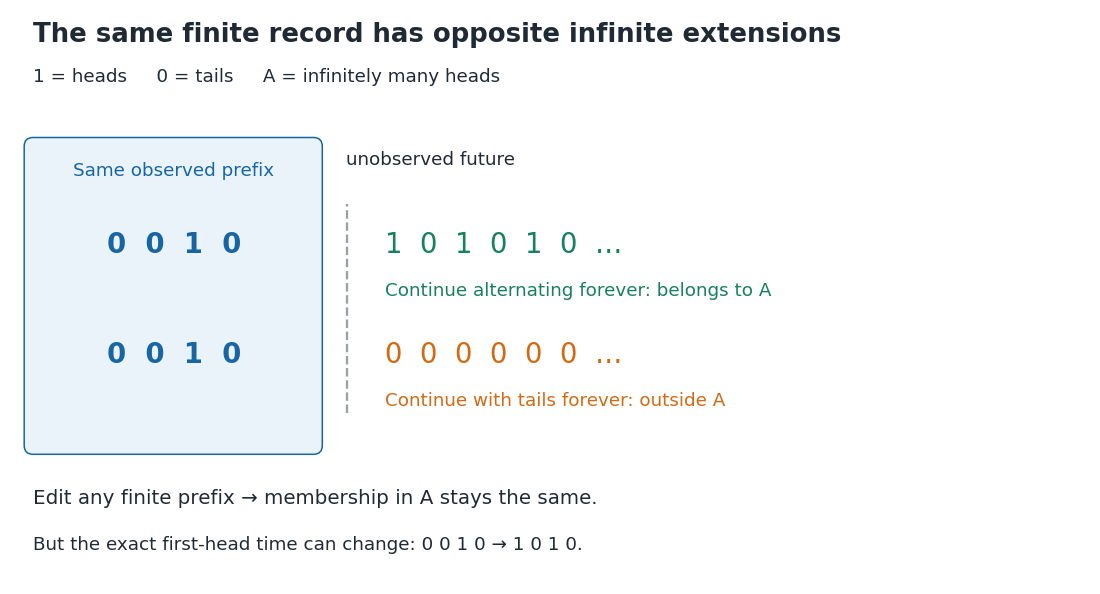
A finite prefix admits both infinitely many heads and only finitely many heads
. The two illustrated extensions have the same initial observations. An alternating continuation belongs to the tail event of infinitely many heads; an all-tails continuation does not. Changing the highlighted finite prefix cannot change that infinite property, but it can change the exact first-head time. Details.
Assume now that the coordinates are fair independent Bernoulli trials. For fixed , let be the event of at least one head among . Its complement requires tails, soThe last equality follows from continuity of probability. Now , a countable intersection of almost sure events, and hence . This determines which of the two possibilities in Kolmogorov's zero–one law occurs. Equivalently, the Borel-Cantelli second lemma applies to the independent events .
Nevertheless, no finite prefix certifies membership in : every finite record can be extended by all tails or by alternating heads and tails. Under the fair independent model, conditioning on any exact finite prefix leaves , since is independent of the initial sigma-algebra. The excluded all-tails continuation has probability zero, but remains a possible member of the sample space. Logical determination by a finite record and a conclusion holding almost surely are different statements.
Complete-intersection candidate family 2026-10-14
Two members of this uniform set family have at least common points in its distinguished prefix, so it is a t-intersecting family. Nonempty indices satisfy . Consecutive-family size comparison reduces to the threshold : gain sets contain both newly introduced coordinates and earlier points; loss sets contain neither and earlier points. Counting these sets with binomial coefficients proves increase below, equality at and decrease above this threshold.
Complementing all members preserves cardinality and gives . Thus complementation bijects t-intersecting families of -sets with -intersecting families of -sets. It swaps left and right coordinate shifts of a set family. When the transformed intersection parameter is positive, extremal families and their generating-support lemmas can therefore be compared in opposite compression directions.
Ahlswede-Khachatrian theorem 2026-10-14
The maximum size of a t-intersecting family of -sets on is the largest complete-intersection candidate family. In strict nontrivial intervals , the maximizing index is , where and . At admissible interior boundaries the consecutive candidates tie. If , the whole level is optimal. A proof uses left compression, the small-support generating lemma for extremal intersecting families for the original and complement families, and the compatibility bound for complementary generating families. The latter forces one generator family to have the candidate threshold size, placing the original family inside a candidate.
Nonuniform t-intersecting family bound 2026-10-14
If , then . The Kleitman diametric theorem therefore gives the sharp nonuniform intersection bound. For , all sets of size at least attain it. For , take all sets of size at least , together with all -sets avoiding one fixed point.
For two-intersecting families on four points, all supersets of a fixed pair form a maximal family of size four: any set missing part of that pair fails its intersection test with the pair itself. The maximum instead has size five, attained by all sets of size at least three. Thus maximality and maximum cardinality diverge for intersection parameter two.
On eight points, the rank-four Frankl family consisting of sets containing at least three of has seventeen members and is two-intersecting. The first fifteen rank-four sets in lexicographic order contain , while the sixteenth is . The earlier set meets it only at one. This disproves preservation of two-intersection by lexicographic replacement even when the rank is half the ground-set size.
Credit tranche loss function 2026-10-14
For aggregate monetary loss and monetary attachment/exhaustion levels , this is the loss allocated to the tranche. It is zero until attachment, rises with losses between and , and is capped at . Expected tranche losses and surviving tranche notional determine protection and premium legs. For basket products whose payoff occurs at a first default, the joint default-time distribution matters as well as the final loss distribution.
Syndrome classification of code cosets 2026-10-14
For a rank- parity-check matrix of a linear code , two words have equal syndromes exactly when their difference lies in . Thus attainable syndromes label cosets bijectively. For a received word , its syndrome is that of the error , so minimum-weight representatives provide minimum-distance decoding.
// Target: algebra.bigb
Syndrome decoding 2026-10-14
For a linear code with parity-check matrix , write the received word as , where is a codeword and an error pattern. Its syndrome depends only on the error because . A syndrome decoder chooses a representative error with that syndrome and returns . Choosing a minimum-Hamming weight representative gives minimum-distance decoding; within the guaranteed correction radius it recovers the unique transmitted codeword. Several representatives may tie outside that radius.
Let , and . The synchronous-to-Newtonian transformation with positive spatial perturbations gives . Since , the displayed identity follows by integration. The emission endpoint combines intrinsic and velocity shifts into the ordinary Sachs-Wolfe effect; the local observer endpoint is a monopole plus a dipole. Without anisotropic stress the remaining integral is the Integrated Sachs-Wolfe effect, . The angular term in the synchronous contraction is positive for this metric convention.
Facing a companion and facing the source of light are different relations. The Moon keeps its near side of the Moon approximately toward Earth, while the direction to the distant Sun is nearly fixed during the idealized orbit shown below. A fixed surface patch therefore turns toward, across and away from sunlight. The far side of the Moon has day and night too; its name does not mean permanent darkness. [ref]
https://science.nasa.gov/moon/facts/. NASA: changing lunar illumination
.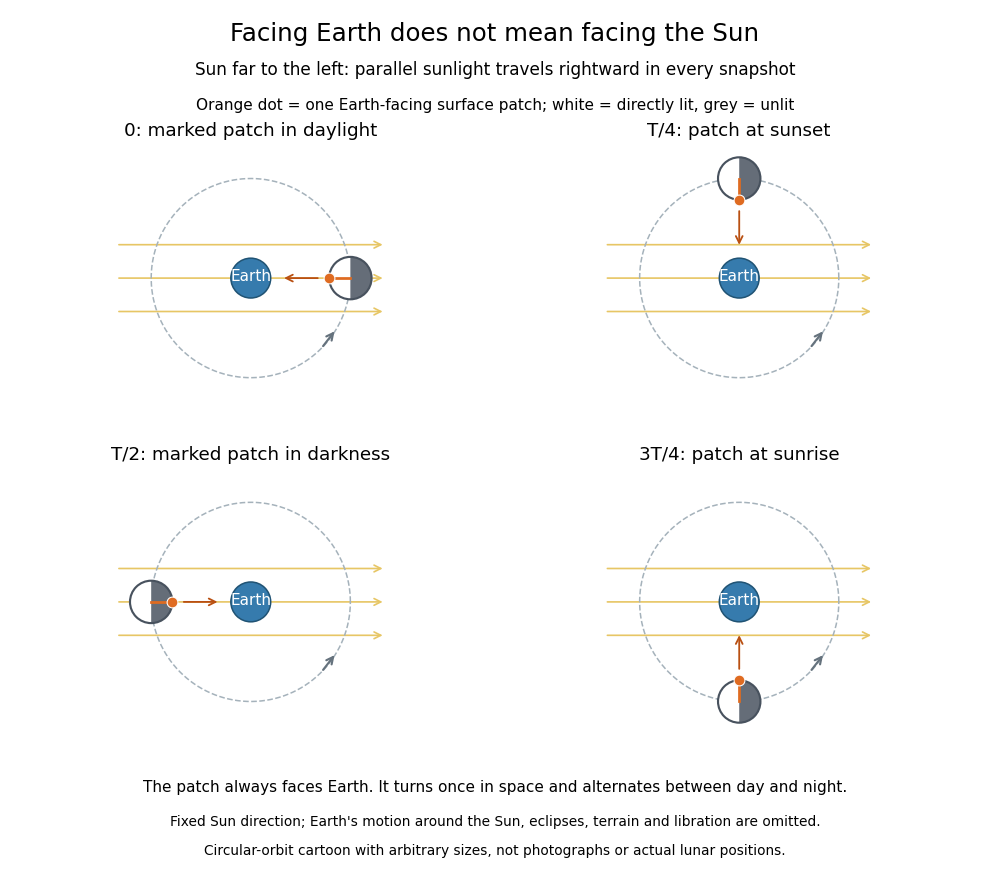

If the Sun direction has fixed angle and the marked surface patch has outward normal vector at angle , its direct illumination is proportional to . With synchronous rotation, , so the patch goes through day and night even though it always faces Earth. In reality the Earth-Moon system advances around the Sun: the lunar spin and orbital cycle relative to distant stars is about Earth days, while the lunar phase cycle has a synodic period of about Earth days. These numbers describe the actual system, not the fixed-sunlight cartoon. [ref]
https://starchild.gsfc.nasa.gov/docs/StarChild/questions/question32.html. NASA StarChild: sidereal and synodic lunar periods
.For a synchronously rotating exoplanet whose orbital companion is itself the illuminating star, the direction to the star turns with the orbit. On an ideal circular orbit, with perpendicular spin axis and no additional oscillations, this direction is fixed relative to the surface, giving persistent day and night hemispheres. Day-night heat redistribution then helps determine the nightside temperature; permanent lack of direct starlight does not imply zero temperature. Orbital eccentricity and departures from this ideal spin geometry modify that simple picture.
Facing geometry of synchronous rotation 2026-10-14
View a circular orbit along its perpendicular spin axis. Let be the orbital angle measured from a fixed direction, choosing an arbitrary zero for the circular limit of true anomaly, and let be the direction of an outward arrow painted on the body, measured from the same fixed direction. The direction from the body to its companion is . Thus an inward-facing arrow satisfiesMore generally synchronous rotation keeps constant; its particular value selects which surface direction faces the companion. Over one orbital period , both and the unwrapped increase by . This is the short geometric explanation for one turn per orbit. For a nonspinning body, instead, and the companion direction sweeps through all surface longitudes. On an eccentric orbit, mean spin does not force to stay exactly constant: true anomaly advances nonuniformly, producing the longitudinal component of libration.
Group of Hamiltonian diffeomorphisms 2026-10-14
This group consists of time-one maps of Hamiltonian isotopies whose flows are defined throughout the specified time interval. With , composition of isotopies generated by has generator , where is the first isotopy. The inverse path has generator . These formulas prove closure under composition and inversion. On a closed symplectic manifold, every smooth time-dependent Hamiltonian has a complete flow over a bounded time interval.
Symplectic subspace 2026-10-14
A subspace of a symplectic vector space is symplectic if the restricted symplectic form is nondegenerate. It has a symplectic orthogonal complement and the ambient space is the direct sum of those two subspaces.
There are unlisted articles, also show them or only show them.