
Trace-class duality 2026-10-14
The dual of the trace-class operators, and also of the normed space of finite-rank operators with the trace norm, is isometrically the space of bounded operators. The pairing is . For , one has and , using an inner product linear in its first argument. A bounded functional on these rank-one operators gives a bounded sesquilinear form and hence a unique by the Riesz representation theorem. The singular value decomposition proves and the triangle inequality for the trace norm.
If is an unramified extension and is a totally ramified extension of non-Archimedean local fields inside a fixed algebraic closure, then is totally ramified of degree . A uniformizer of has an Eisenstein polynomial over . Since a uniformizer of remains a uniformizer in , that polynomial remains Eisenstein over and generates .
A quadratic form of rank on is congruent to . Pair its nonzero coordinates into vectors , and include the radical of a bilinear form. Their span is a totally isotropic subspace and has dimension . The form vanishes on every vector of this subspace, not merely on its basis vectors.
Isotropic dimension bound from real inertia 2026-10-14
For a nondegenerate real quadratic form of inertia , projection of a totally isotropic subspace onto either its positive or negative coordinate subspace is injective: a vector with one projection zero would have strictly one-signed quadratic value unless it vanished. Thus its dimension is at most both and . This bound is attained by pairing one positive and one negative coordinate for each of independent null vectors.
For a Pareto distribution of shape three and minimum with count rate , the sum of insurer and reinsurer aggregate variances is for , and for . The first branch has its unique minimum at ; the second is increasing. The branches agree in value and slope at , giving the displayed global minimum. This criterion minimizes the sum of party variances; the total portfolio variance includes their covariance and remains .
Counting synthematic totals 2026-10-14
Two disjoint synthemes form a six-cycle, whose complement is a triangular prism. The prism has a unique partition into three perfect matchings, so the pair extends uniquely to a total of synthemes. Eight synthemes are disjoint from a fixed syntheme; grouping them four per total yields two totals through it, and double counting gives six totals in all.
// Target: combinatorics.bigb
Torque-driven circular swept area 2026-10-14
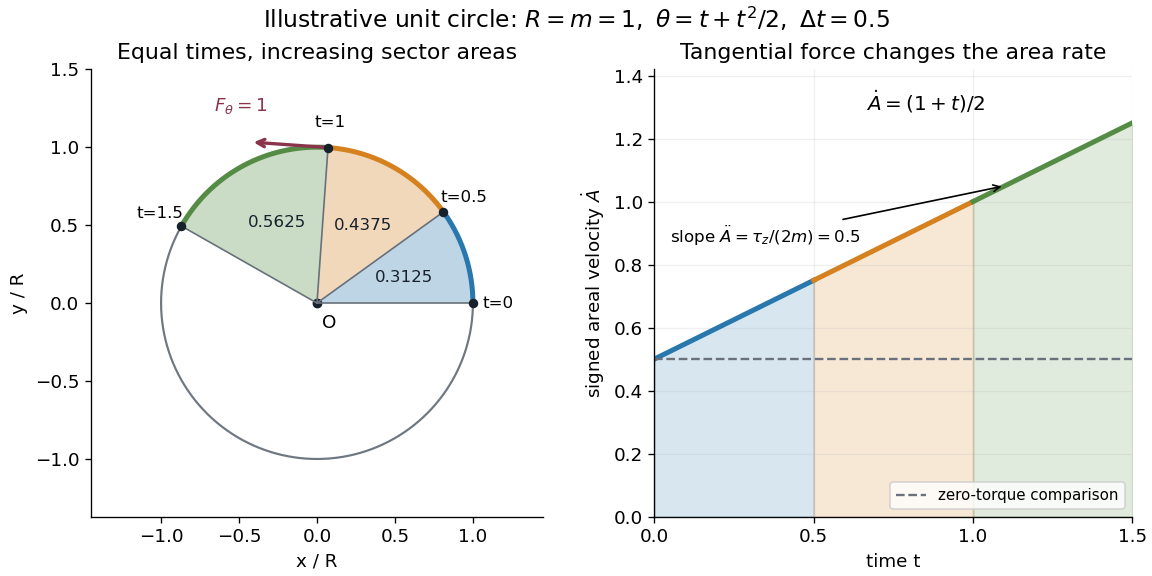
A path along a circle can have variable areal velocity. As an illustrative controlled trajectory, keep a point mass on a circle of radius with angleIts acceleration in polar coordinates and the required net force arewhere and are the radial and transverse unit vectors. A circular guide can supply the radial force, while a tangential drive supplies . HenceFor in illustrative units, the three equal time intervals , and sweep areas , and . Their difference comes from the transverse force's positive torque, even though the radius and path shape stay fixed. The area under each areal velocity graph segment equals the corresponding swept area.

An axial uniform magnetic field and localized radial differential rotation generate a steady toroidal magnetic field. The angular factor is an eigenfunction of the toroidal angular diffusion operator with eigenvalue . Its radial amplitude satisfies . Differentiating the integral in the title proves the formula. It is regular at the origin and decays at infinity when is finite at zero and decays sufficiently rapidly.
Brown's representability theorem 2026-10-14
A reduced contravariant homotopy functor on based CW complexes satisfying the wedge-to-product axiom and the Mayer-Vietoris weak-pullback gluing axiom is represented by for a CW complex . Half-exactness alone is not the full hypothesis. A reduced generalized cohomology theory supplies these axioms; suspension compatibility assembles its representing spaces into an Omega-spectrum.
Topological generator 2026-10-14
An element of a topological generating set of a topological group. A finite tuple consists of topological generators when the abstract subgroup it generates is dense in the group; it need not equal that abstract subgroup.
Isotonic solution 2026-10-14
An isotonic solution produces no sustained change in cellular volume under the stated comparison conditions. Water can still exchange in both directions.
Hypertonic solution 2026-10-14
A hypertonic solution favors initial net water loss under the reference conditions above. In a walled plant cell, enough loss can produce plasmolysis.
Hypotonic solution 2026-10-14
A hypotonic solution favors initial net water entry under the reference conditions above. A susceptible biological cell may undergo osmotic lysis; a sufficiently strong cell wall can instead support turgor pressure.
Permeating solute 2026-10-14
A permeating solute can cross the specified membrane appreciably during the observation interval. This is a property of a solute-membrane-time comparison, not an immutable label attached to a molecule. Passage can reduce a concentration difference through passive transport while water is also moving; it does not require water to wait.
For an original dilute ideal example, stipulate a flexible model biological cell with retained particles and an external reservoir with retained particles plus freely permeating neutral solute. Initially the total osmolarities are equal. Suppose the permeating solute eventually has equal internal and external concentrations, there is negligible pressure difference, no active transport, and the internal retained particle amount is conserved. The permeating contributions cancel from the final osmotic balance; the internal retained concentration must fall from to . The required volume is twice its initial value. This illustrates an initially equal-osmolarity but hypotonic solution; it assumes the boundary can survive that expansion and predicts no universal time course.
For with fixed noncommuting Hermitian operators, . A constant ratio of the envelopes is sufficient to remove time ordering. Independently changing that ratio generally produces commutator corrections in the Magnus expansion, and a product of successive pulses need not equal the exponential of their summed areas.
Magnus expansion 2026-10-14
For and , the Magnus expansion writes the logarithm of the propagator as iterated integrals of commutators. Its first terms are and . For a Quantum Hamiltonian, , so a noncommuting time-dependent control has corrections beyond the exponential of its integrated Quantum Hamiltonian. This formula is a local convergent expansion under suitable smallness conditions, or a formal expansion; it must not be assumed globally convergent for arbitrary pulse durations.
The inspected apparatus sends picosecond diode-laser pulses into a sample cuvette. A neutral attenuation filter keeps detected events rare; an emission cut-off filter rejects scattered excitation. Collection optics deliver fluorescence to a photodetector; detector pulses and the laser-driver synchronization signal feed the timing electronics. The illustrated arrangement uses a PDL 800-B driver and TimeHarp 200 electronics. The note's recorded comparison uses two dye solutions and a prompt instrument-response trace; the dye tails have distinct slopes on a logarithmic display. Its Figure 9 measurement specifies an 80 MHz source, separately from the Figure 8 driver-setting example.[ref]
For a defensible new measurement, separately acquire detector background with excitation blocked, a solvent/container blank under excitation, and a prompt response appropriate to the timing channel. Compare successively attenuated acquisitions to expose pile-up; compare early and late acquisition intervals to expose photobleaching. Choose a repetition period long enough for the relevant decay or include residual population from earlier pulses in the model. These are proposed checks, not additional controls claimed for the published curves. Photon shot noise, background mismatch, and uncertainty in the fluorescence instrument response limit how uniquely multiple decay components can be inferred.
Fluorescence instrument response 2026-10-14
A fluorescence instrument response is the distribution of recorded delays for an effectively prompt optical signal. Finite excitation-pulse width and timing variation in the photodetector and electronics contribute. With a normalized response , intrinsic fluorescent photon rate , and background rate , the expected trace isFit a candidate decay after this convolution with the measured response; treating the broadened leading edge as the intrinsic decay can bias fluorescence lifetime. The accessible technical note describes measuring prompt scattered excitation with a nonfluorescent scattering sample.[ref]
Time-Correlated Single Photon Counting (technical note v. 2.1) by Michael Wahl. Michael Wahl, Time-Correlated Single Photon Counting, v. 2.1, p. 3: scattering-medium response measurement and iterative reconvolution
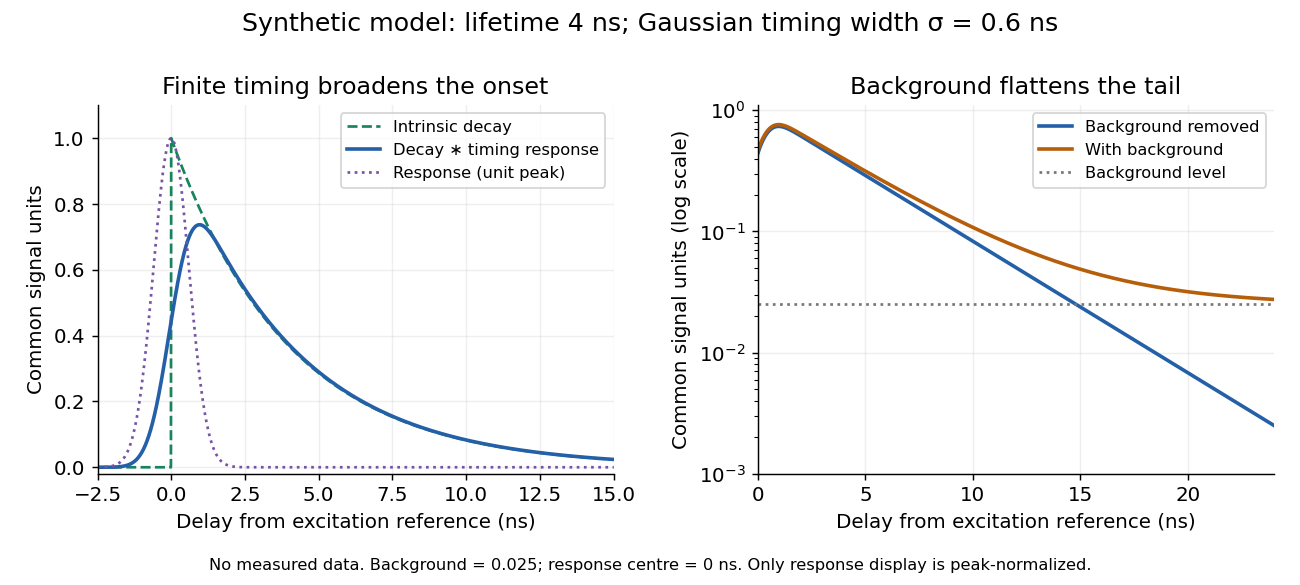
Synthetic fluorescence lifetime decay broadened by an instrument response
. Original stipulated model, not measurements: for and zero otherwise; is a normalized Gaussian function of standard deviation centred at zero; the background is in the common signal units. The left panel compares intrinsic and convolved traces; the right shows how an unremoved background flattens the tail on a logarithmic scale. Negative delays come from the stipulated timing response about the pulse reference, not emission before excitation. Only the instrument-response curve is rescaled to unit peak for display. Details.
With Fourier convention , the velocity divergence is . Thomson drag in the velocity equation is the conformal scattering rate times the velocity difference. Taking its divergence and dividing the whole divergence equation by leaves the same rate multiplying the difference of velocity potentials; an additional is not retained. Weighting the photon Euler equation by and adding the baryon equation cancels the drag. In tight coupling the remaining equation is , with sound speed .
Metric Tietze two-thirds approximation 2026-10-14
For a real function in the bounded continuous functions of norm on a closed subset of a metric space, separate its closed level sets and by . The distance to a set functions make continuous with the displayed bounds. Empty level sets are handled by the constants , or . Iterating on the residual yields a uniformly convergent continuous extension with no increase in the supremum norm.
There are unlisted articles, also show them or only show them.