
Diameter of a set family 2026-10-14
This is the maximum Hamming distance between the characteristic vectors of members of a set family. In a down-set, one can replace a pair by disjoint subsets with the same union, so the maximum distance equals the largest size of a union of two members. A t-intersecting family has diameter at most .
Hamming space 2026-10-14
The Hamming space of length over a finite field is the set equipped with Hamming distance, the number of coordinates at which two words differ. The Hamming weight of a word is its distance from zero.
For , a codeword in a Hamming code is a subset of the nonzero vectors of whose sum is zero. Ordered weight-three supports of a vector are determined by two distinct nonzero vectors, giving choices. For weight four, the third vector must avoid the three nonzero vectors in the linear span of the first two, giving choices. For weight five, the first three must be linearly independent, and the fourth must avoid all seven nonzero vectors in their linear span, giving choices. The final vector is their sum. Dividing by , , and counts unordered supports of a vector and proves the displayed weight enumerator coefficients.
Compactly supported Hamiltonian vector fields can attain any prescribed tangent vector at a point of a symplectic manifold: prescribe the derivative of a local Hamiltonian and multiply by a bump function. Composing flows for a tangent basis gives an open orbit by the inverse function theorem. Every orbit is open, so on a connected manifold the compactly supported Hamiltonian transformations act transitively.
Morse potential 2026-10-14
The Morse potential models an anharmonic molecular bond with dissociation energy , equilibrium separation , and inverse length . Unlike a quantum harmonic oscillator, it has finitely many bound levels and a dissociation continuum.
For a positive self-adjoint Hamiltonian operator, finite energy means that a normalized state lies in , its form domain, and has expectation value . This domain can be larger than . With a complete orthonormal basis of energy eigenstates, and give by applying and taking its squared norm. Membership in instead requires . For a Dirichlet free-particle Hamiltonian operator on an interval, the energy form is on functions with square-integrable weak derivative and zero endpoint values.
Cold halocline 2026-10-14
The Arctic cold halocline is a near-freezing layer in which salinity increases downward and produces stable density stratification, helping isolate sea ice from warmer water below. It can be maintained through shelf-water input, cooling and limited winter convection of inflowing waters, followed by freshwater capping and advection. Its formation cannot be inferred from shelf area alone: water-mass volumes, salt budgets and residence times matter.
For any prime set , every finite soluble group has Hall -subgroups, any two are conjugate, and every -subgroup lies in one. Induction uses an elementary abelian minimal normal subgroup of characteristic . If , the preimage of a quotient Hall subgroup is itself a Hall subgroup. If , coprime splitting over an elementary abelian normal subgroup gives a conjugate class of complements in that preimage. The same complement conjugacy in the preimage of a smaller quotient subgroup gives the embedding assertion.
Schur-Zassenhaus theorem 2026-10-14
A finite normal subgroup whose order is coprime to its index has a group complement: if is a Hall subgroup, then and for some subgroup . Complement conjugacy holds when either or is solvable; the existence assertion does not require that extra hypothesis.
Hall obstruction 2026-10-14
A Hall obstruction is a left subset with fewer distinct neighbours than vertices. At most members of can be matched, so at least must remain unmatched. The pigeonhole principle proves failure without enumerating every proposed assignment.
For a stronger counterexample than an isolated vertex, take and withEvery vertex has positive degree of a vertex, the sides have equal cardinality, and . Every two-vertex left subset also passes the Hall condition. Nevertheless has only , so rules out matching saturation of .
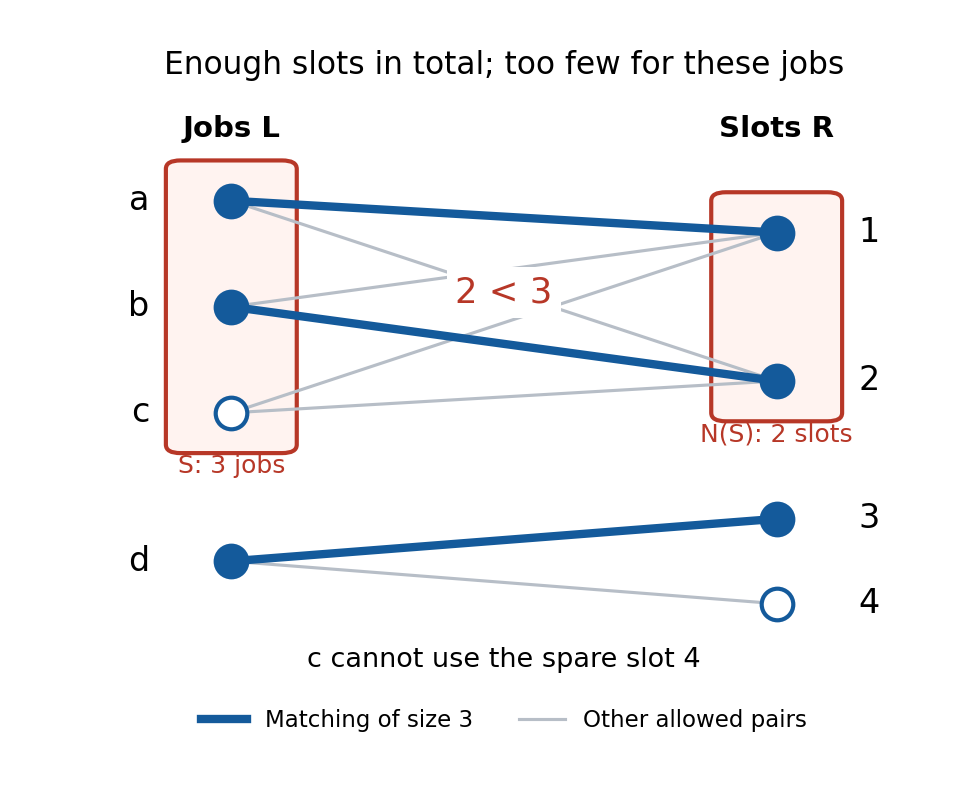

All sixteen left subsets can be checked by writing and if , otherwise . ThenOnly violates the Hall condition. Every matching in a graph uses at most two edges incident to and at most one incident to , so the matching number is three. There are exactly twelve size-three matchings in a graph: choose two of in three ways, assign them to in two ways, and choose or for . Thus the obstruction identifies the bottleneck: adding availability only for cannot help; allowing to use slot permits , a perfect matching.
If are independent with density on the positive axis, the Jacobian matrix of the inverse transformation has determinant . The joint density is for , factoring into an exponential distribution for and a unit-scale half-Cauchy distribution for . The underlying radial symmetry makes radius and angle independent.
Spin-averaged electromagnetic parton tensor 2026-10-14
For an on-shell massless quark with incoming momentum and outgoing momentum , average the initial spin and sum the final spin. The gamma matrix trace identities give . On shell , and defining and yields the displayed transverse decomposition. With the hadronic-tensor prefactor , one-particle Lorentz-invariant phase space gives . The antiquark has the same unpolarized tensor and squared electric charge.
For electromagnetic deep inelastic scattering with an unpolarized target, Lorentz invariance, parity and current conservation leave two independent deep-inelastic structure functions. With and , both tensor structures are transverse to . Terms with a free index disappear on contraction with a conserved leptonic tensor, although such terms can still be necessary to make the full hadronic tensor transverse.
For an absorbed spacelike photon, use , , and the physical momentum delta function . The displayed invariant final mass is compatible with deep inelastic scattering for . Using with the same positive- definition instead gives , which becomes negative in the Bjorken scaling limit and has no physical hadronic spectral support. Reversing the photon convention requires reversing the associated scalar-product and scaling-variable conventions too.
Use the full orthonormal Haar system, including the constant function. Dyadic partial sums are cell averages and converge uniformly for continuous . On a cell of length , a normalized detail has and pointwise size . Fix a coarse level where the modulus is small. Above a level chosen by reaching that small modulus, no detail can survive the threshold. Below it, omitted details along any one dyadic chain sum to a geometric bound. Thus the thresholded expansion differs from a sufficiently fine cell average by a uniformly small amount.
Minimal left covering net of a compact group 2026-10-14
For an open identity neighbourhood in a compact topological group, a finite left covering net is a finite set such that the left translates , , cover the group. Compactness gives such finite sets; minimum cardinality gives a minimal one. Left translation preserves minimality because implies .
Pauli-coordinate Haar measure on SU(2) 2026-10-14
The hemisphere graph of SU(2) as the three-sphere has induced metric , whose determinant is . Its volume density is therefore . Fixed left or right multiplication preserves the Euclidean norm on the four Pauli coefficients, so the round volume is Haar measure. Both hemispheres have volume , giving total volume and normalized density on each hemisphere. The apparent equatorial divergence is an integrable coordinate singularity.
Weyl integration formula for SU(2) 2026-10-14
For a class function on SU(2) and normalized Haar measure, the displayed formula reduces a group integral to its conjugacy-class angle. The weight follows by identifying SU(2) with the unit sphere in four real dimensions: writing a unit quaternion as gives spherical volume proportional to . Since , normalization gives .
Haar integral 2026-10-14
A Haar integral integrates a function against Haar measure. On a compact group, normalizing the measure to total mass one makes it an averaging operation. Translation invariance then implies that the average of a nontrivial continuous unitary character is zero: translating the integral multiplies it by a character value different from one.
For a compact group , positive normalized linear functionals on form a nonempty weak-star topology compact convex set. For finitely many translations, apply the Schauder-Tychonoff fixed-point theorem to the average of their induced affine dual maps. A fixed functional is stationary under this average. For each real continuous , its orbit function is continuous on the compact subgroup generated by those translations and satisfies a finite averaging identity. At a maximum, every summand must attain that same maximum; iteration and density of the positive-word semigroup force to be constant. Thus the functional is fixed by each of the finitely many translations. Compactness and the finite intersection property now give a functional invariant under every translation. The Riesz-Markov-Kakutani representation theorem turns it into a normalized Haar measure, without assuming commutativity of the group.
There are unlisted articles, also show them or only show them.