
For an augmented graded algebra , its positive augmentation ideal has indecomposable quotient . For a Sullivan minimal model , this quotient is with zero differential because every is decomposable. The map induced by projection is dual to the rational Hurewicz homomorphism under the finite-type model identification.
Dimension of a filtered module 2026-10-14
For a good filtration of a module over a fixed finite-dimensional filtration of a ring whose associated graded algebra is commutative and finitely generated, the cumulative Hilbert function is eventually a quasipolynomial by the Hilbert-Serre theorem. Its leading asymptotic degree is the dimension of the nonzero filtered module. Monotonicity forces the leading coefficients in its residue classes to agree. If the associated graded algebra is a standard graded algebra, the Hilbert function is eventually polynomial. Two good module filtrations bound one another after fixed shifts, so they have the same growth degree. Set . For the Bernstein filtration this is the Bernstein growth dimension of a Weyl algebra module.
Suppose is a right Noetherian ring and every essential right ideal contains a regular element of a ring. Preimages of essential regular principal right ideals under left multiplication are essential, so they contain regular elements and prove the right Ore condition. In the classical right ring of quotients , every right ideal is generated by its contraction to , making right Noetherian. An essential right ideal of contracts to an essential right ideal of , hence contains a regular element and is all of . A maximal disjoint complement to any right ideal has essential sum with it, so every right ideal is complemented. The right regular module is therefore a finite direct sum of simple modules, making semisimple Artinian.
A nonzero two-sided ideal of the classical right ring of quotients contains a nonzero element of the original ring: multiply a nonzero fraction by its regular right denominator. If the original ring is prime, the contractions of any two such ideals have nonzero product, so the quotient ring is prime too. The Goldie theorem makes it semisimple Artinian, and the Artin–Wedderburn theorem expresses it as a finite product of matrix rings over division rings. Primeness excludes more than one factor.
Lambda quotation 2026-10-14
For an effective Gödel numbering , the quotation is a Church numeral coding the syntax of . It is not a code of a beta equivalence class. The operations taking syntax codes to the code of an application, or to the code of the numeral itself, are total computable functions and hence lambda-definable functions.
Glycine titration 2026-10-14
Adding sodium hydroxide to acidified glycine successively removes its two titratable protons. Two broad buffer solution regions appear around the two pKa values, separated by a steep pH rise near the isoelectric point. This is useful evidence for two separated acid-base chemistry steps even though the changing chemical species are invisible. In the approximation that added hydroxide only changes glycine protonation, is the added base amount of substance per initial amount of substance of glycine. Then , and correspond to , and ; endpoints are not exactly pure chemical species. [ref]
Organic Chemistry by John McMurry. §26.2, Figure 26.2: calculated two-leg titration and half-equivalent interpretation
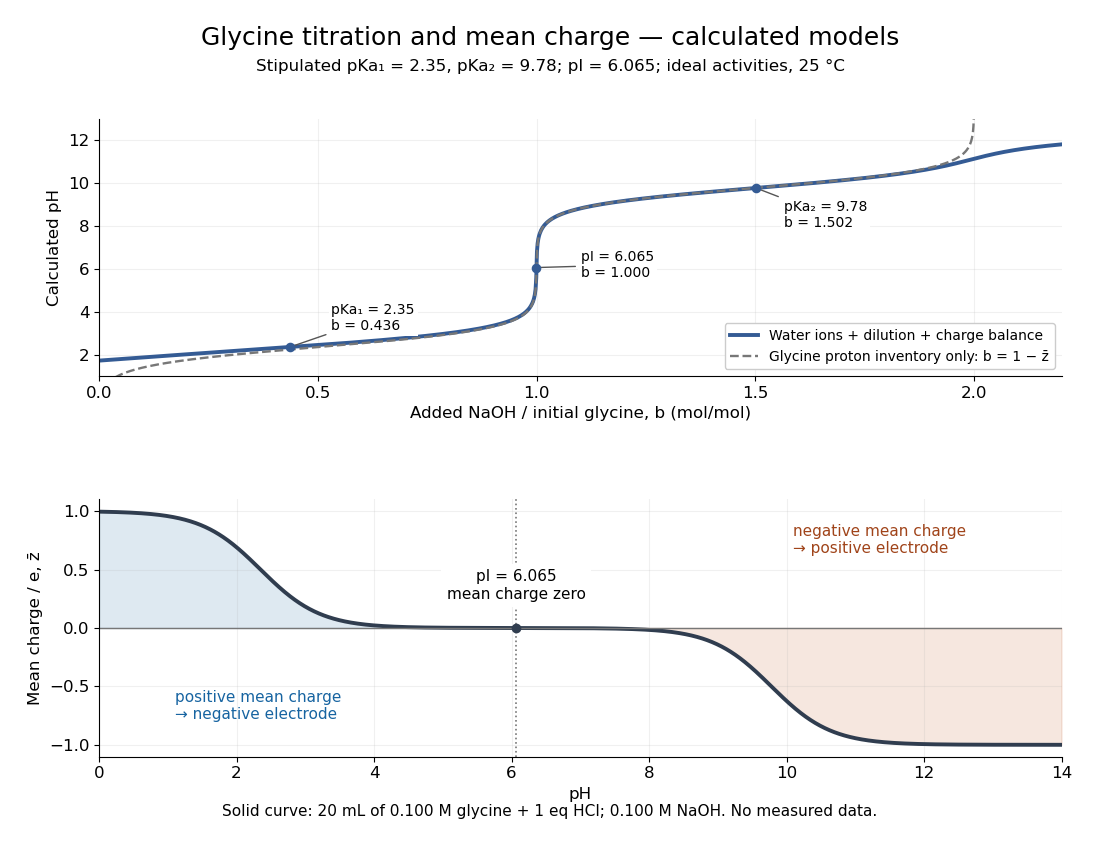

For the solid-curve model, start with of glycine in and exactly of fully dissociated hydrochloric acid; this fixes the chloride inventory, but does not force every glycine molecule to remain . Let the sodium hydroxide concentration be and . Assume volume is additive and no other ions are present; stipulate for self-ionization of water at a temperature of . ThenBalancing all positive and negative electric charges requiresSolving this equation gives the solid curve. It remains finite at and beyond , where ignoring free hydronium and hydroxide would fail. At the first pKa, the full model gives , rather than : appreciable free hydronium makes that half-equivalent shortcut inaccurate. At the second pKa, . Known acid inventory, dilution, and thermodynamic activity assumptions are therefore part of any quantitative interpretation, not optional corrections inferred from the curve's shape.
Glycine speciation model 2026-10-14
In an ideal aqueous chemical solution, set , with , and approximate activity coefficients by one. Put and for the stipulated dimensionless acid dissociation constants. The Henderson-Hasselbalch equation gives the adjacent-state ratiosWith analytical concentration , normalization gives the three fractions and mean electric charge in units of the elementary charge:All three fractions are nonnegative and sum to one. At pH , the model gives about zwitterion, cation and anion; . Predominantly zwitterionic therefore need not mean exactly at the isoelectric point.
Setting requires . Taking the logarithm yieldsAt this model isoelectric point, and : about of each charged form remains. At either pKa, the relevant adjacent fractions are equal, but the third fraction is not mathematically zero. This three-state model neglects the minor uncharged form ; macroscopic pKa values alone do not determine its fraction separately from the zwitterion.
Core of a glove game 2026-10-14
If there are fewer left owners than right owners, deleting any right owner leaves the grand-coalition value unchanged. The complement's core constraint and efficiency force that owner's payoff to be zero. Mixed-pair inequalities then require every left owner to receive at least , and efficiency makes all these payoffs exactly . Reverse the types when right owners are scarce. If both counts equal , sum all mixed-pair inequalities. Their total is exactly times the grand-coalition payoff, so each pair sum is . Hence all left owners receive a common and all right owners . Such allocations meet every coalition constraint because . This proves the complete core description.
Let be globally generated of rank on a projective curve, and put . The pairs with form the total space of the kernel of the evaluation map over the curve. This incidence variety has dimension . Its image in is closed because the curve is proper, and is a proper subset by the dimension bound. A section outside it vanishes nowhere and gives a line subbundle with locally free quotient.
For a vector bundle of finite positive rank let be an upper degree bound for the line subbundles of . If , no nonzero map can exist for any point : its saturated image would have degree at least . Serre duality then gives . The evaluation exact sequence shows that is surjective at every point, proving the assertion with a uniform bound in .
Orient the upper-quadrant contour from down to zero and then to . The reflected half-line transform has zero inverse contribution for positive . Adding times this contribution, and deforming boundary integrands through the second quadrant where , gives boundary coefficients . Thus removes the unknown Neumann trace for a prescribed Dirichlet value, while removes the unknown Dirichlet trace for a prescribed Neumann value. The initial reflected term has coefficient and cannot be discarded after the time-dependent spectral decomposition.
For the linear dispersive Stokes equation , let . Its local relation is obtained with . Integrating over the half-line gives the displayed global relation, with negative-exponential Half-range Fourier transforms and . The spatial transforms are holomorphic for , whereas the finite-time boundary transforms are entire functions.
Drift-diffusion half-line global relation 2026-10-14
For on , write and . Twice integrating by parts gives in the lower transform half-plane. The dispersion relation is invariant under . This global relation eliminates one unknown boundary trace after the symmetry maps the inversion contour into the transform's analytic domain.
Semistrip Laplace spectral global relation 2026-10-14
Let be a real harmonic function in a semistrip, , and . Let be the negative-exponential Half-range Fourier transforms of and , and put , . The closed differential form has zero boundary integral. Integration by parts of tangential derivatives cancels all corner values and gives the displayed global relation, for .
// Target: analysis.bigb
Finite-interval Airy global relation 2026-10-14
For the Airy equation on , define and analogously at . Set and . Integrating the local relation with flux proves the displayed global relation. The dispersion relation is invariant under multiplication of by a cube root of unity; the resulting three equations determine the three missing boundary transforms for data .
Let and . Using the roots of cubic dispersion symmetry with negative transport, put . The Fokas method formula is an initial real-line integral minus an integral over of , both divided by . The boundary is oriented with on the left. Its unknown final-state transform has zero integral by analyticity and upper-half-plane decay.
A physical unitary gate used without coherent control gives the same quantum channel for and :Interleaving any preparations, known operations and measurements preserves this equality. Equivalently, each fixed measurement branch with uses gains only the overall factor , which cancels in its probability. Thus unrestricted repeated uncontrolled uses do not determine the common phase of the eigenvalues. A supplied controlled unitary gate is a different resource: changes by a relative control phase when is replaced by . Such controlled access permits quantum phase estimation to measure that phase relative to the identity branch.
For , both logarithms in the display can use their principal logarithms. The real part is and the derivative is . The two residues cancel on a loop surrounding both points. Equivalently is globally single-valued outside the unit circle, although individual logarithms of and are not.
// Destination: complex-dynamics.bigb
Critical region of a phase transition 2026-10-14
The critical region is the range of control parameters near a thermodynamic critical point where correlated order parameter fluctuations invalidate a simple mean-field approximation. For short-range scalar quartic theory below four dimensions, the dimensionless Ginzburg criterion ratio grows as in fixed microscopic units. The range where this ratio is of order one or larger is fluctuation dominated. Its width depends on nonuniversal microscopic coefficients even though the limiting critical exponents can be universal.
For the dimensionless scalar Landau-Ginzburg theory with stiffness , quadratic coefficient and quartic term , the mean-field approximation gives and correlation length . Restricting the Gaussian Fourier transform covariance to estimates the variance of the field averaged over a correlation volume as , up to a dimension-dependent constant. Dividing by proves the displayed Ginzburg criterion ratio. It diverges below four dimensions, vanishes above four and is marginal at four. Short-distance fluctuations renormalize microscopic coefficients and should not be confused with this long-distance critical test.
There are unlisted articles, also show them or only show them.