
Write the trap angular frequency as and the single-particle oscillator length as . The center of mass coordinate and relative coordinate give independent quantum harmonic oscillators, both of frequency , with masses and reduced mass . Label their excitation numbers by and . The unperturbed energy eigenvalue is .
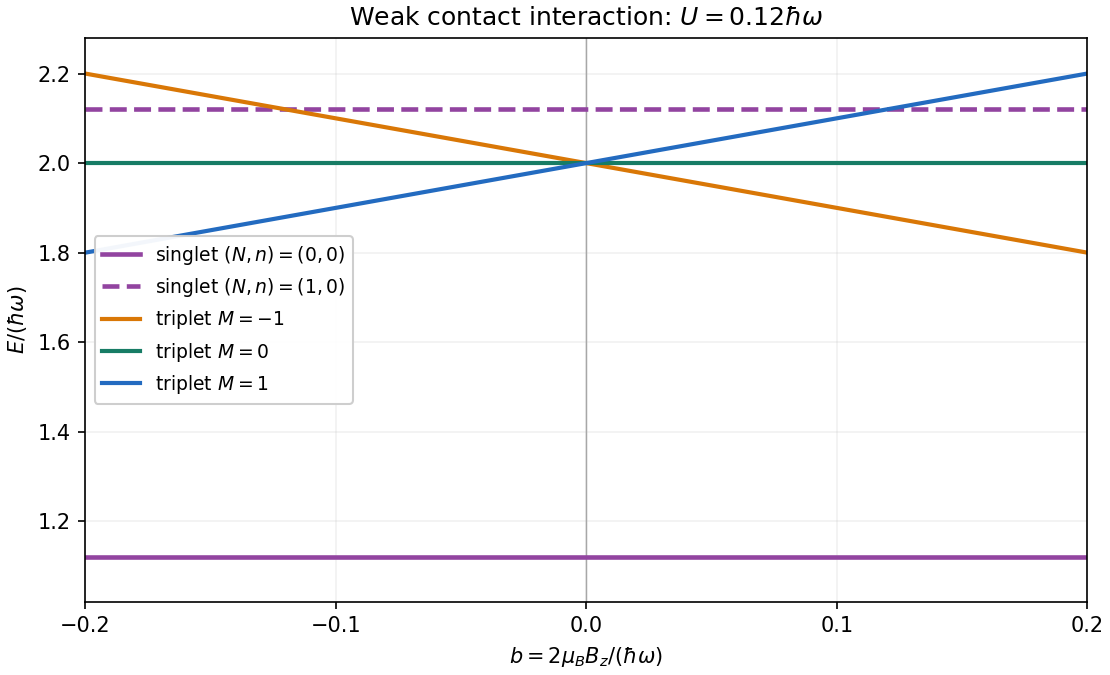
Particle exchange leaves unchanged and sends to . The exchange symmetry of two identical spin-one-half fermions therefore requires even to accompany the spin-one-half singlet state, and odd to accompany a spin-one-half triplet state. For the contact shifts of two spin-one-half fermions in a harmonic trap, the delta potential depends only on . For odd , the relative wavefunction vanishes at , so its contact shift is zero. Within the first-excited manifold, both perturbations are diagonal in the labels : this is a perturbation diagonal within a degenerate eigenspace. For , the relative oscillator length is , giving the first-order nondegenerate perturbation theory shiftThe Zeeman splitting is for total spin projection . Thus the five lowest states, counted with multiplicity, haveunder the assumed conditions . The three triplet states have slopes , while both singlet states are field independent at this order. The three triplet state branches coincide at zero magnetic field. Their crossing with the excited singlet state is allowed because the total-spin sectors do not mix. The odd relative wavefunctions are in fact unaffected by this delta potential at any coupling; the displayed singlet state shifts retain only first order.

A density matrix has unit trace. The Pauli matrices are traceless, so and hence . Using in the expectation value givesConsequently the required Bloch vector and density matrix areThe two eigenvalues are and , both positive, so this is a valid density operator. Its purity of a density operator isTherefore it is a mixed state. Equivalently, its spectral decomposition is , an ensemble of the two distinct spin one-half along an axis states, rather than a single pure state.
By addition of angular momentum, combining the first two spin one-half particles gives . Adding the third gives the three spin-one-half angular-momentum decompositionThus there is one total-spin sector and two independent sectors. Since the particles are distinguishable, no fermionic exchange symmetry restriction removes either copy. In a simultaneous angular momentum eigenstate, and have eigenvalues and , soThe energy levels and their generic multiplicities areThe count agrees with the dimension of the three-particle tensor product. These multiplicities must be added whenever numerical energy eigenvalues coincide. In particular, for and , there are two fourfold degenerate energy levels, and . For and , the multiplicities at are . If both coefficients vanish, the single energy level has multiplicity eight. Other coincidences between the two total-spin sectors occur when , with from the quartet and from a doublet.
There are unlisted articles, also show them or only show them.