
Past exam of the advanced quantum physics course of the University of Cambridge 2017 2 a Solution 2026-10-18
A spherical tensor operator of rank transforms under rotation like an angular momentum . The Wigner-Eckart theorem writes its matrix elements asThe reduced matrix element contains the radial and other dynamical information; the Clebsch-Gordan coefficients determine the dependence on the projections. Ratios within a fixed pair of multiplets therefore follow without a radial integral. The angular selection rules include and .
For the position vector, choose the rank-one componentsLet . The stretched Clebsch-Gordan coefficients and one lowering step giveFor example, apply the total angular momentum ladder operator to the stretched state. The result has components with coefficients and , corresponding to lowering the initial angular momentum and the vector component, respectively.
Only the component of contributes to . The operator cannot connect the projections in , so that matrix element vanishes. With the convention above,Thus the requested relative magnitudes and their squared values areThese ratios presume a common nonzero reduced matrix element. The position operator has odd parity, so an electric dipole transition requires opposite-parity multiplets; for one Electron the electric-dipole selection rule also gives . The displayed labels alone do not establish that condition. If the common reduced matrix element vanishes, all three matrix elements vanish and no nonzero ratio can be inferred.
Past exam of the advanced quantum physics course of the University of Cambridge 2017 1 c Solution 2026-10-18
Write . The shell theorem makes the potential energy of the Electron constant inside the charged spherical shell. Relative to the point-proton Coulomb potential, the perturbation isIt is positive: the finite charge distribution weakens the attraction close to the origin.
The first-order energy correction is the expectation value of this perturbation in the unperturbed hydrogen atom ground state. Integrating its probability density over spherical volume givesFor a proton radius much smaller than the Bohr radius, expand the exponential uniformly over this short interval. The leading integral isSince , the signed fractional change isEquivalently, to leading order: the energy increases and the binding-energy magnitude decreases. This is the finite proton-shell correction to hydrogen ground energy.
If no small-radius expansion is made, the same time-independent perturbation theory integral gives, with ,Its expansion starts with , in agreement with the leading result. The integral is exact for the first-order calculation; it is not an exact solution of the perturbed Schrödinger equation.
Past exam of the advanced quantum physics course of the University of Cambridge 2017 1 b Solution 2026-10-18
The operators associated with the two angular momenta commute with one another, and each squared angular momentum operator commutes with every component of that same angular momentum. Two useful identities areConsequently the two maximal commuting subsets of the displayed collection are
The first set gives the uncoupled eigenbasis . Its eigenvalue is already fixed by . The second gives the coupled eigenbasis for the addition of angular momentum. Its scalar-product eigenvalue is already fixed by . Thus an independent complete set of commuting observables uses four operators in either case; literal maximality within the question's list includes the dependent fifth operator.
For generic nonzero angular momenta, no further listed operator can be added. In particular,is generally nonzero, and . The same obstruction applies to . Their sum commutes because the two commutators cancel.
Past exam of the advanced quantum physics course of the University of Cambridge 2017 1 a Solution 2026-10-18
Use the isolated nuclear spin Zeeman effect implied by the supplied nuclear magnetic moment, with hyperfine structure neglected. The proton gyromagnetic ratio isThe two spin levels are separated by . Resonant nuclear magnetic resonance therefore requires the Larmor frequency
The duration is a Rabi pi pulse: in a frame rotating with the resonant transverse magnetic field, the spin must rotate through . If denotes the magnitude of a circularly rotating field with the correct sense of rotation, the Rabi angular frequency is . The shortest pulse is then
There is an amplitude convention to specify. If the applied transverse magnetic field is instead the linearly oscillating , its resonant circular component has magnitude . The rotating-wave approximation gives and henceThe wording does not specify this polarization convention, so the two pulse durations should be distinguished. Odd multiples of either shortest Rabi pi pulse also invert the spin within the corresponding ideal model.
Longitudinal resistance in a Hall bar 2026-10-18
Voltage contacts separated along the current direction measure longitudinal resistance, even when the device is called a Hall bar. For an approximately uniform rectangular strip, . Transverse contacts measure instead. Shubnikov-de Haas effect oscillations in need not be Hall-resistance plateaus; in the integer quantum Hall effect, longitudinal minima accompany quantized transverse plateaus.
Hall bar 2026-10-18
A Hall bar is a strip with current contacts at its ends and additional voltage contacts along its sides. Opposite-side contacts measure a transverse electric potential difference; same-side contacts at different longitudinal positions measure a longitudinal electric potential difference. Separate voltage leads reduce the influence of current-contact electrical resistance when their input electric currents are negligible.
Let the first layer have channel resistances and the second , with a common spacer . Define . The same circuit rules giveSubtracting their numerators gives . The sign therefore depends on whether the two layers favor the same global spin channel. With , and , the values reverse: , . The model's ratio is then . Positive magnetoresistance was a consequence of the identical-layer assumptions, not a theorem about every two-channel network.
Define a dimensionless channel contrast and spacer ratio . Positive give , and substitution gives the displayed expression. Equal channel responses, , eliminate the model's magnetic-configuration signal. Increasing the common spacer resistance at fixed increases the denominator and decreases .
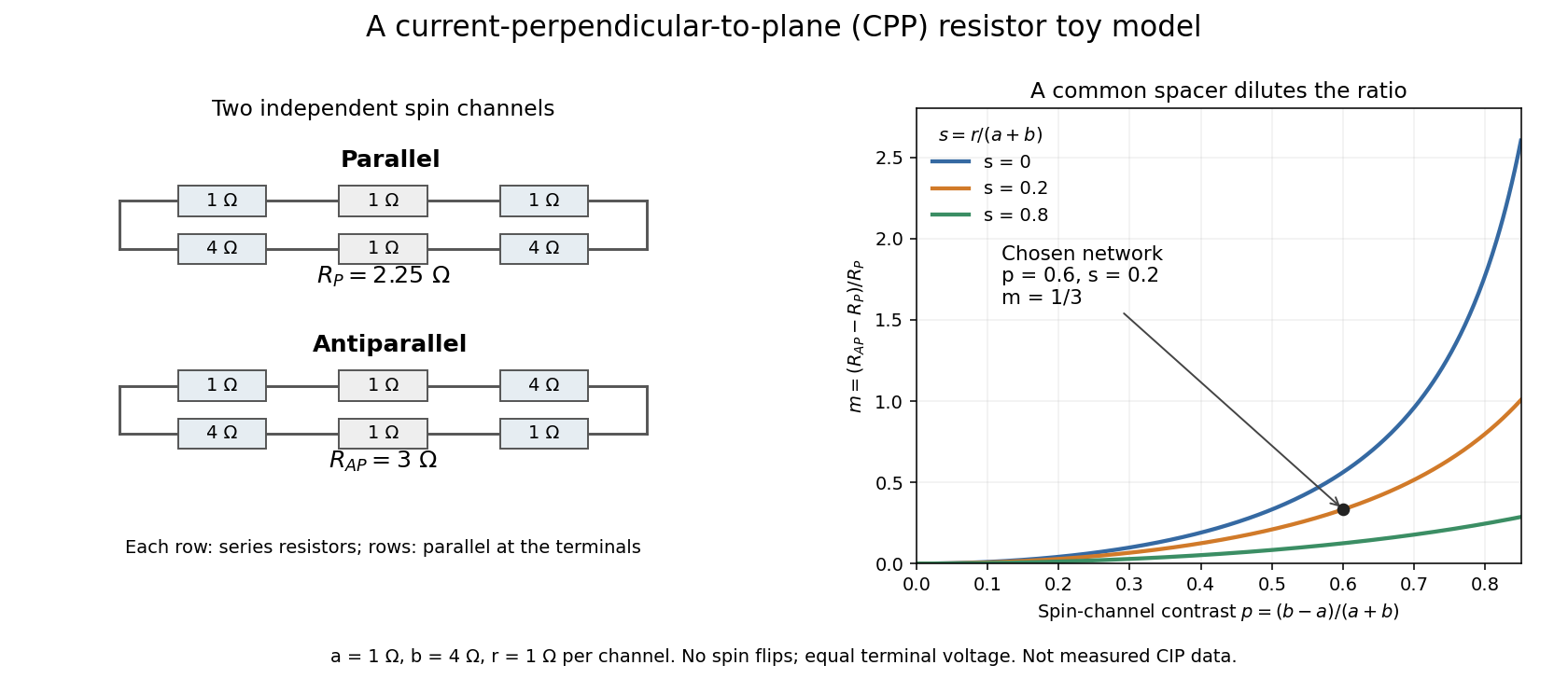

This is a controlled comparison within the model. In an actual multilayer, changing a spacer thickness can change the magnetic coupling and the interfaces as well as electrical transport. Spin-flip scattering also mixes the channels that the calculation kept independent.
Magnetoresistance ratio 2026-10-18
A quoted percentage needs its denominator. Define the resistance increase relative to the low-resistance state by . The decrease relative to the high-resistance state is instead . For ,The chosen example has and : a increase and a decrease describe the same pair of resistances. A paper reporting a field-induced drop relative to its zero-field value need not be using the same percentage convention as a plot normalized by .
X unit 2026-10-18
The historical X unit was a practical X-ray wavelength unit, approximately . Its scale used an assigned calcite spacing; relative wavelength measurements could be more precise than absolute determinations. Variation between crystal specimens led to calibration using reference spectral lines. An X unit value therefore cannot simply be read as an exact multiple of .[ref]
Nomenclature System for X-ray Spectroscopy prepared by R. Jenkins and others. IUPAC, Nomenclature system for X-ray spectroscopy, §5.1 Units, printed p. 745
An angular-scale check determines how an indicated rotation corresponds to an angle. A reference line transfers a wavelength scale. An absolute determination ties that scale to an independently established length standard. These are different calibration tasks. Repeating measurements can reduce random scatter without correcting the common scale: if every inferred is too large by a chosen , all inferred absolute wavelengths are too large by , while ratios using that same are unchanged.
Ramsey interferometry 2026-10-18
Ramsey interferometry uses two coherent pulses with a free interval between them: the first creates a quantum superposition, the interval accumulates relative quantum phase, and the second converts that quantum phase into measurement probabilities. Its attraction is that an ordinary population readout can reveal the quantum coherence hidden from an energy measurement during the free interval.
Here is an ideal qubit model with an explicit pulse convention. Let , prepare , apply , evolve freely with , and apply the inverse pulse before a computational-basis measurement. The first pulse gives . Direct matrix multiplication givesThus the Born rule gives and . Before the second pulse, the same computational-basis measurement would give for both outcomes for every . At , the second pulse changes these probabilities to and . If the two pulses have the same sign instead, the output labels interchange: the pulse convention is part of the prediction.
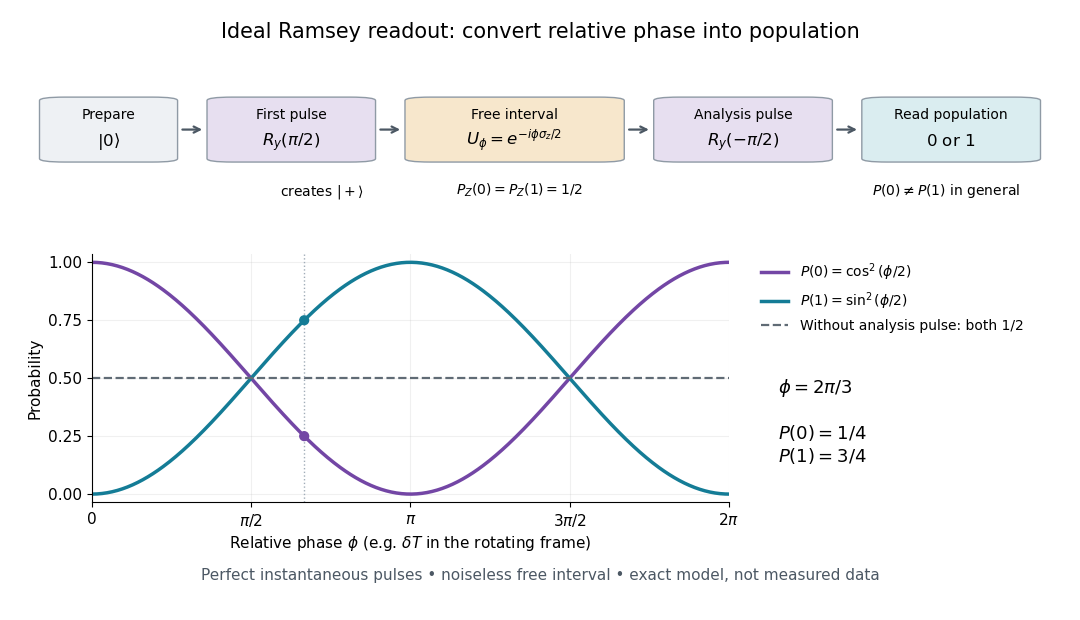

In a pulse experiment the phase is measured relative to the oscillator supplying the coherent pulses. In a rotating frame, write the free Hamiltonian operator as with signed angular frequency difference in the chosen labeling convention. A free interval then accumulates ; changing the second pulse's phase changes the analysis direction. This comparison makes Ramsey interferometry useful for measuring frequency differences and diagnosing loss of quantum coherence.
For example, suppose the first pulse has prepared a density matrix with equal populations and transverse Bloch vector length :The same inverse analysis pulse yields . The pure state case gives the full ideal fringe; the mixed state gives the flat result . This is a controlled mathematical comparison, not a fit to an experiment. Experimental contrast alone does not identify quantum decoherence: imperfect preparation, pulse errors and readout errors can also reduce it.
There are unlisted articles, also show them or only show them.