
Interpret the stated as the coherence-decay time, or the mean interval between fully phase-randomizing collisions in the simple impact model of pressure broadening. Then each line has correlation . The collisional phase relaxation and Lorentzian linewidth transform givesThe intrinsic spectrum is the sum of two such Lorentzian line shapes, still centred apart. With equal weights and balanced arms, its normalized visibility isFor the intensity normalization of the first source plot, the corresponding model interferogram isThe constant background remains ; only the oscillatory contrast decays. The beating zeros and recurrence spacing remain fixed, but successive visibility revivals shrink, reaching a factor at and at . Long-delay fringes disappear toward the background.
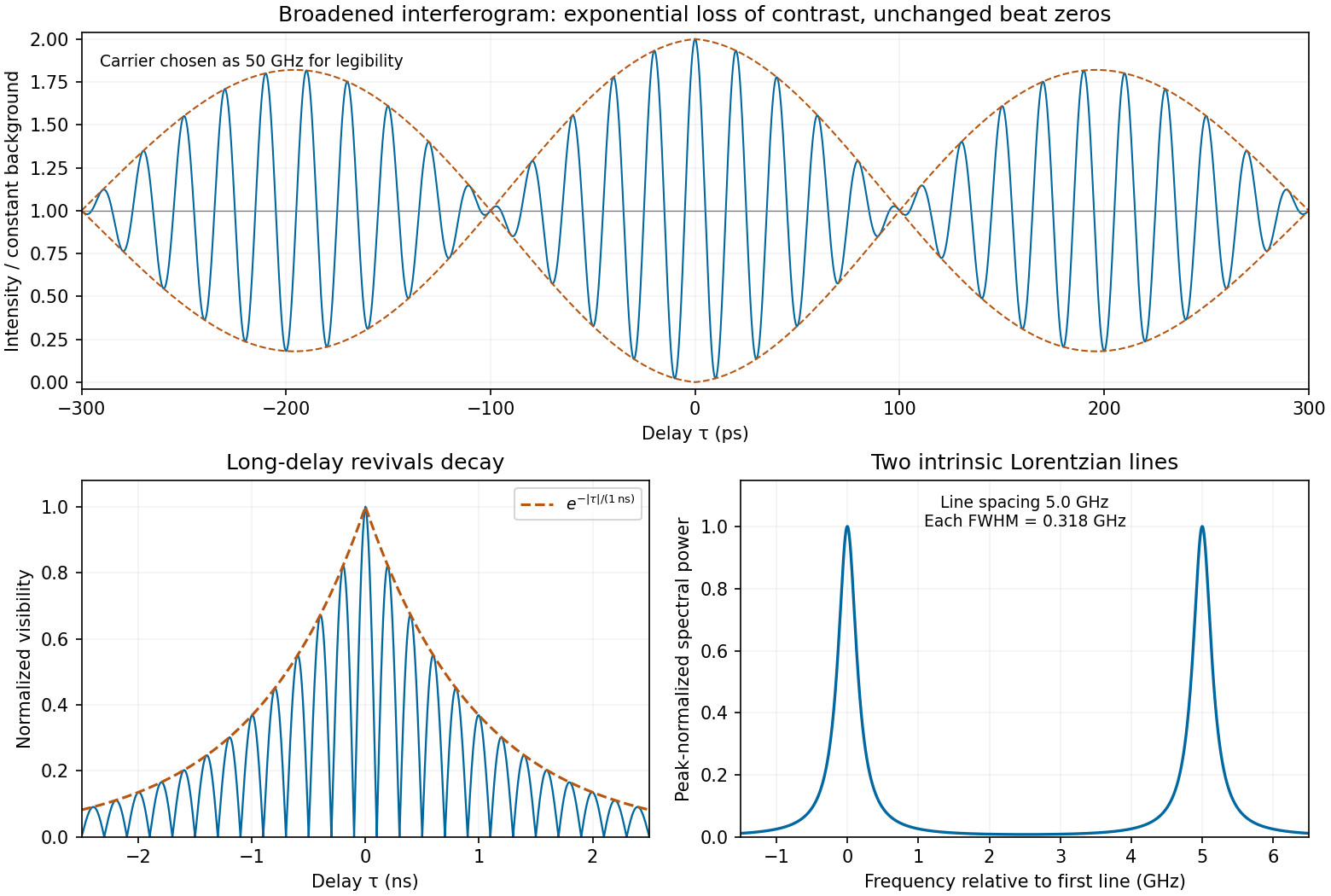
Calculated pressure-broadened interferogram, decaying visibility revivals and Lorentzian doublet for a one-nanosecond coherence time
. Details. 
The sketch chooses a carrier frequency for legibility; the envelope and linewidth follow from the inferred spacing and specified coherence time. A finite experimental delay window additionally convolves these intrinsic Lorentzians with the instrumental line profile. If were instead a population lifetime, the lifetime-limited field decay rate would be and the corresponding linewidth would be half the boxed value. The source does not define that time convention explicitly; pressure-collision coherence decay is the interpretation used here.
For equal line intensities, the correlation is proportional to . The two-line coherence beating envelope is therefore .
In the original first plot, the first visibility zeros are at approximately ; the envelope revives at and about . HenceUse the envelope recurrence or its nulls, not the much faster carrier fringes. The visibility zeros indicate equal component intensities in the ideal model; unequal intensities would leave a nonzero minimum. The arbitrary vertical normalization does not affect the inferred separation.
Let the two arms deliver intensities with unit Jones vectors . For a perfectly coherent input, the recombined intensity under relative phase isConsequently the polarization overlap in interferometric visibility isFor equal returned intensities, two linear polarizations at angle have overlap and thereforeChoose one linear direction as and a circular polarization as . Their overlap has magnitude , givingA non-polarizing beam splitter does not by itself guarantee equal arm losses; if , multiply either boxed polarization factor by . Perfect temporal coherence does not compensate for polarization or intensity imbalance.
A non-polarizing beam splitter divides the incident spectrum into a fixed arm and an arm with a translating mirror. Recombining their returned fields gives a detector signal as a function of mirror position . The round-trip optical path difference is relative to the equal-arm position, so the delay is in air approximated as vacuum. Record both detector signal and calibrated position, subtract the constant background, and take a Fourier transform of the interferogram.
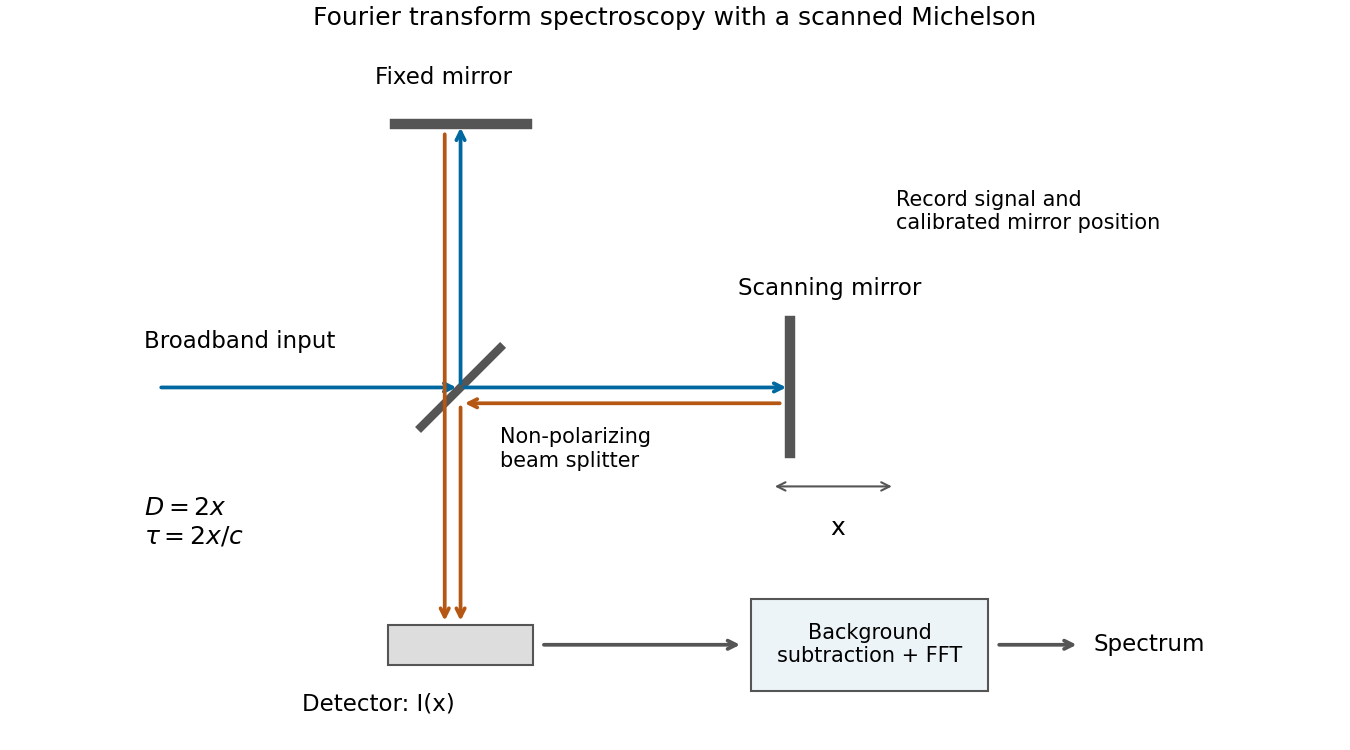
Scanning Michelson spectrometer: mirror position sets delay, and a Fourier transform of the recorded interferogram recovers the spectrum
. Details. 
For matched arm polarizations and balanced throughput, write the ideal signal aswhere is the incident spectral power density and is a constant set by the beam splitter and detector. This is the cosine-transform form of Fourier transform spectroscopy, or equivalently the Wiener-Khinchin theorem applied to delayed self-interference.
The delay-range resolution in Fourier transform spectroscopy follows because recording a finite delay range multiplies the correlation by a window. Its transform broadens each spectral line by an instrumental width of order the reciprocal delay range. A mirror travel range creates a delay range of order , soAt fixed wavelength, absolute wavelength resolution therefore improves inversely with travel range. The numerical coefficient depends on whether is a one-sided or total travel, on the window or apodization, and on whether resolution means first zero, half width or another criterion. The proportionality is the requested convention-independent result. Position sampling must also be fine enough to sample the fastest fringe variation without aliasing.
A complete pairwise tensor contraction of copies of is represented by closed index cycles. Each cycle is a trace , possibly with a sign from reversing an index pair. If a contraction is internal to one copy, it contains the already vanishing . Otherwise an odd total number of copies forces at least one cycle of odd length, since a sum of even lengths is even. That trace vanishes by the transposition argument in part (ii). Therefore every such complete contraction is zero. This proves vanishing odd complete contractions of an antisymmetric matrix without assuming that all contractions form a single trace.
The contraction is . Since , transpose and invariance of the trace giveThis is the odd-power case of vanishing odd complete contractions of an antisymmetric matrix.
Relabel the two dummy indices and use the respective symmetries:Thus the symmetric tensor and antisymmetric tensor subspaces are orthogonal in the Frobenius inner product.
Let . The product rule and differentiation of the matrix exponential givewhere brackets are the operator commutator. Evaluating at zero gives , and . The Taylor series at zero is consequentlyIn particular , which also follows by multiplying the two matrix exponential series through quadratic order. For fixed finite matrices the remainder has the stated Big O notation in any matrix norm.
Termwise differentiation of the absolutely convergent matrix exponential series givesBecause and commute, also commutes with every power of and hence with . The product rule therefore givesDirect differentiation gives , and both initial values are . The uniqueness theorem for ordinary differential equations, applied to the finitely many matrix entries, implies . One can see uniqueness directly: the difference obeys and , soand the product is identically zero. At this yields
Complete the square in the Hermitian matrix polynomial:For every nonzero vector ,Thus is a positive-definite matrix, so . In finite-dimensional spectral theorem terms, each eigenvalue isIf , the scalar polynomial has real roots of a polynomialAn allowed nonzero root can be an eigenvalue of , a Hermitian matrix which is also an invertible matrix, in which case has a zero eigenvalue. For example, , , gives . The weaker inequality does not force failure for every ; it removes the general positive lower bound. There is also the harmless corner , for which stays positive definite because is invertible, even though the strict discriminant hypothesis is absent.
For the unitary matrix , . Therefore is a Hermitian matrix:Every positive integer power remains a Hermitian matrix, since . Its eigenvalues are real by the finite-dimensional spectral theorem. Equivalently, matrix similarity giveswhose eigenvalues are , where the are the real eigenvalues of .
Put , so . Because the Hermitian matrices commute,For every nonzero vector ,since is an invertible matrix. Thus and are invertible matrices, justifying the inverse in the definition of . The conjugate transpose of is . Since and commute, their inverses do too, andHence is a unitary matrix.
Using the conjugate transpose and the Hermitian matrix assumptions,Thus is a Hermitian matrix, whether or not and commute.
Take . Indeed the conjugate transpose isso the anticommutator is a Hermitian matrix. The original PDF, p. 6, supplies the factor that is corrupted in the local OCR.
The conjugate transpose reverses the order of matrix multiplication. Since and are Hermitian matrices,Consequently : the condition is exactly that the two matrices commute.
Iterating the Gamma function recurrence gives a meromorphic continuationNear , the numerator is analytic and tends to . Exactly one denominator factor, , vanishes, while all other factors tend to the nonzero product . ThereforeThus . More precisely, the Gamma function residue at a nonpositive integer is . Taking large enough to put in the original right half-plane also shows that this continuation introduces no other finite poles.
Past exam of the mathematics course of the year 2 of the natural sciences course of the University of Cambridge 2024 Paper 1 7 b ii Solution Created 2026-10-18 Updated 2026-10-20
For real , apply integration by parts to the gamma integral with and :The boundary term vanishes: at zero, and exponential decay dominates the power at infinity. This proves the Gamma function recurrence
Past exam of the mathematics course of the year 2 of the natural sciences course of the University of Cambridge 2024 Paper 1 7 b i Solution Created 2026-10-18 Updated 2026-10-20
Substituting into the defining gamma integral givesBoth endpoints are convergent, so no continuation of the Gamma function is needed here.
For the upper Apollonius circle, let its constant ratio be . Matching the center and radius from part (i) givesSubtracting their squares yields . AlsoThe relevant inverse hyperbolic cosine is positive. Now is the real part of a local holomorphic logarithm, hence a harmonic function away from . The point is inside the excluded disk, because , while is below the real axis. Thus neither singularity lies in the physical domain.
On the numerator and denominator have equal modulus, so the logarithm is zero. On the circular boundary its value is . Therefore the harmonic potential between a grounded line and a circular boundary isThis verifies Laplace's equation and both prescribed Dirichlet boundary conditions. It also tends to zero at infinity. A uniqueness assertion on this unbounded domain would require an additional boundedness or infinity condition; the displayed function is the natural decaying solution requested.
Write and square the modulus equation. It becomesFor , completing the square gives the Apollonius circleHenceThe printed statement needs the exception : equal distances from and give their perpendicular bisector, a straight line rather than a finite-radius circle. For the center lies in the upper half-plane; this is the case needed in part (ii). The original PDF confirms the numerator , correcting the duplicated, corrupted OCR formula.
There are unlisted articles, also show them or only show them.