
The variable initial energy replaces in the kinematic expression before differentiation. The charged-lepton mass remains fixed:Thus the required Jacobian determinant in this one-dimensional change of variables isEquivalently, gives , so , the same result. It is dimensionless in natural units.
In the pion rest frame, write its four-momentum as and the charged lepton's as . By four-momentum conservation, the massless antineutrino has , with . ThereforeIts energy is , and for a massless antineutrino, . The final momenta are equal and opposite, soThe expression is positive precisely when the two-body decay is energetically allowed, , neglecting the neutrino mass.
Ignoring the requested final-mass difference and initially taking equal hadronic matrix elements, the common factor cancels. A decay width is proportional to the squared decay amplitude, soWith the supplied Cabibbo angle,The quoted measurement, about , is larger by a factor . If that whole difference were attributed to a ratio of other amplitudes, it would require a factor .
This does not invalidate quark mixing. The supplied Cabibbo-Kobayashi-Maskawa matrix is only a schematic hierarchy in powers of , particularly for ; its omitted coefficients matter greatly after squaring. Equal phase space also does not imply equal hadronic decay amplitudes: the two transitions have different hadronic form factors and strong-interaction dynamics, and loop contributions can interfere with the charmless tree amplitude. Thus the calculation correctly predicts enhancement of the charmed channel, but the supplied CKM hierarchy alone does not quantitatively predict the measured ratio. It would be unjustified to treat as a precision prediction with only the quoted experimental error.
The antiquark in the specified is a spectator. For the charmed final state the leading external-W boson tree iswith and . For the charmless final state replace the active transition by , giving and the same . Their weak amplitudes have factors and , respectively, up to an irrelevant overall conjugation convention.
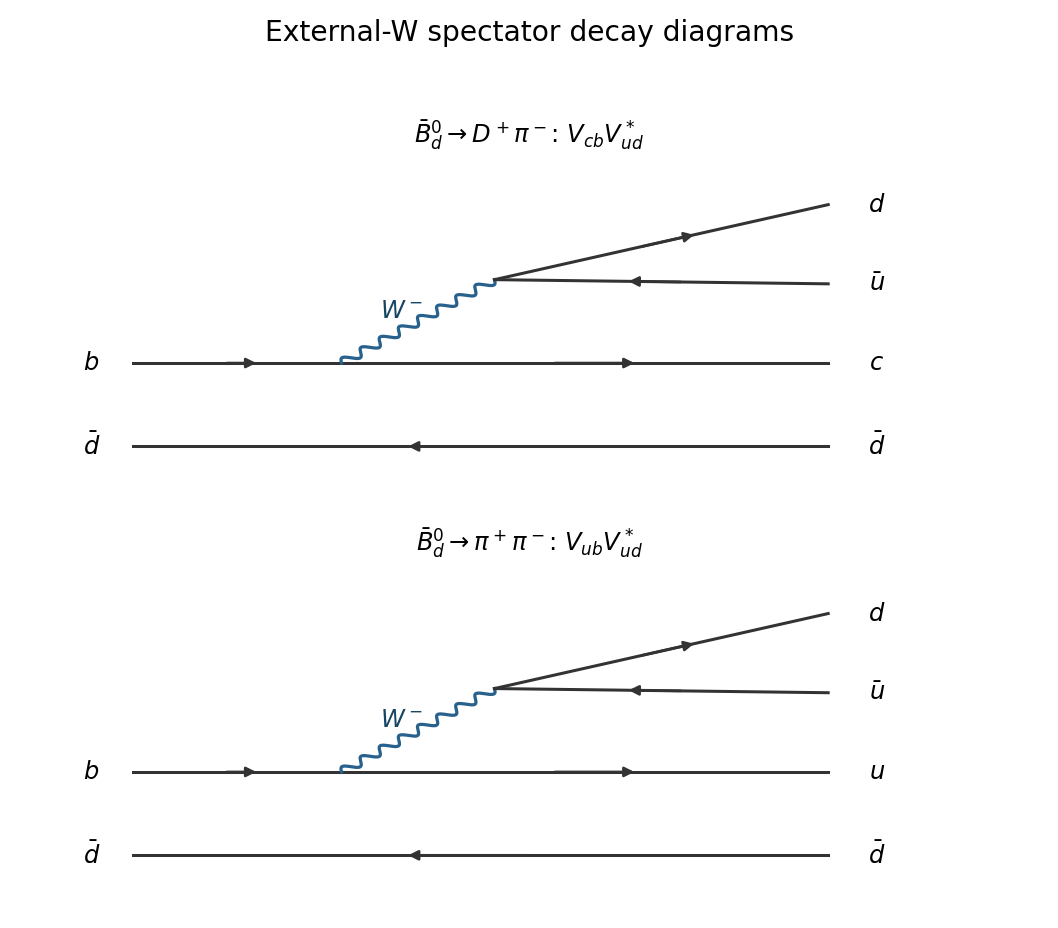
The diagrams determine the leading weak flavour factors. Strong-interaction matrix elements and, particularly for the charmless channel, additional loop diagrams can also contribute to physical branching fractions.
For both modes, a leading weak quark transition in is , followed by , with the original acting as a spectator quark. This produces the four quarks needed for , using the component of . Producing three pions additionally requires a pair from strong hadronization. A representative quark-line diagram draws it as gluon emission and splitting.
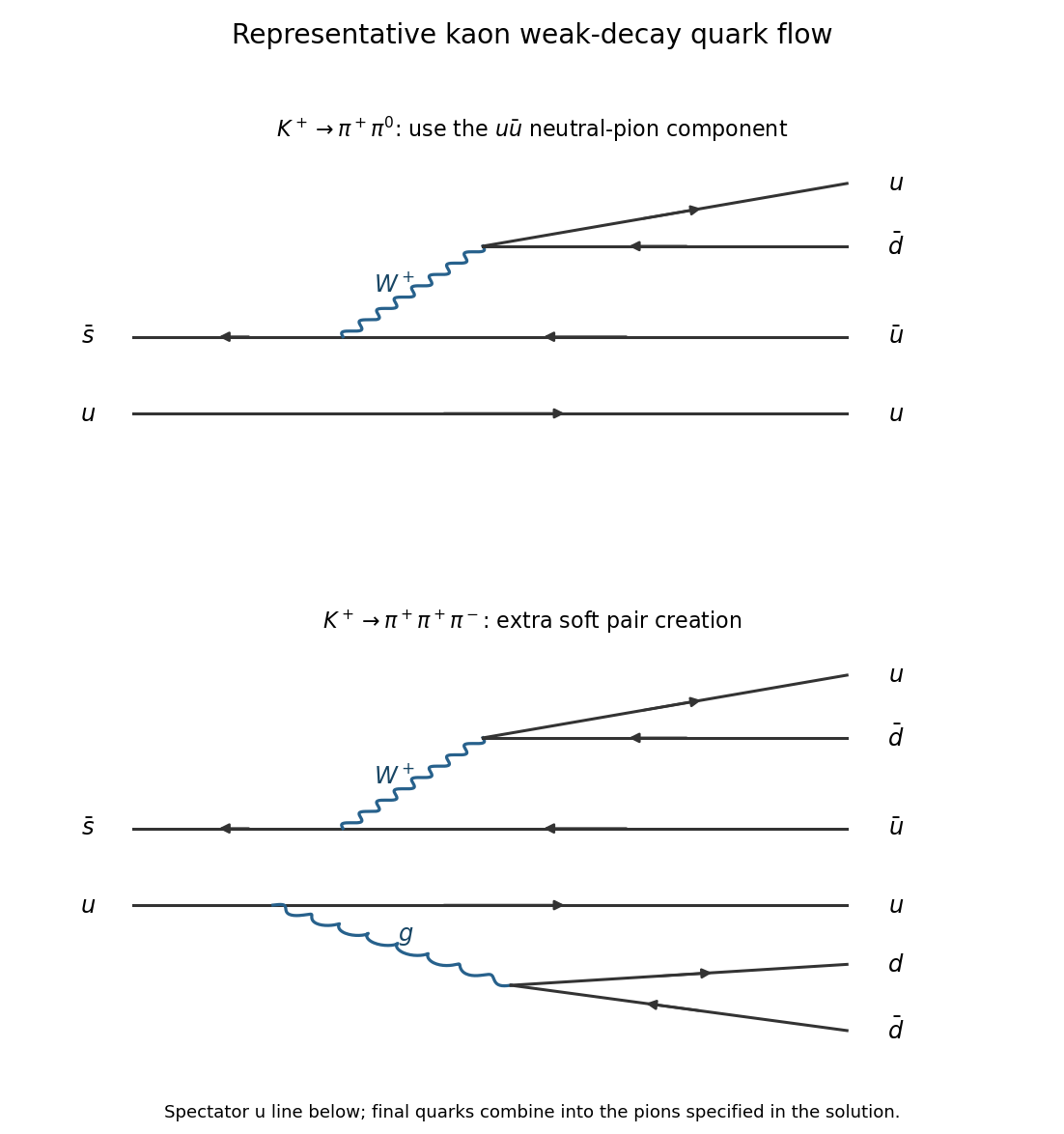
The three-pion assignment is , , and , matching . The extra soft pair creation is a schematic representation of hadronization, not a controlled perturbative prediction of the relative decay rates. Both processes are first order in the effective weak interaction.
There is an explicit error or hypothetical assumption to address: the original PDF assigns to all these mesons. Taken literally, the two-pion final state has , because all particles have zero spin and the initial is zero. Its parity is . For three spinless particles, use two Jacobi orbital angular momentum quantum numbers . Coupling to total zero requires , so the orbital parity is and the three-particle parity is also . Thus under the printed assignment, both channels conserve parity.
The named physical pions and kaons are instead pseudoscalar mesons with . With those physical assignments,ThereforeThese two opposite-parity final states from the same physical kaon are a classic illustration of parity violation in a weak decay. The physical conclusion requires correcting the printed parity assignment explicitly.
Past exam of the particle and nuclear physics course of the University of Cambridge 2021 Section B 4 b Solution Created 2026-10-18 Updated 2026-10-20
In the Wu experiment, Chien-Shiung Wu and collaborators studied beta-minus decay of polarized cobalt-60,A thin cobalt-60 layer on a cerium magnesium nitrate crystal was cooled by adiabatic demagnetization to a few millikelvin. A polarizing magnetic field produced nuclear polarization. An anthracene scintillation counter and photomultiplier detected the emitted electrons; angular gamma ray observations from the daughter de-excitation monitored whether the nuclei remained polarized.[ref]
Experimental Test of Parity Conservation in Beta Decay by Chien-Shiung Wu and others. Apparatus and polarization controls, pp. 1413–1414
The electrons were emitted preferentially opposite the parent nuclear spin. Reversing the nuclear polarization reversed the asymmetry, while warming the sample removed both polarization and the effect. Those controls distinguished a spin-correlated asymmetry from a fixed detector bias.
The relevant angular correlation is a polarized beta-decay angular distribution of the formUnder parity, but , so the spin-momentum correlation changes sign. Parity conservation would require equal rates for these two directions relative to the same spin. The observed nonzero coefficient therefore demonstrated parity violation in beta decay. An unpolarized source would average this correlation to zero and could not provide the same test.
Parity is full spatial reflection, , represented by a parity operator . A polar vector, such as momentum, reverses, whereas an axial vector, such as spin, does not. A state of definite parity has , with in the usual convention. A multiparticle state's parity includes both the product of its intrinsic parities and its orbital spatial factor, for example for relative orbital angular momentum .
An interaction conserves parity when its dynamics are invariant under this transformation, equivalently for a time-independent Hamiltonian. Parity violation means that a process and its fully reflected counterpart need not have the same probability. It is more than a left-right asymmetry in an unreflected laboratory apparatus.
The electromagnetic and strong sectors of the Standard Model conserve parity to the accuracy relevant here, taking the strong-sector Yang-Mills theta term to vanish. The weak charged current selects left-chiral fermions and right-chiral antifermions, as defined by fermion chirality; the reflected right-chiral charged current is not equally present. The neutral weak current also generally has different left- and right-chiral couplings. Consequently the weak sector violates parity; this does not mean that every individual weak decay must have opposite initial and final parity. For a massive particle, helicity and fermion chirality should be distinguished.
Past exam of the particle and nuclear physics course of the University of Cambridge 2018 Section A A1 c Solution Created 2026-10-18 Updated 2026-10-20
The four tree-level diagrams for electron-positron annihilation into W-boson pairs are
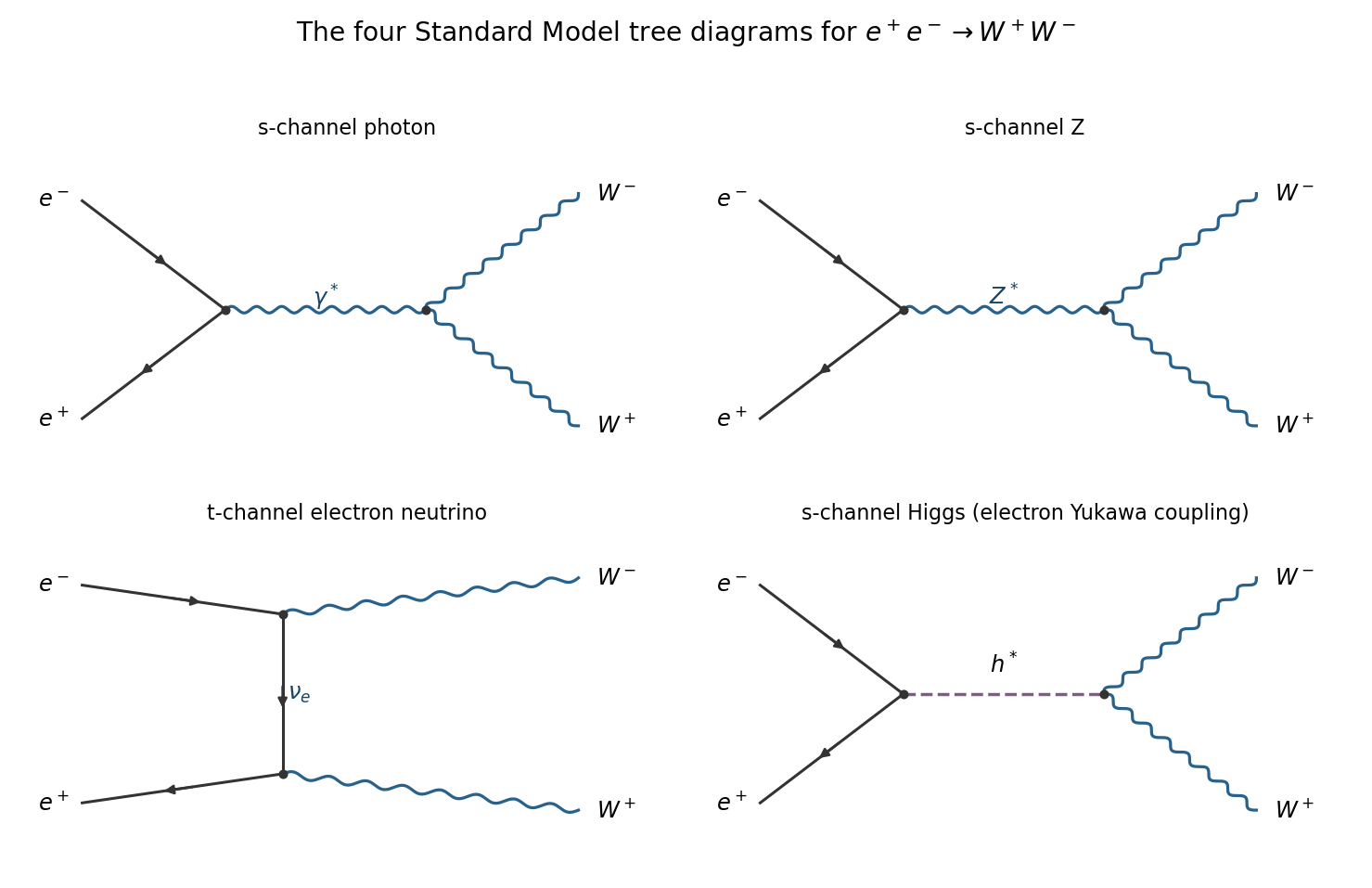


The first two diagrams contain the electromagnetic interaction and weak interaction neutral electron currents and the gauge boson self-interaction vertices and . The third has two weak charged current vertices joined by an electron neutrino propagator. In the fourth, the incoming electron-Positron pair couples to the Higgs boson, which then couples to .
The small factor is at the initial Higgs-electron vertex. With the usual electroweak vacuum value , electron Yukawa suppression of Higgs production givesThese are tiny compared with ordinary electroweak interaction gauge couplings. The decay amplitude for the Higgs boson diagram carries this small coefficient, and its separate squared contribution carries its square. Thus the Higgs diagram is negligible because the electron Yukawa coupling is proportional to the electron mass. It vanishes in the massless-electron approximation, even though the Higgs boson-W boson coupling itself is not small. The remaining three gauge diagrams must be added coherently, including their interference.
For gamma decay, the nuclear gamma-ray multipole selection rules require the radiation's angular momentum to satisfy the triangle inequalityHere , so . A real emitted photon has no monopole radiation mode, leaving .
The two nuclear quantum states have the same parity. An electric multipole has parity factor , while a magnetic multipole has factor . Thus electric radiation requires even and magnetic radiation odd :In particular, an nuclear transition cannot emit the single real photon requested here; processes such as internal conversion are different decay channels.
For usual nuclear gamma ray energies, , where and is the nuclear size. Higher multipole radiation orders bring extra powers of this small parameter, so and are the likely important contributions, with , and generally much smaller. Often is dominant, but an allowed matrix element can be hindered and an transition can be collectively enhanced. The quantum numbers alone do not fix a numerical relative contribution or an unconditional ordering of the and rates.
Past exam of the particle and nuclear physics course of the University of Cambridge 2018 Section A A1 a Solution Created 2026-10-18 Updated 2026-10-20
Treat the quoted maximum as the resonant Z boson contribution described by the Breit-Wigner resonance cross section. The electron and Positron each have spin , while the Z boson has spin one, soNeglect the electron mass at this centre-of-mass energy. Each incident momentum magnitude is then in natural units. Write . At the resonance peak the denominator is , and the same partial decay width appears for production and decay:The peak resonance cross section and branching fractions relation contains , because the electronic channel occurs at both ends of the resonant process.
For an area in ordinary units, restore . The original PDF prints , which is dimensionally incomplete: the intended standard conversion is . Also,ConsequentlyThis estimate uses the supplied resonance model. The full physical elastic electron-Positron cross section also contains nonresonant photon exchange and interference; an experimental use of the formula must isolate the resonant contribution.
The information in the original question is insufficient to determine a unique spin-induced change of charge density. It specifies ideal dielectric filaments with a prescribed excess linear charge density, but not the charge carrier species, their spin state, charge carrier mobility, binding potential or relaxation mechanism. A classical line charge has no spin variable at all. The following conditional conclusions are supported by the fields already calculated.
For a carrier moving with its filament, the local magnetic field in its instantaneous rest frame is, for the transverse fields here,where is that carrier's laboratory velocity. Exclude its filament's singular self-field and first retain only the prescribed straight convective motion.
In Case 1 there is a common rest frame in which both filaments and the excess charges are stationary and the interfilament magnetic field vanishes. Equivalently, in the laboratory , so B's co-moving charges have . Thus uniform common translation alone creates no extra mutual rest-field spin splitting. This does not exclude intrinsic spin-orbit coupling of electrons moving within their atomic binding potentials; that material physics was never specified.
In Case 2 there is relative motion and no frame in which both source distributions are stationary. Put as in part (c). At the respective filament axes, the external fields experienced in each carrier distribution's own rest frame areFor the first expression B is at rest in ; for the second A is at rest in and the field comes from B moving at . For a carrier with magnetic dipole moment , the interaction distinguishes opposite transverse spin orientations. A field gradient could exert a spin-dependent force on mobile carriers; spin relaxation could instead produce a spin polarization. These are possible responses, not consequences of charge density alone. In B's frame the displayed interaction is directly a magnetic-moment coupling to the moving source's field; treating the moving carrier's electrostatic orbital term in another frame also requires consistent binding and acceleration dynamics, including any applicable Thomas precession.
For example, if and mobile electron spins can relax, the lower magnetic-energy orientation has the electron's magnetic moment toward and its spin toward . Oppositely oriented moments would experience opposite gradient forces. The sign changes if the source charge changes sign. None of these statements fixes a net charge redistribution without a confinement and response model, and the stipulated zero transverse size supplies no resolved “sides” on which charge could accumulate.
Therefore Case 1 has no new mutual spin effect from common bulk motion alone; Case 2 permits motion-induced spin-dependent interactions, but neither case determines an additional charge-density profile from the supplied data. In particular, the factor relating proper and laboratory linear charge densities in part (b) follows from length contraction and is not an effect of spin-orbit coupling. If the charges remain pinned in an ideal dielectric, their imposed density remains the prescribed density in either case.
Past exam of the optics and electrodynamics course of the University of Cambridge 2022 Section B 6 d Solution Created 2026-10-18 Updated 2026-10-20
Spin-orbit coupling is a relativistic interaction between a particle's spin and its orbital angular momentum or, more generally, its motion through an electric field. A moving electron experiences a transformed magnetic field, which couples to its magnetic dipole moment. For an electron bound in a central electrostatic potential energy , the leading interaction, including the Thomas precession correction, isHere is orbital angular momentum and is spin. The factor of one-half relative to the simplest rest-field argument comes from Thomas precession of the accelerated electron frame.[ref]
Topics in Quantum Mechanics by David Tong. §3.1.3, printed pp. 71–75: rest-frame magnetic interaction and Thomas correction
For example, in the hydrogen atom, the states with total angular momentum and have different eigenvalues. Their splitting is part of the atomic fine structure. The interaction redistributes and splits spin-dependent energies; it is not the same physical effect as the spin-independent convective magnetic force between charged filaments.
The infinitely long filaments have no finite total force; the meaningful result is force per unit length in the laboratory. Evaluate only A's field at B, excluding B's singular self-field. B is at , so defineIn both cases A moves at , hence at BFor a filament with linear charge density and convective electric current , the Lorentz force per laboratory length isIn Case 1, and . Electric repulsion and magnetic attraction givesoThe cancellation uses . In Case 2, B is stationary, and , givingBoth results have units and are repulsive, away from A, irrespective of the common sign of . In Case 1 the velocity independence of force per laboratory length does not violate the transverse force transformation: a material segment of proper length occupies laboratory length , so its force is the rest-frame force divided by . The calculation interprets the stated as each filament's final proper density; holding a laboratory density fixed during acceleration would be a different preparation.
Fix coordinates and use the following convention for the contravariant electromagnetic field tensor:For moving with velocity relative to , the Lorentz transformation hasThe rank-two tensor transformation rule isFor example,Similarly, and . The component is unchanged because , and the component is unchanged since neither index lies in the boost plane. Reading off the six field components givesAn alternative overall sign convention for gives the same physical Lorentz transformation of electromagnetic fields when its identifications with and are used consistently.
The given static induced surface charge and the dipole integral from part (b) giveHere is the dimensionless relative permittivity, as required by the stated expression; is the SI electric polarizability. Take and . In the Rayleigh scattering regime the field is approximately uniform across the sphere. Its induced dipole radiates mean powerThe incident time-averaged light intensity in vacuum is . Dividing power by intensity gives the total cross section,The units are ; the comparison is with the geometric projected area , not with a length:The inequality holds for an ordinary nonabsorbing dielectric, with finite contrast factor and . It explains why a sufficiently small transparent sphere scatters weakly and why its scattered power has the characteristic dependence. Near a material resonance where is small, this simple inequality and static-polarizability approximation need reconsideration, including loss and radiative corrections. For the stated low-frequency ordinary dielectric the supplied polarizability is the intended approximation.
Let be the sphere's mechanical moment of inertia about its rotation axis, and let . For an undriven rigid sphere the rotational energy is . In the weak-radiation-loss approximation, conservation of energy givesIntegrating givesEquivalently, the characteristic spin-down time isThe radiative spin-down of a rotating electric dipole therefore has angular frequency that decays as at late times within this model, rather than exponentially. The original paper gives no mass or mass-density profile, so cannot be determined from and the relative permittivity. If a homogeneous solid sphere of mass is additionally assumed, insert ; uniform dielectric response alone does not imply this mechanical mass distribution.
The approximation is important. If the dipole angle is with , direct differentiation gives . Using the constant-frequency radiation law instantaneously neglects the second term and assumes . This gives the standard leading slow spin-down solution above. An exact nonadiabatic radiation reaction evolution would require the mechanical and near-field dynamics beyond the information supplied, rather than treating this leading law as exact at arbitrarily rapid damping.
The prescribed surface charge density is that of a uniformly polarized sphere and has zero total charge because . Its electric dipole moment at isThe transverse components cancel by axisymmetry, while the component isThusThe angular surface distribution is a pure degree-one spherical harmonic. Hence its static external electric potential is exactly that of this dipole, with no higher electric multipole moments; it is not an assertion that the potential inside the finite sphere equals a singular point-dipole potential.
For right-handed uniform rotation about , the rigidly attached dipole isConsequently is constant. The electric dipole radiation formula givesThere is no extra factor of one-half: the squared sine and cosine contributions of the two perpendicular oscillating components sum to one. This is the leading electric-dipole approximation for radiation, requiring and observation in the radiation zone. The stated permanent surface distribution is interpreted as the actual charge producing the given external dipole; adding another dielectric screening factor would contradict the dipole moment the question asks to establish. The relative permittivity enters the induced-polarization problem in part (d), not this prescribed total dipole moment.
Only the fields transport a nonzero outgoing power to infinity. Retain those terms from the Hertzian dipole fields:The brackets mean evaluation at the retarded time,for a point source at the origin in vacuum. They are not a time average. The radial Poynting vector in the radiation zone isIntegrating over a sphere usesThereforeNear-field terms either give inverse powers of after the surface integral or describe reversible exchange with the near field. The emitted power labelled by source time is ; the enclosing surface receives it one light-travel time later. For a changing dipole orientation, the general form is .
There are unlisted articles, also show them or only show them.