
For every integer , and . Thus the summand simplifies to . The resulting series is twice the harmonic series, so it diverges to .
Start with the supplied Gaussian integral and part (i)'s . Repeated use of the Gaussian moment recurrence givesThe even indices inherit the factor from , while the odd indices inherit rational values from .
For , write and apply integration by parts, using the antiderivative for the second factor:The boundary term is zero: at zero, , and at infinity Gaussian decay dominates every power. Consequently the Gaussian moment recurrence is
The difference and sum of the two antiderivatives in part (i) giveandTheir derivatives also verify the signs immediately.
Write and . Two applications of integration by parts, first taking the sine and then the cosine as the differentiated factor, giveThus and , in each case up to an arbitrary constant of integration. Keeping that freedom avoids identifying independently chosen antiderivatives too rigidly.
Here and , so the constant and quadratic terms vanish, while the linear coefficient remains . A further derivative givesConsequently . Since and have opposite signs, and also have opposite signs, and their difference is nonzero. The first two nonzero terms are thereforeThis is where the full sign condition rules out a further cancellation in the Taylor expansion.
The second derivative chain rule givesWith , the constant term vanishes, , and by the specified case. Thus the first two nonzero terms in the Taylor expansion are
Write and . The chain rule givesThe condition ensures . Since , also and . Hence the first two nonzero terms are the constant and linear terms:The inequality , together with continuity of , makes the logarithm defined on a neighbourhood of zero. The remainder is written in Big O notation.
First express the function in the original variables:The chain rule givesTaking its partial derivative with respect to yieldsThe numerator in the second fraction reduces to , reproducingBoth logarithms are defined for every real because their arguments are at least one.
For , the needed partial derivatives areSubstituting these into part (ii) givesSince , the last two terms combine. Thus
Apply the product rule and the chain rule once more to each expression in part (i). The second derivative chain rule givesandFor example, the coefficient of in the mixed partial derivative is , while the final term is . The symmetry is used in combining the mixed terms under the usual twice-continuously-differentiable interpretation.
The chain rule gives and . Since , , and , the answer isEvery partial derivative of on the right is evaluated at , .
For , integrate with respect to to obtainIts other partial derivative is . Comparing with gives . Thus the most general potential on the plane is
An exact differential form must have . Direct partial differentiation givesThus must hold identically. Since is not identically zero for a fixed nonzero , the only possibility isThe explicit potential in part (ii) verifies sufficiency.
For a vertical slice through the triangle, and . Reversing the order by Fubini's theorem givesThe agreement checks that both orders describe the same region.
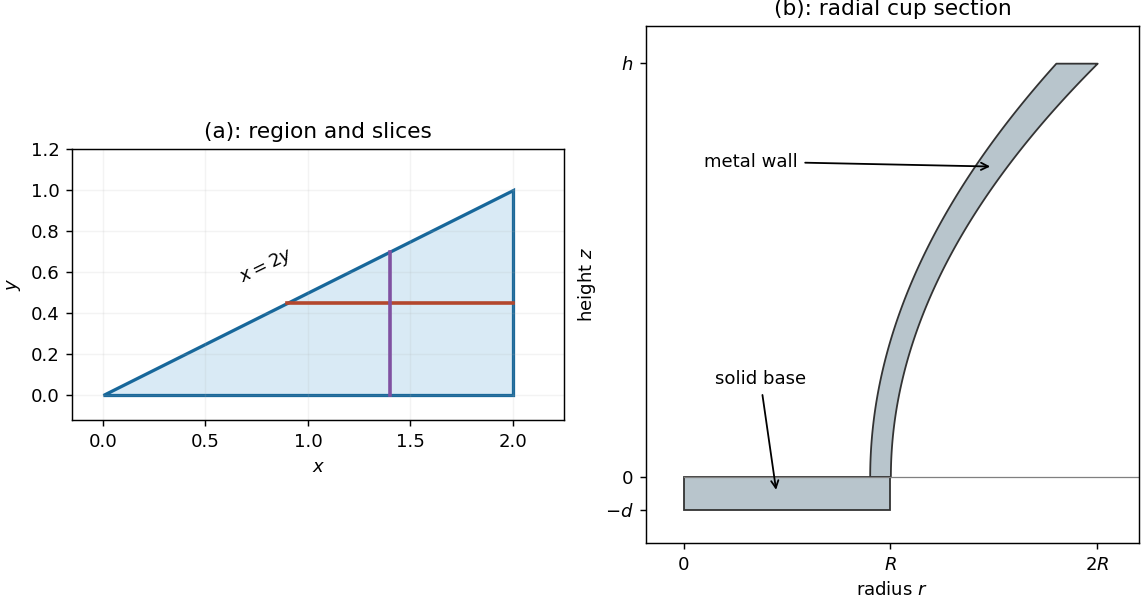

The stated bounds depend on , so must be held fixed while the integral over is performed. The intended iterated integral isThe original PDF places the two sets of bounds beside the opposite integral signs relative to the printed . That placement cannot be read literally as a conventional nested integral; the dependence of the lower bound on , and the explicit instruction to integrate over first, specify the intended region unambiguously.
There are unlisted articles, also show them or only show them.