
At , the integrand is unbounded but integrable: . Thus the lower-limit integral is understood as an improper integral. With ,The lower endpoint corresponds to , givingThe limiting value at is zero. Here is the inverse hyperbolic cosine.
A suitable real antiderivative on the disconnected domain isFor , directly; for , and the chain rule again gives . The graph is even, crosses zero at , tends to on either side of zero, and tends to as . Independent additive constants may be chosen on the two disconnected half-lines; both are set to zero here.
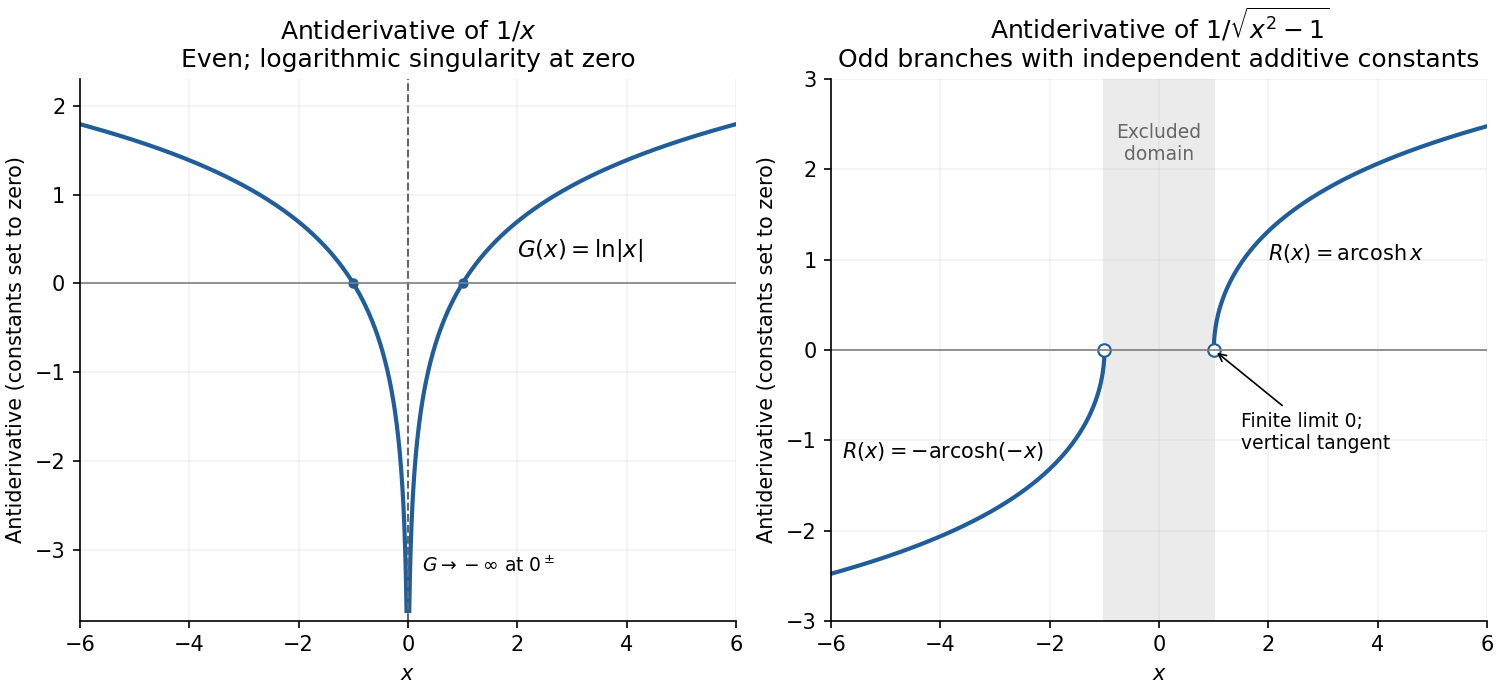
On the negative half-line, differentiation gives . The integration path from to stays away from the singularity at zero. ThereforeThis choice satisfies .
The sample space outcomes with qualifying sums have totals three, four and five. Their ordered patterns are , the three permutations of , and the three permutations each of and . Thus there are qualifying outcomes:
To find the probability of exactly one pair, choose its repeated face in six ways, the distinct face in five ways, and which of the three dice has that distinct face in three ways. HenceAs a check, the disjoint events exhaust the sample space, and .
Choose the first face in six ways, the second in five ways avoiding the first, and the third in four ways avoiding both. ThusEach ordered outcome is equally likely in this sample space, so dividing the count by gives the probability.
The sample space has equally likely ordered outcomes. The repeated value can be any of the six faces, giving six outcomes . Therefore
Set in the relative total differential and use the two equal mass increases:Thus the separation must increase by . In this special case the result is also exact: the mass product increases by , and preserving the inverse-square force requires , hence .
For the force magnitude in Newton's law of universal gravitation, the total differential isDividing by the positive value gives the particularly useful relative formFor finite small changes this gives the first-order approximation to the fractional change; higher-order products of increments are omitted.
Combine the complementary function and particular solution:The boundary condition at zero gives , while that at gives . HenceThe two boundary conditions determine both constants uniquely; substitution at each endpoint gives zero.
Use the method of undetermined coefficients, choosing a particular solution . Substitution givesMatching the constant and cosine coefficients to gives , . ThusNeither forcing term is resonant with the homogeneous angular frequency one.
The homogeneous linear differential equation is . Its characteristic equation is , with roots . The general real complementary function is thereforeThe two trigonometric solutions are linearly independent, supplying the two arbitrary constants required for this second-order linear ordinary differential equation.
The positive-domain graph starts with limiting value and limiting slope , then decreases towards the horizontal asymptote , with for large . In fact direct differentiation givesThe first inequality follows from for . Thus the graph is strictly decreasing and convex upward, with and no stationary points. The integral representation also shows its positivity.
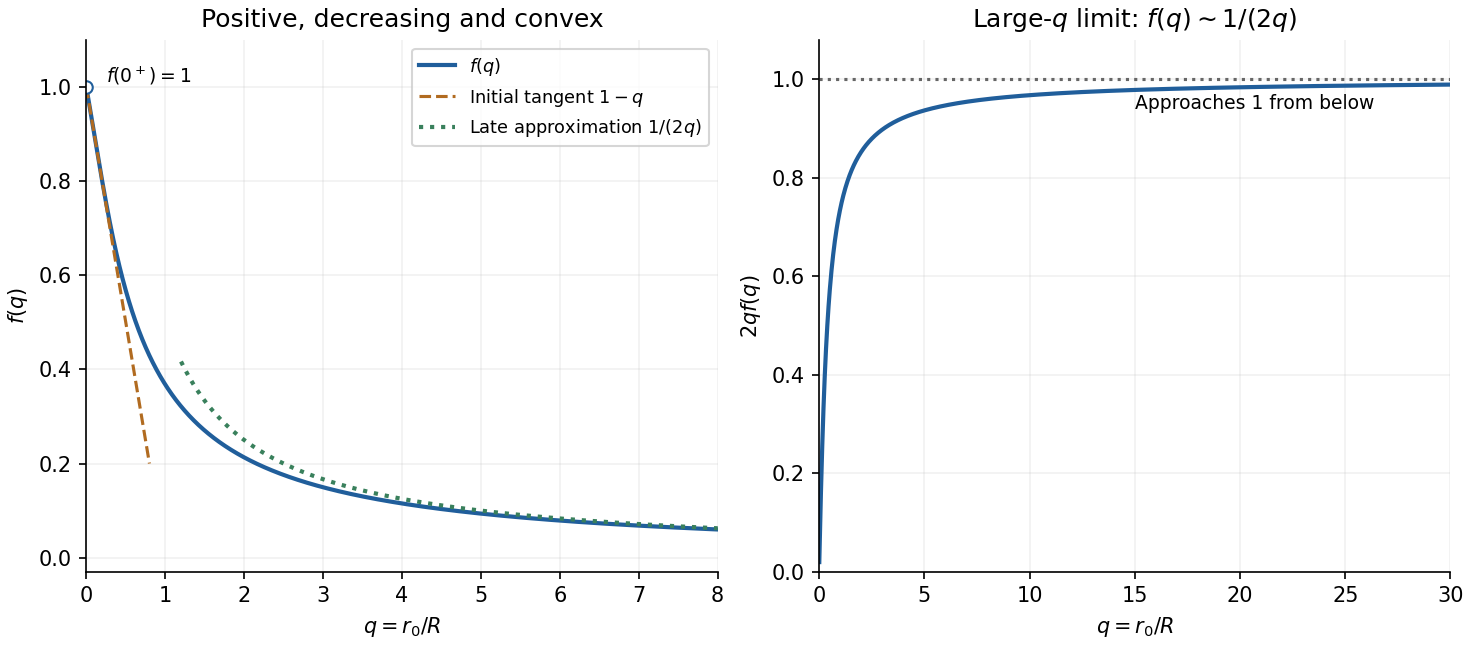


These properties belong to the reusable exponential spherical mass factor.
For , expand the exponential function in powers of :The constant and linear terms cancel in , givingFor , is exponentially small:The small- correction is smaller than every positive power of beyond the displayed linear term. In dimensional terms, the large- leading mass is , while the small- limit is .
In spherical coordinates, with polar angle and azimuth , the volume element isThe mass density is radial, so integrating over both angles givesWriting , this becomesAlthough the mass density diverges like near the origin, multiplication by the spherical volume element gives an integrable expression. Thus the central singularity does not produce infinite mass.
Put . Part (b)(ii) gives , soThe parameter increases strictly from to . Therefore the imaginary part increases from to , while the real part is . The endpoints areThe real axis crossing is at , giving at . The two imaginary axis crossings satisfy , givingIn order, the trajectory passes from its lower endpoint through , then the leftmost point , then , to its upper endpoint. It is a right-opening parabola segment, traversed continuously upward as shown in the right panel.
Squaring givesThus is constant, while . The trajectory is the horizontal line segmentIt crosses the imaginary axis at , when , and never crosses the real axis. The middle panel shows the rightward direction.
Write . Its coordinates are , , so . For the given positive range of , this traces a segment of the first-quadrant hyperbola, moving rightward and downward:The complex conjugate is . It is the reflection in the real axis, tracing in the fourth quadrant, rightward and upward:Neither trajectory crosses either axis, because and remain nonzero. The left panel of the figure marks the endpoints and directions.
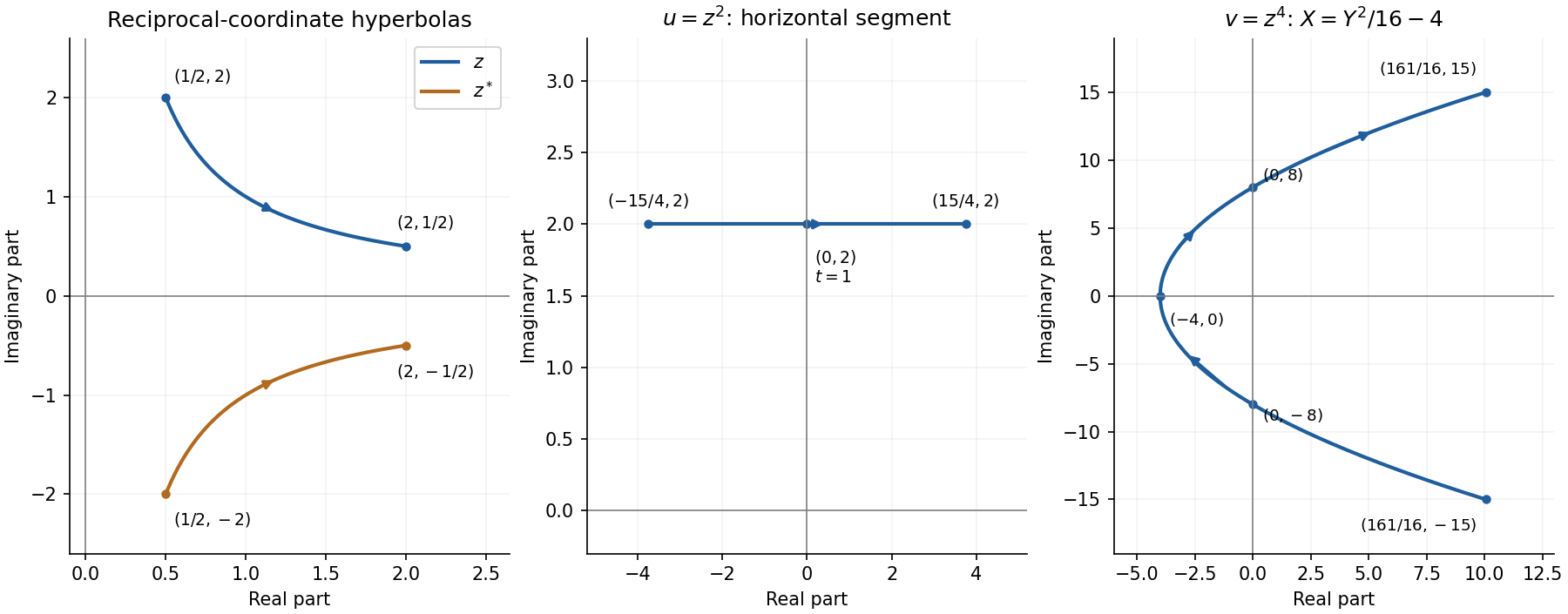
Trajectories under complex conjugation, squaring and fourth powers, with endpoints and axis crossings
. Details. 
There are unlisted articles, also show them or only show them.