
Differentiate once, then substitute the other equation. The required second-order linear differential equation is
Let count tests up to and including the first failure. By independence of random variables, the event requires passes and then a failure. With pass probability and failure probability , this is the geometric distributionUsing part (iii), its expected value isThis counts the test that discovers the fault. The expected number of earlier passing tests alone would be one.
The absolutely convergent geometric series has sum for . Its Cauchy product with itself isThere are exactly pairs of nonnegative integers whose sum is . Relabeling provesAbsolute convergence justifies the multiplication and regrouping; no differentiation of an infinite series is needed.
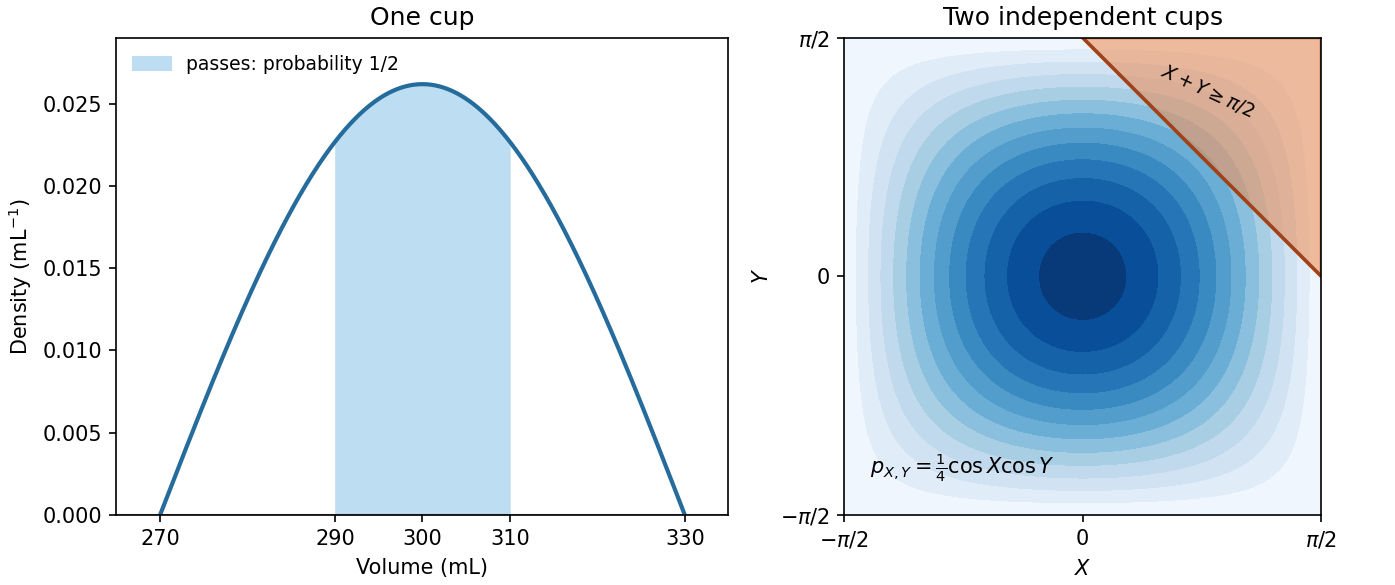
Passing corresponds to in the normalized variable from part (i). Integrating its probability density,The complementary probability of detecting the fault in one test is also .
The probability density is symmetric about , vanishes at and , and has its single maximum at . It is zero outside that interval. Its area is one: with the dimensionless change of variablesnormalization is .
The square is minimized when its first term vanishes. ThereforeThis agrees with the distance between skew lines found in part (b). The corresponding parameter on the first line is its orthogonal projection valueThe closest pair is and ; their connecting vector is perpendicular to both direction vectors.
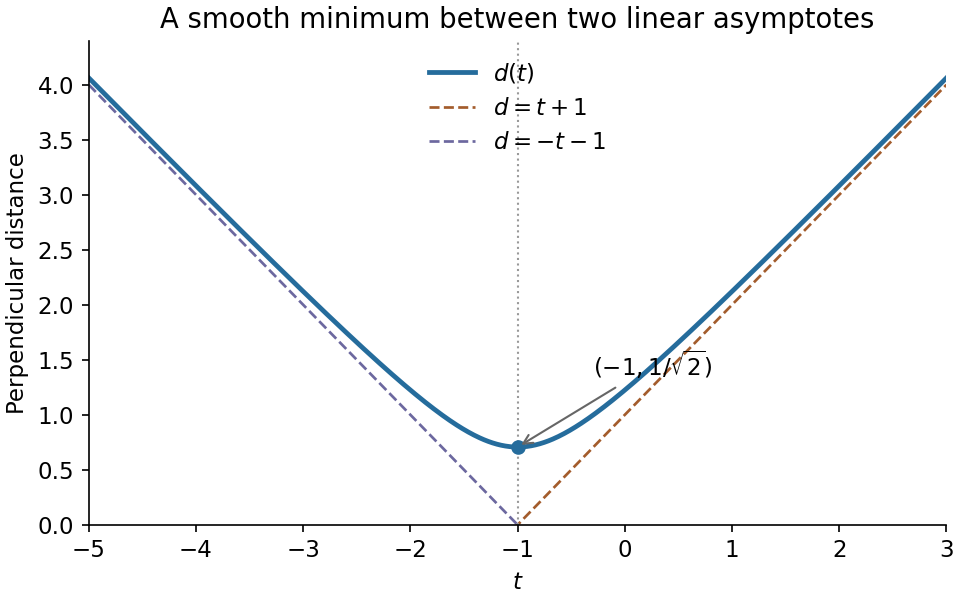
The graph is the upper branch of the hyperbola . It is symmetric about , positive everywhere, and has its lowest point at . Its derivatives areso it is strictly convex. Sinceits two oblique asymptotes are


For a point , the magnitude of is the area of a parallelogram. Dividing by its base length gives the perpendicular Euclidean distance to the first line. Explicitly,HenceThis use of the cross product removes any component parallel to the first line automatically.
Use only the dot product to minimize the squared Euclidean distance from the origin:Completing the square givesThe square is minimized at , yieldingGeometrically this subtracts the squared length of the orthogonal projection parallel to the line. At the minimizing point, , as required for perpendicular distance.
For every positive integer , the bound givesFor , the positive p-series converges. The comparison test therefore provesNo special arithmetic condition on is required for this sufficient condition.
Use the derivative definition and the specified value :The last factor tends to one. Therefore the limit is zero when , equals when , and diverges to when . A finite derivative exists exactly whenIn particular gives continuity without differentiability. The threshold is an example of regularity of a power times a function with a simple zero.
Since and are fixed, the standard sine limit givesIf , this tends to the assigned value zero. At , the right and left limits are and ; if , they diverge with opposite signs. HenceThe cancellation comes from the simple zero of at the origin, not rapid oscillation there.
Among the two orthogonal matrices from part (d)(i), gives , a rotation matrix through angle . For , the determinant is , so the matrix reverses orientation and is a reflection rather than a rotation:It is the reflection matrix across the axis.
An orthogonal matrix has orthonormal columns. The first column of has squared norm , so . Orthogonality of the two columns then gives , hence . The second column must have squared norm . ThereforeBoth resulting matrices satisfy directly.
For the choice of in part (b)(i), the two-by-two matrix inverse formula givesMultiplication gives , providing a direct check.
The characteristic polynomial of isIts distinct eigenvalues are and . For , the eigenvector relation gives , so choose . For , it gives , so choose . Put these independent eigenvectors into columns:Then column by column. Also , so this choice supplies the diagonalization of a matrix . Scaling columns or interchanging their order gives other valid choices, with the matching order in .
Expanding the determinant along the first row givesUnder the matrix trace condition , this simplifies to . A square matrix is invertible exactly when its determinant is nonzero. Thus
A single formula valid on both real components isLet . Since ,Equivalently, for and for . The graph is odd for this choice of constants, increases on both components, and approaches zero with vertical tangent as or . Its far-field behaviors are on the right and on the left. The interval is excluded. Independent additive constants could again be assigned to the two components. The right panel sketches these real inverse-hyperbolic antiderivative branches.
There are unlisted articles, also show them or only show them.