
The angles in the PDF are measured from the vertical normal to the interface. The horizontal displacements of the two path segments are and , while their lengths are and . Thus the geometric constraint and travel time areThe Lagrange multiplier equations giveCancelling the positive geometric factors gives , henceThis is Snell's law, . The relation depends only on the ratio of the two speeds, so changing leaves the relation unchanged; it changes which angles satisfy it together with the geometric constraint.
For a minimum check, let be the horizontal distance to the crossing point. ThenandThus the travel time is a strictly convex function of , and its stationary point is the unique global minimum. For positive , , placing the crossing between the two endpoint projections.
Use the root limit of a finite sum of powers. Put . For every , at least one of the three terms is and none is larger, soTaking the positive th root givesSince , the squeeze theorem givesIndeed, for both remaining bases are at most ; for , ; and for , . The endpoint cases are included in the same bound.
The original PDF specifies . The quotient is the difference quotient for the function at the positive point . The chain rule gives , so
For , the consecutive ratio isThus the ratio test proves convergence when and divergence when . At , the series is , which diverges by comparison with . ThereforeAll terms are nonnegative, so convergence here is also absolute convergence.
The term at is finite. For every ,The comparison P-series converges, so the comparison test for series proves that the given series converges absolutely.
Again , but the principal inverse sine would give at . The required branch is , corresponding to . ThereforeAt the bracket is , as required. Both the initial condition and the original differential equation are thus satisfied on the stated branch.
The initial condition gives . Since belongs to the principal inverse sine range, choose in part (i). The particular solution isThe upper endpoint is excluded because there and the original tangent ceases to be defined.
Use the substitution for a homogeneous first-order differential equation. Since , it givesWhere , this separable differential equation integrates to , hence . One can obtain the same relation without division by : the equation gives , so , including .
All real branches of the inverse sine are captured byEach branch is used on an interval with and , with fixed . The strict inequality excludes zeros of , where the original tangent is undefined. When , the formula includes all straight-line solutions . Keeping both families of inverse sine branches is essential for the two different initial conditions below.
The horizontal cross-section is a triangle, so its area is half its width times its depth:Thus the volume integral, with , isFor the substitution rule, put . The endpoint values are and , and , givingTherefore .
At height , the horizontal triangle has half-width along and depth along . These shrink with , so its orthogonal projection onto the plane is the base triangle with vertices , and :The orthogonal projection onto the plane is the triangle with vertices , and :The orthogonal projection onto the plane is bounded by , and the two curvesEquivalently, these curves lie on the parabola , truncated at height . In particular the top width is , so this projection has a horizontal upper edge from to ; it is not triangular. The top horizontal cross-section has zero depth, consistent with this edge.
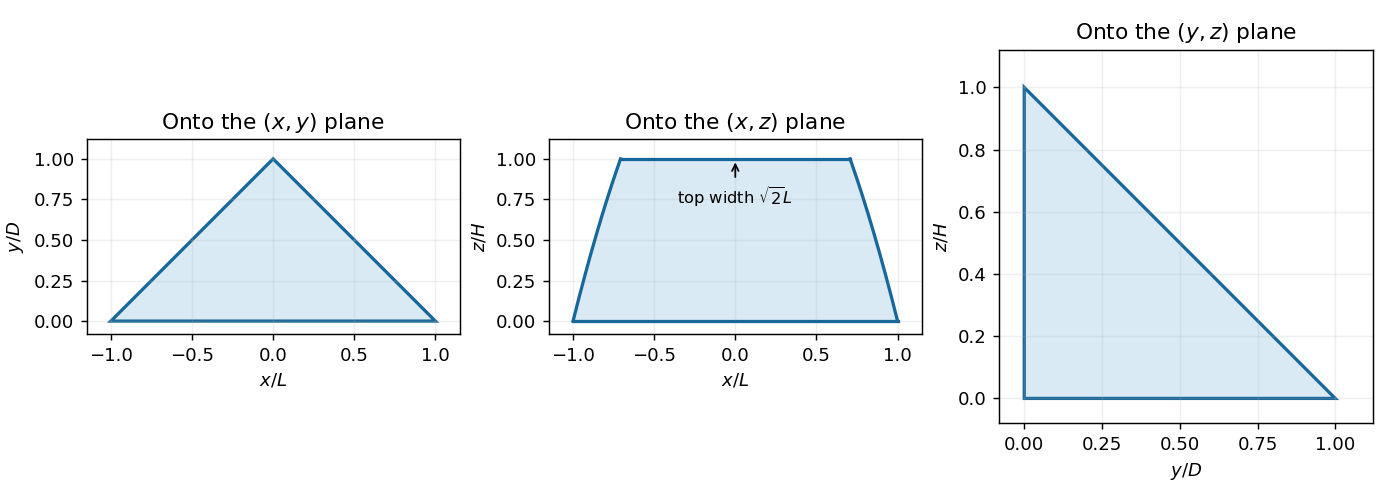
The three coordinate projections of the triangular-section solid in Question 12
. Details. At height , the circular sector has radius and angle . Its area is , so slicing by horizontal cross-sections gives the volume integralUse the substitution rule . ThenAn integration by parts gives the antiderivative , whose endpoint difference is . Therefore
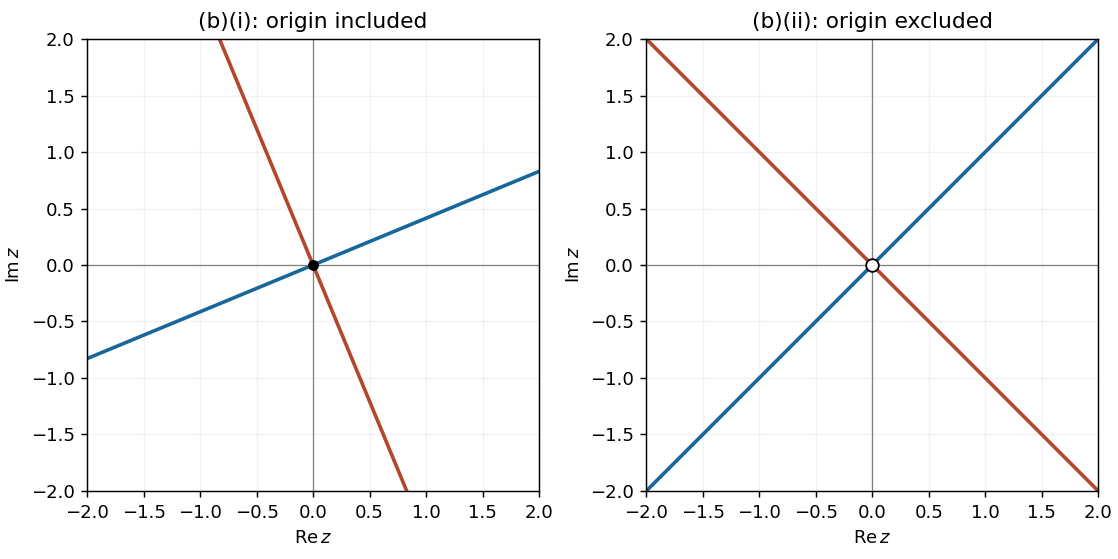
The denominator requires . Write , where and . Multiplication by the nonzero denominator givesso . Conversely, if and , then and . Thus the required Argand diagram consists exactly ofThese are two perpendicular straight lines, with the origin removed as shown in the figure in part (i).
Since , equating its real part and imaginary part gives , orThe quadratic equation in factors as . Thus the set is the union of two straight lines through the origin:Their slopes multiply to , so they are perpendicular. Their angles to the real axis are and , modulo . The origin is included.


Multiply numerator and denominator by the complex conjugate :Thus the real part is and the imaginary part is .
The standard Fourier series iswith Fourier coefficientsThese follow by taking inner products with the individual basis vectors and using their orthogonality and squared norms.
With inner product , orthogonality meansThe constant function has squared norm , and each sine or cosine has squared norm . Thus the displayed family is orthogonal but not normalized; these different lengths determine the coefficient factors.
A standard complete orthogonal family is the real Fourier basisCompleteness gives expansion in the L2 space for a square-integrable function. Mere integrability alone does not guarantee pointwise convergence of a Fourier series; the explicit function in part (b) is continuous and piecewise smooth, so this issue does not obstruct its expansion.
There are unlisted articles, also show them or only show them.