
For either sign, the dot product with isThe remaining pair also satisfiesHence the three eigenvectors are mutually orthogonal. This also follows from the spectral theorem for real symmetric matrices, since and its eigenvalues are distinct, but the displayed products verify the actual chosen vectors directly.
Compute the characteristic polynomial using :Its three distinct real roots are and . For , the first row of gives and the second then gives , so take .
For either root of , take and solve the row equations to get . Substitution makes the first two row residuals opposite multiples of the quadratic equation and the third zero. Thus a complete choice isEvery nonzero scalar multiple is another valid eigenvector in the corresponding one-dimensional eigenspace.
Multiply the Maclaurin series for the exponential and the sine, keeping terms through degree three:Only , , and contribute at these orders, so
Past exam of the mathematics course of the year 1 of the natural sciences course of the University of Cambridge 2009 Paper 1 11 c iii Solution Created 2026-10-18 Updated 2026-10-20
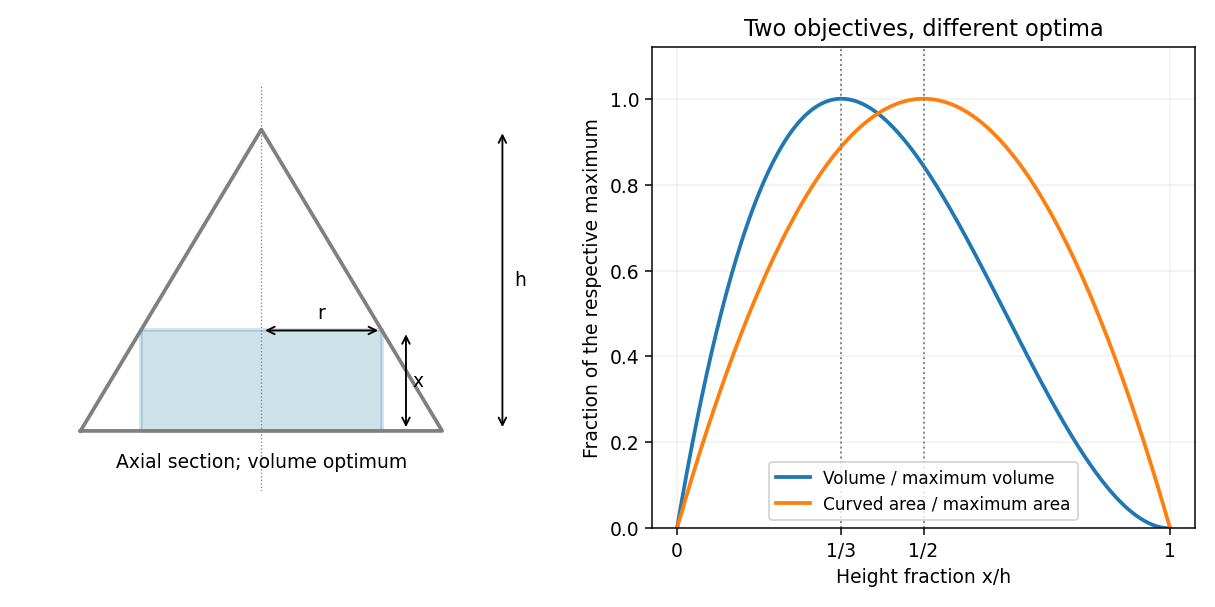
The curved surface area excludes the two end disks, so . Completing the square givesThusIt differs from the volume optimum because the objective contains one power of the radius rather than two.
Past exam of the mathematics course of the year 1 of the natural sciences course of the University of Cambridge 2009 Paper 1 11 c ii Solution Created 2026-10-18 Updated 2026-10-20
At fixed , the derivative is . It is positive for and negative for . The endpoint volumes are zero. Thus the unique positive-volume global maximum is atIts value is , whereas the cone volume is . HenceThis is the volume case of the optimal cylinder inscribed in a cone.
Past exam of the mathematics course of the year 1 of the natural sciences course of the University of Cambridge 2009 Paper 1 11 c i Solution Created 2026-10-18 Updated 2026-10-20

Past exam of the mathematics course of the year 1 of the natural sciences course of the University of Cambridge 2009 Paper 1 11 a ii Solution Created 2026-10-18 Updated 2026-10-20
For the real inverse hyperbolic tangent, take and . Its logarithmic expression givesThe same derivative holds on a differentiable complex branch away from its singularities.
Past exam of the mathematics course of the year 1 of the natural sciences course of the University of Cambridge 2009 Paper 1 11 a i Solution Created 2026-10-18 Updated 2026-10-20
Differentiate the numerator and denominator using the product rule and quotient rule:The numerator simplifies to , giving
Past exam of the mathematics course of the year 1 of the natural sciences course of the University of Cambridge 2008 Paper 2 16 b ii Solution Created 2026-10-18 Updated 2026-10-20
For , is real symmetric. Sylvester's criterion says that all eigenvalues are positive exactly when its leading principal matrix minors are positive. These are , , and . ThereforeAt either endpoint one eigenvalue is zero, so the strict positivity requirement excludes it.
Past exam of the mathematics course of the year 1 of the natural sciences course of the University of Cambridge 2008 Paper 2 16 b i Solution Created 2026-10-18 Updated 2026-10-20
With , the characteristic polynomial factors into , up to the overall sign convention. The eigenvalues are and . Integer values require an odd integer satisfying . The positive integer factorization forces andThe resulting eigenvalues and corresponding nonzero eigenvectors areAny nonzero scalar multiple is equally valid. The factorization also shows that no other positive integer works.
Past exam of the mathematics course of the year 1 of the natural sciences course of the University of Cambridge 2008 Paper 2 16 a iv Solution Created 2026-10-18 Updated 2026-10-20
Past exam of the mathematics course of the year 1 of the natural sciences course of the University of Cambridge 2008 Paper 2 16 a iii Solution Created 2026-10-18 Updated 2026-10-20
Past exam of the mathematics course of the year 1 of the natural sciences course of the University of Cambridge 2008 Paper 2 16 a ii Solution Created 2026-10-18 Updated 2026-10-20
Past exam of the mathematics course of the year 1 of the natural sciences course of the University of Cambridge 2008 Paper 2 16 a i Solution Created 2026-10-18 Updated 2026-10-20
The permutation matrix acts by . Applying this cyclic permutation three times returns every vector to itself, proving . Explicitly and multiplication once more gives the identity matrix.
Past exam of the mathematics course of the year 1 of the natural sciences course of the University of Cambridge 2008 Paper 2 15 b ii Solution Created 2026-10-18 Updated 2026-10-20
The parametric curve runs from to , with . Substitution into the two line integrals givesHenceThe first is unchanged because the field is conservative. The two different answers for the second exhibit its path dependence, consistent with its nonzero curl.
Past exam of the mathematics course of the year 1 of the natural sciences course of the University of Cambridge 2008 Paper 2 15 b i Solution Created 2026-10-18 Updated 2026-10-20
On the first segment, , so both line integrals vanish. On the second, , giving contributions and . On the last, , the contributions are and . ThereforeThe first also equals , as the fundamental theorem for line integrals predicts.
Past exam of the mathematics course of the year 1 of the natural sciences course of the University of Cambridge 2008 Paper 2 15 a ii Solution Created 2026-10-18 Updated 2026-10-20
Past exam of the mathematics course of the year 1 of the natural sciences course of the University of Cambridge 2008 Paper 2 15 a i Solution Created 2026-10-18 Updated 2026-10-20
Integrating the first component in gives . Matching the second requires , so . Matching the third gives . Thus the field is conservative, with scalar potentialDirect differentiation verifies on all of .
Past exam of the mathematics course of the year 1 of the natural sciences course of the University of Cambridge 2008 Paper 2 14 b ii Solution Created 2026-10-18 Updated 2026-10-20
For , the chain rule gives and . ConsequentlyThusThis is the potential form of the Cole-Hopf transformation, with . For it is a forward diffusion equation; at the exponential transformation is undefined, while negative gives a backward heat equation.
There are unlisted articles, also show them or only show them.