This is a standing wave. At x=0 and x=π it vanishes for all t. At t=0 its displacement is sin2x, and its time derivative−5sin2xsin5t is zero. Also ytt=−25y and yxx=−4y, directly checking the original equation.
This is the centre of the liquid volume, rather than of the curved wall. The density cancels because it is uniform; the larger disks near the top place the centre above half-height.
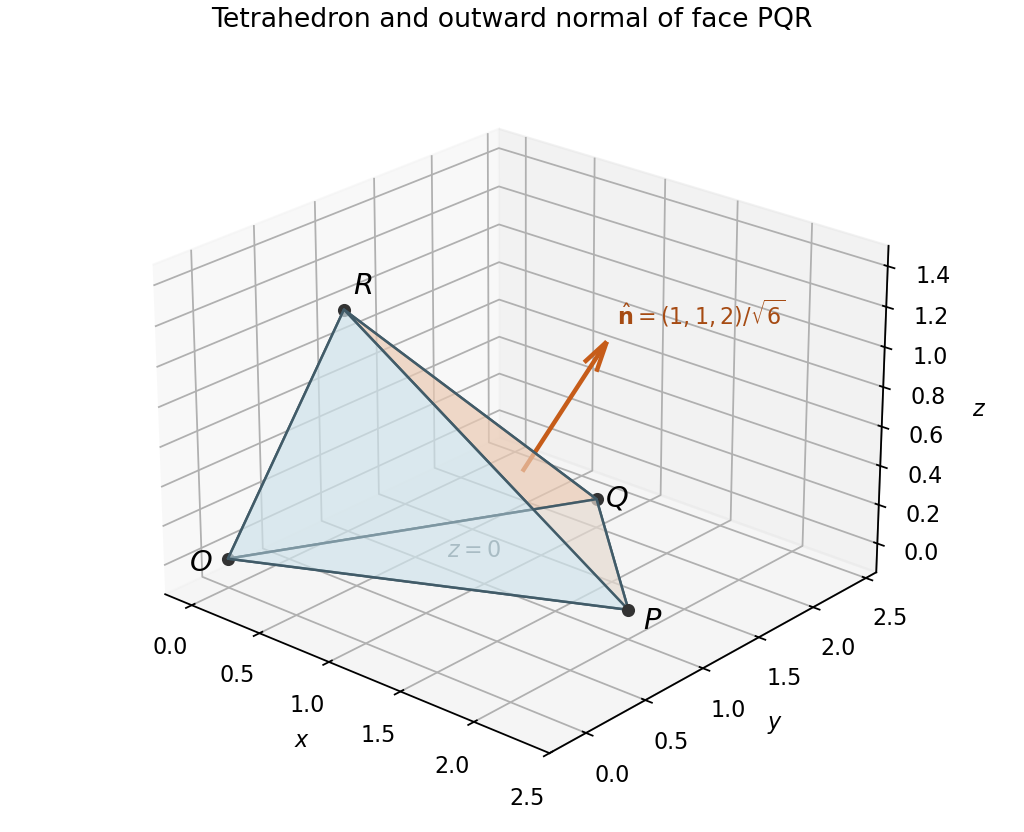
This also equals the cosine of the acute angle between the unoriented face planes. The outward-normal angle itself has cosine −2/3; keeping that distinction avoids asignambiguity.
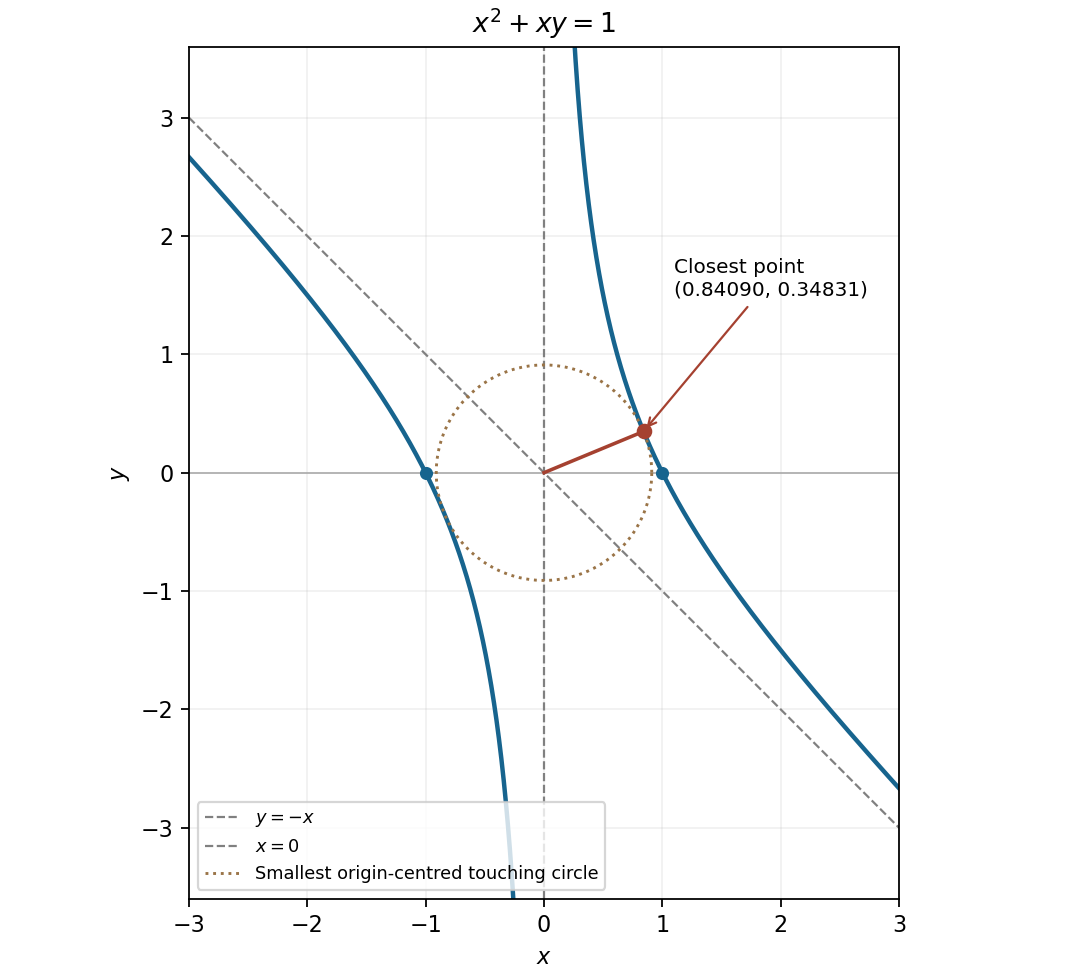
The constraint gradient cannot vanish on this branch, since its second component is x>0. Eliminate λ=2y/x to obtain x2=2xy+y2. Put t=y/x; then t2+2t−1=0, so t=−1±2. But the constraint says x2(1+t)=1, requiring 1+t>0 and selecting t=2−1. It follows that
The arithmetic-geometric mean inequality proves this bound, with equality only when 2x2=x−2, namely x=2−1/4. Thus the stationary point is the unique closest point on the required branch. Numerically it is approximately (0.840896,0.348311) and its distance is 0.910180 in coordinate units.
The curve has x=0 and can be written y=1/x−x. It is a hyperbola with vertical asymptotex=0 and oblique asymptotey=−x, crossing the horizontal axis at (±1,0). It is symmetric under (x,y)↦(−x,−y).
On each branch dy/dx=−1/x2−1<0. For x>0, the branch descends from +∞as x↓0, passes through (1,0), and approaches y=−x from above as x→+∞. The negative branch follows by the central symmetry.
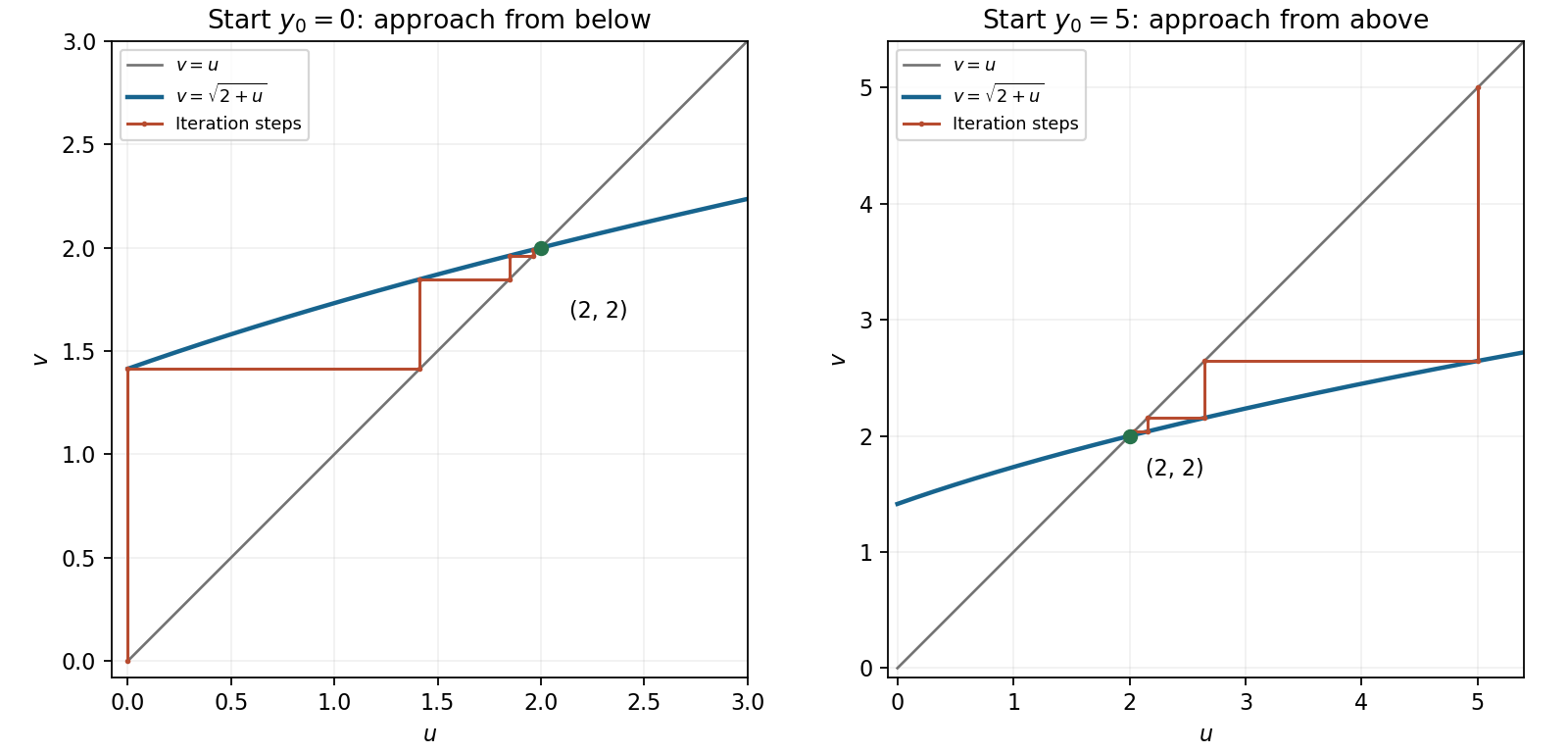
For 0≤u<2, (2+u)−u2=(2−u)(1+u)>0, so u<2+u<2. Thus a start below 2 gives a strictly increasing sequence bounded above by 2. For u>2 the inequalities reverse to 2<2+u<u, givinga strictly decreasing sequence bounded below by 2. Both types of staircase approach the same intersection.
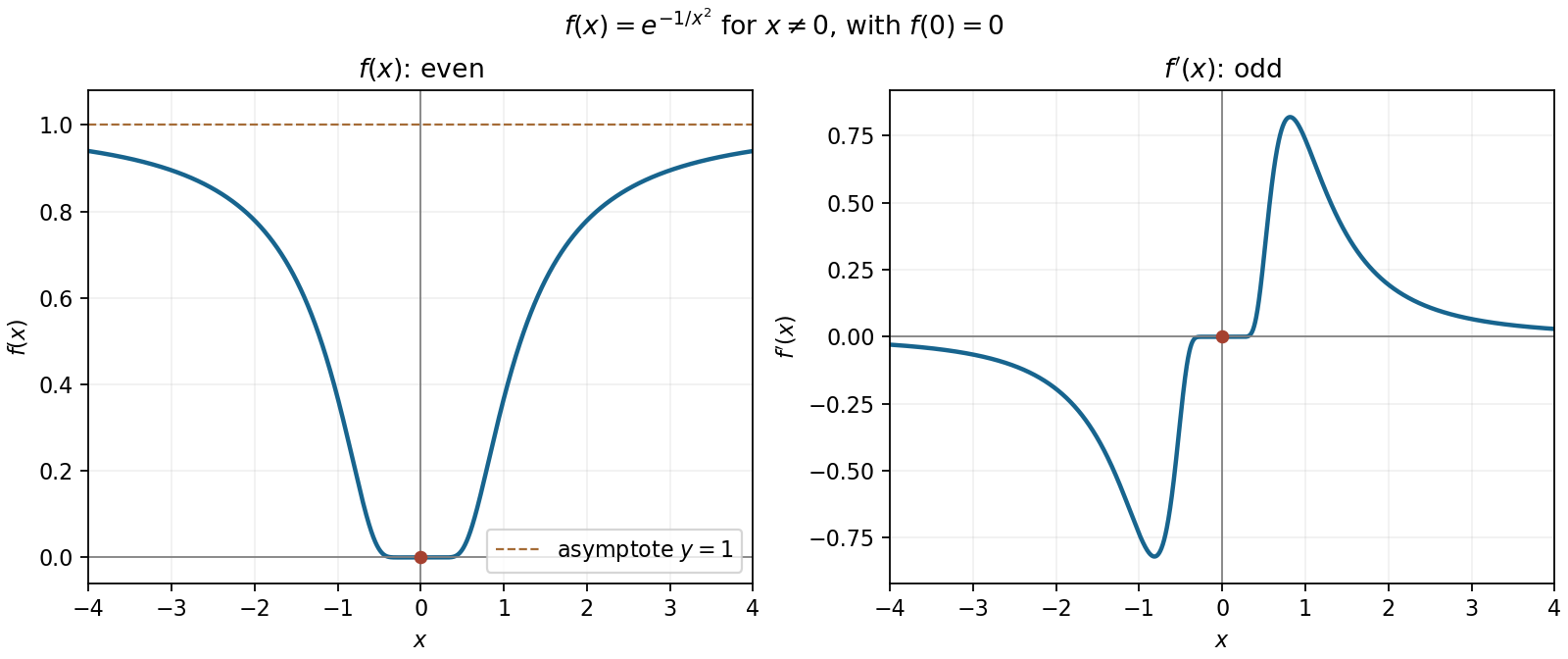
Its derivative is an odd function: f′(x)=2x−3e−1/x2 off zero, with f′(0)=0. It is negative to the left and positive to the right, tends to zero both at the origin and at infinity, and has one negative trough and one positive crest. Indeed f′′(x)=2e−1/x2(2−3x2)/x6 away from zero, so the change in slope of f′ occurs once on each side. The exact crest and trough coordinates are not needed for the sketch.
The parameter λ cancels because the threshold scales with the distribution. Also μ−2σ<0 lies outside the support, so in this particular case the two-sided event ∣X−μ∣>2σ has the same probabilityas the stated upper-tail event.