
Use the usual model of independent games, each with Sheila-win probability . After games, an outcome with wins and losses has possible orders. Since both totals are below eleven, none of those sequences has already ended the match. ThusFor a completed Sheila win with losses, the last game must be her eleventh win. The preceding games contain ten wins and losses, so their probability is , followed by one further factor . The allowed loss counts are , and these terminal events are disjoint. HenceThis is the match win probability with a fixed winning score, obtained by the negative binomial stopping argument. Constant marginal game-win probabilities alone would not justify the product without the usual independence assumption.
Normalize the Rayleigh distribution by substituting :For its sketch, the density starts at zero, is positive for , and tends to zero at infinity. Differentiation givesIt therefore has a single maximum at , with height .
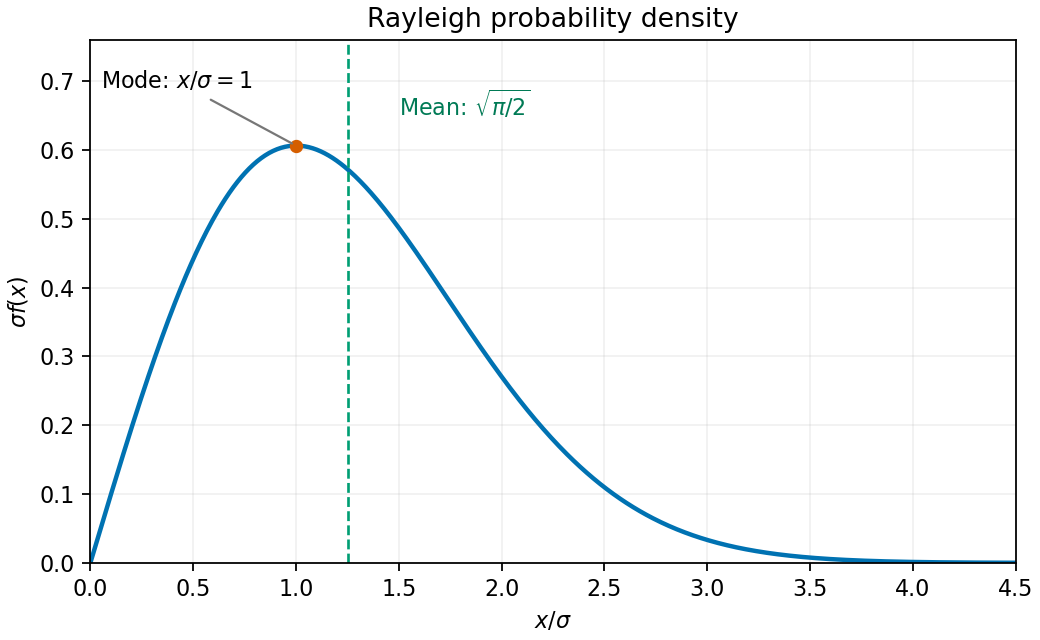
The expected value isIntegrating by parts with makes the boundary term vanish and leaves . The Gaussian integral gives
Let mean control-group membership and the adverse event. Equal allocation gives , so the law of total probability gives . Bayes' theorem then givesThis is defined when . If both are zero, the conditioning event has zero probability and the stated conditional probability is undefined.
Integrate the probability density function over the specified interval:The endpoint inclusions make no difference for this continuous distribution.
Real points require , and the two branches areThis is a semicubical parabola, symmetric about the horizontal axis and with a cusp at the origin. The parametrization , traces both branches. Their limiting slopes at the origin are zero, so the common tangent direction is the positive horizontal axis, even though the curve has a cusp there.
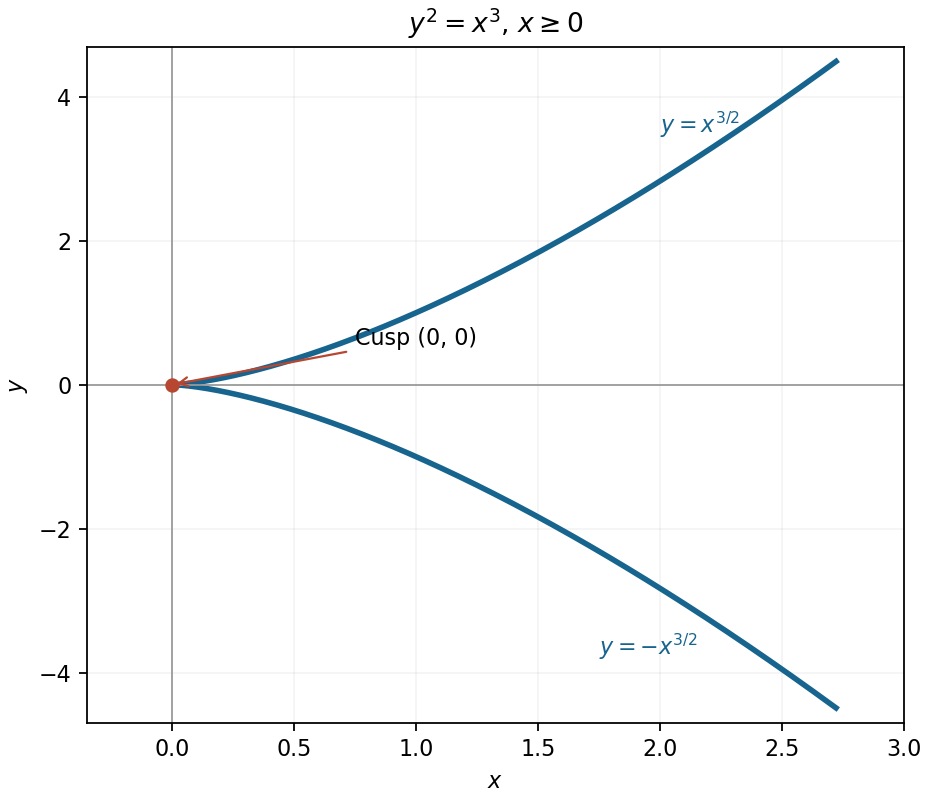
The two real branches of the semicubical parabola and their cusp at the origin
. Details. On , the quadratic polynomial is positive. The required area is therefore its definite integral above the horizontal axis:The units are square coordinate units.
The second derivative is , so . By the second-derivative test, the stationary point is a strict local minimum, at . It is not a global minimum, since this cubic is unbounded below toward negative infinity.
Differentiate the polynomial and factor:The stationary points therefore have horizontal coordinatesFor a check, is negative at the first and positive at the second, giving a local maximum and a local minimum respectively.
This exponential function is positive everywhere, with , as and as . Its derivatives areIt is strictly decreasing overall, with a horizontal stationary inflection point at . A second, nonstationary inflection point occurs at , where . The only horizontal asymptote is toward positive infinity; the graph is not symmetric about the vertical axis.
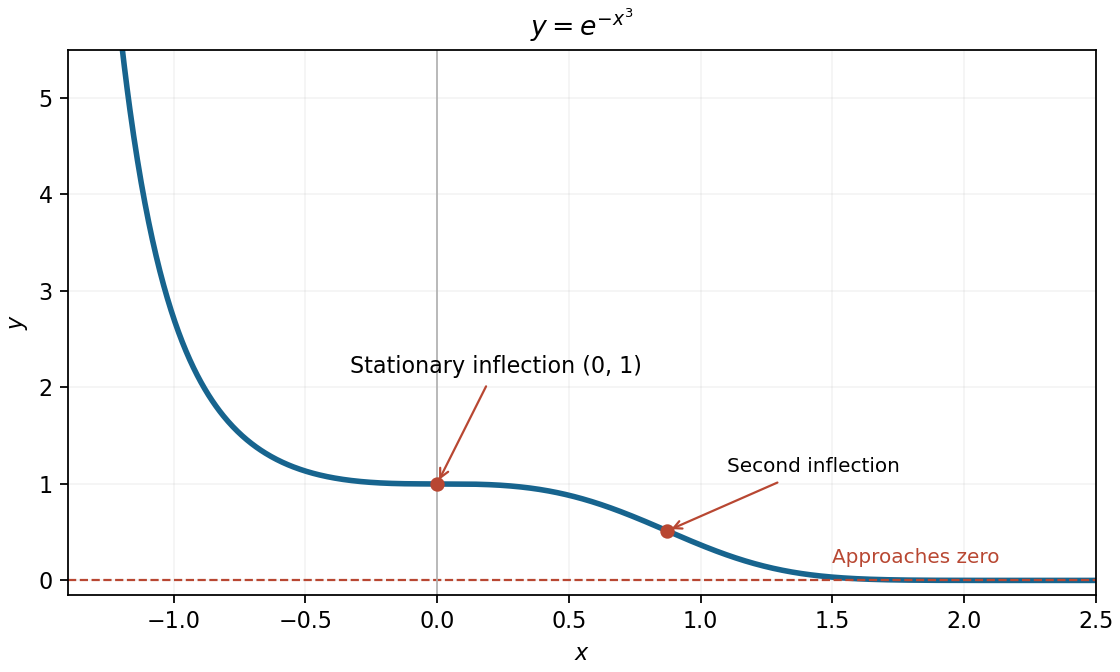
The decreasing cubic exponential, its stationary inflection, and its positive horizontal asymptote
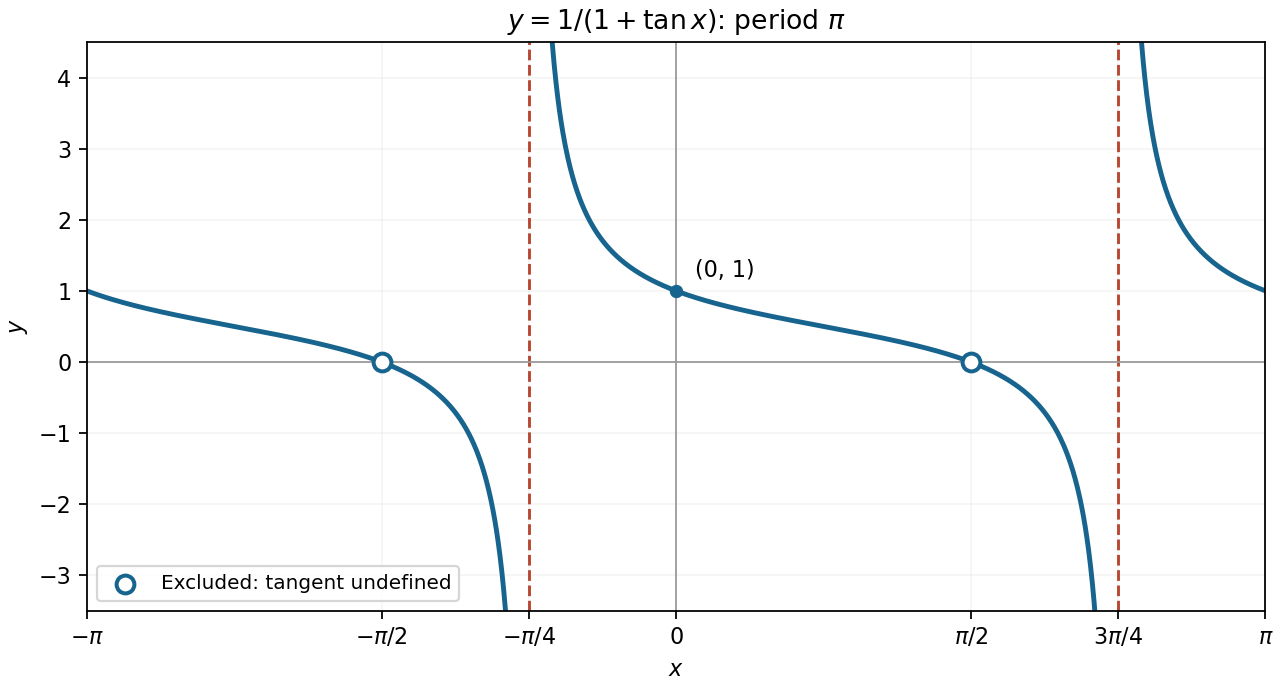
. Details. Where the original expression is defined, multiplication by givesThus the graph repeats with period and has vertical asymptotesBetween consecutive asymptotes the extended cotangent branch decreases from to , since . It passes through and .
It is essential to preserve the domain when simplifying a function. At , the original tangent is undefined. The finite limiting value is zero, so the graph has holes at , rather than actual zeros. The simplified expression extends across those points, but the original one does not.
Interpret the stated side lengths as all eight edges of the square pyramid. The equal lateral edges put its apex above the base centre. The base-centre-to-vertex distance is half the diagonal, . The Pythagorean theorem therefore givesUsing the pyramid volume formula with a base,
The sphere has surface area . Dividing the given surface-patch area by that total gives the dimensionless fractionor about of the surface. The patch area is already measured on the surface, so no planar projection or spherical-cap conversion is needed.
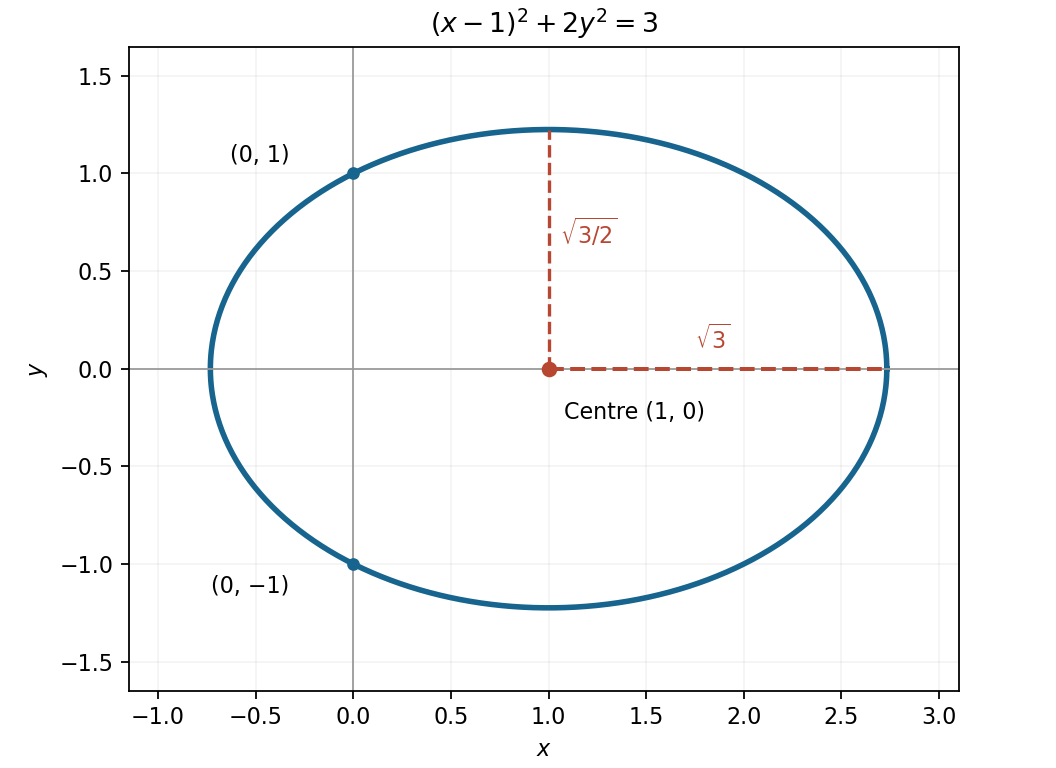
The general solution of this first-order linear ordinary differential equation is . Its initial condition gives , soDifferentiation verifies and substitution at zero gives the required value.
The specified range ensures , so the separable differential equation can be written . Integrating gives . The range selects the principal inverse tangent, henceEvery finite produces a solution within the required range. Constant solutions at the excluded values are not part of this family or of the question's domain.
Use the real antiderivative , valid on either half-line away from zero:The negative answer is consistent with a negative integrand and increasing integration limits.
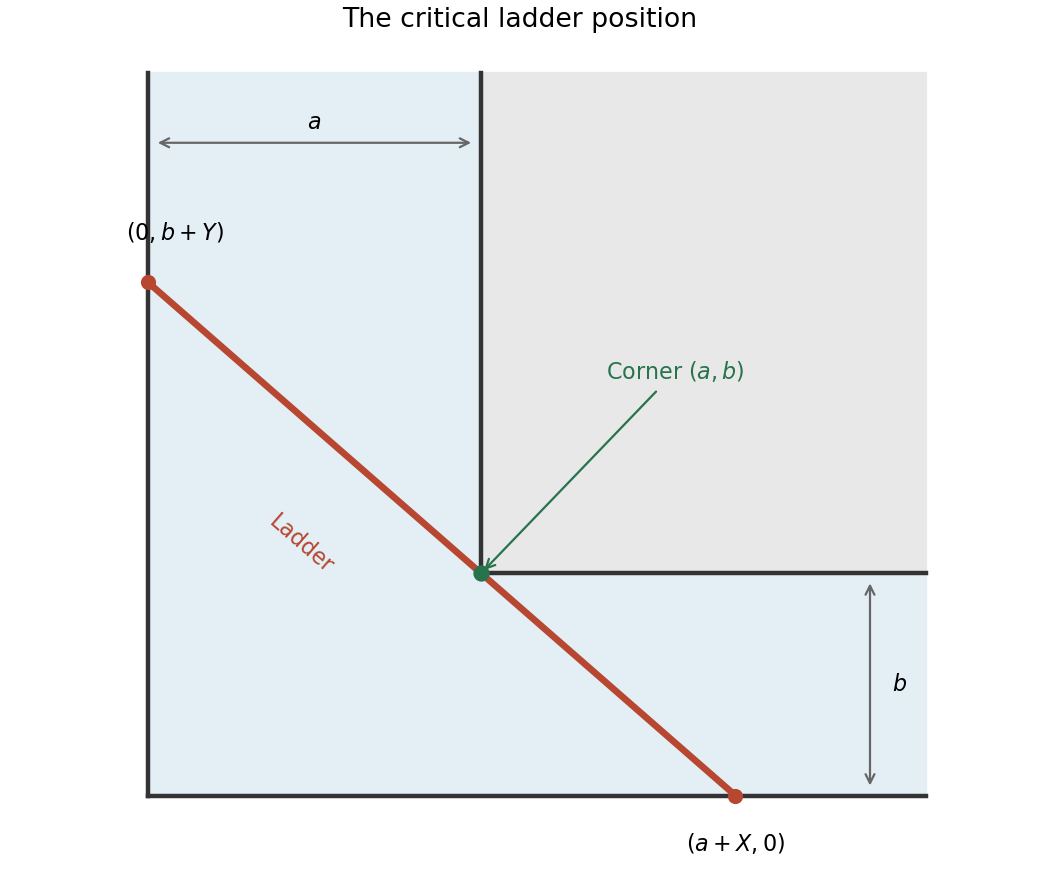
Assume positive corridor widths . Write the line through the two wall-contact endpoints in intercept form. Requiring it to pass through the inner corner givesIts squared length is . Apply Lagrange multipliers to this function subject to :Multiplying by and respectively eliminates the multiplier, giving . Substitute and multiply by :The branch is geometrically inadmissible. Thus and . If and , the two intercepts become and , soAlong in the positive quadrant, as or , and this is its only stationary point. It is therefore the minimum of the longest sticks that fit at each orientation. A stick being turned must pass through every intermediate orientation, so this narrowest clearance is precisely the maximum carryable length, rather than a maximum of . This is the ladder around a right-angled corner problem, with a zero-width stick and wall contact allowed as in the ideal geometry.


There are unlisted articles, also show them or only show them.