
Along a change in volume at fixed temperature, the first law of thermodynamics givesUse the Helmholtz Maxwell relation derived in (a) to replace the entropy derivative. This provesFor the stated Van der Waals equation, temperature-independent give . Hence . Integrating with respect to yieldsThe dilute-limit condition holds at every fixed and forces , soThe result is the internal energy of a van der Waals gas in the fixed-amount convention of the question. Its volume derivative is positive even though the attractive energy correction itself is negative.
For fixed amount of substance, take the internal energy . The first law of thermodynamics identifies and . Equality of mixed second derivatives givesFor the Helmholtz free energy, subtract the product differential from the first law of thermodynamics to obtain . Its natural variables are , so and . Exactness therefore givesFor the Gibbs free energy, the product rule gives . Thus , , andFor the enthalpy, , giving , andThese are the four Maxwell relations, each following from exactness in the appropriate pair of natural variables.
Assume the components of have continuous second partial derivatives. Expanding the divergence of its curl givesEach positive term cancels a negative term because the corresponding mixed derivatives commute. Consequently
Put and denote the distances to and by and . Direct expansion using givesSince and , both expressions inside the final square roots are positive. Hencefor every point of this right branch. This is the focal-distance identity for a hyperbola; on the left branch the signed difference would reverse, while its absolute value would remain .
Solving for gives with . For large , the square root is , so the two asymptotes areThe curve lies between these lines on the right side and has its nearest point, with vertical tangent, at . As increases it travels from the lower unbounded end through that vertex to the upper unbounded end. The left hyperbola branch is not part of the given curve.
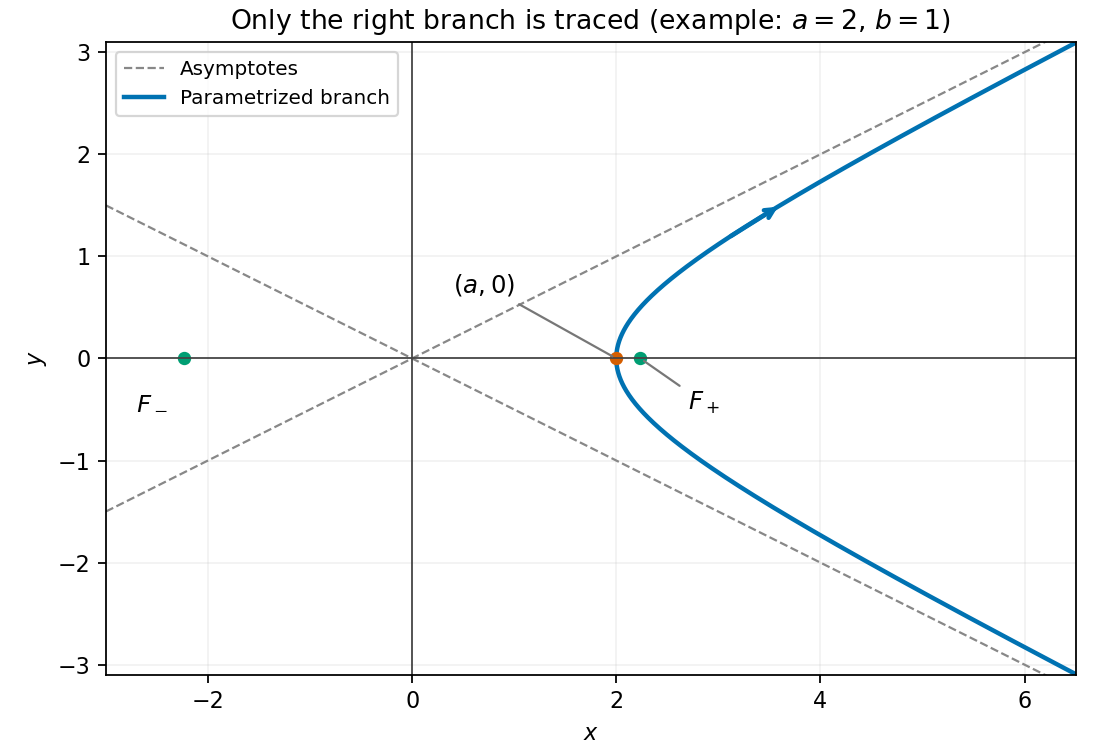

The hyperbolic functions identity eliminates from the parametric curve:The restriction is essential: , so the parametrization traces only the right branch of the full hyperbola. Conversely, every point on that right branch is reached by taking .
The Euclidean distance is . Along the parametric curve,This is at least , with equality exactly when . Therefore
The common homogeneous solution is . For forcing , a trial gives , so the first general solution isFor forcing , the frequency produces resonance in a differential equation. A trial gives , so and the second solution isThe superposition principle permits adding the two particular solutions. The sum-forcing equation therefore hasOnly one pair of homogeneous constants is needed, because the two original homogeneous families coincide.
The characteristic equation has roots zero and three, giving . Since the forcing is quadratic and the homogeneous solution contains a constant, use the polynomial trial . Substitution givesMatching coefficients gives , , and . Therefore
The tangent half-angle substitution gives and . The endpoints become zero and one, soUse completing the square, , and integrate:Thus both integrals equal .
Use integration by substitution with and the Gaussian being an even function:The factor two from the differential exactly cancels the half-line factor in the given full-line Gaussian integral.
There are unlisted articles, also show them or only show them.