
Write the partial fraction decomposition as . After multiplying through, . Setting gives , and setting gives , so
For , set , . This integration by substitution givesThis case is treated separately because the denominator in part (a) vanishes.
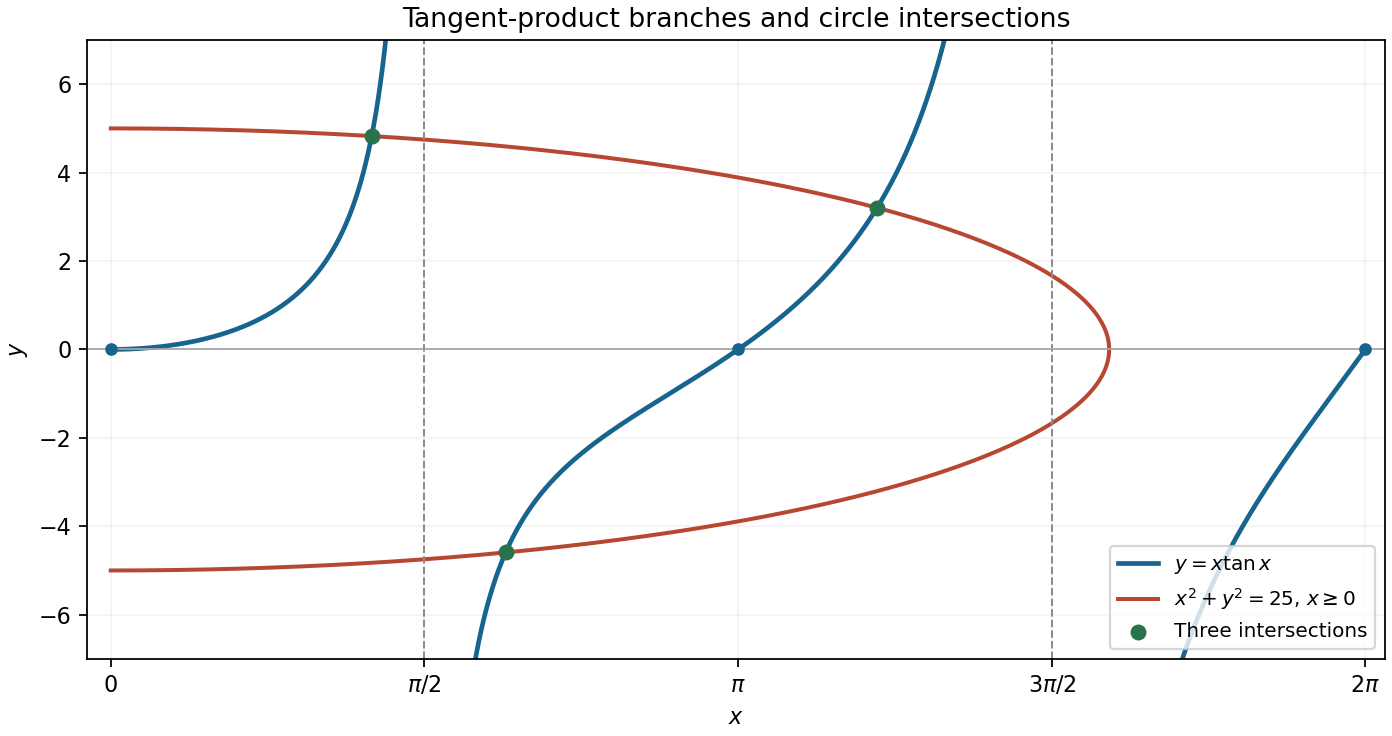
The tangent has poles at and , so these are vertical asymptotes of . The zeros on the given interval are . Near zero, , so the graph starts with a horizontal tangent line.
Each of its three branches is increasing. Indeedand the numerator starts at zero with derivative , so it is positive for . The first branch rises from zero to , the middle branch rises from through to , and the last rises from to .
Multiply the separable differential equation by : . The left side is , hence . ThereforeThe real general solution is taken on any connected interval where the logarithm's argument is positive.
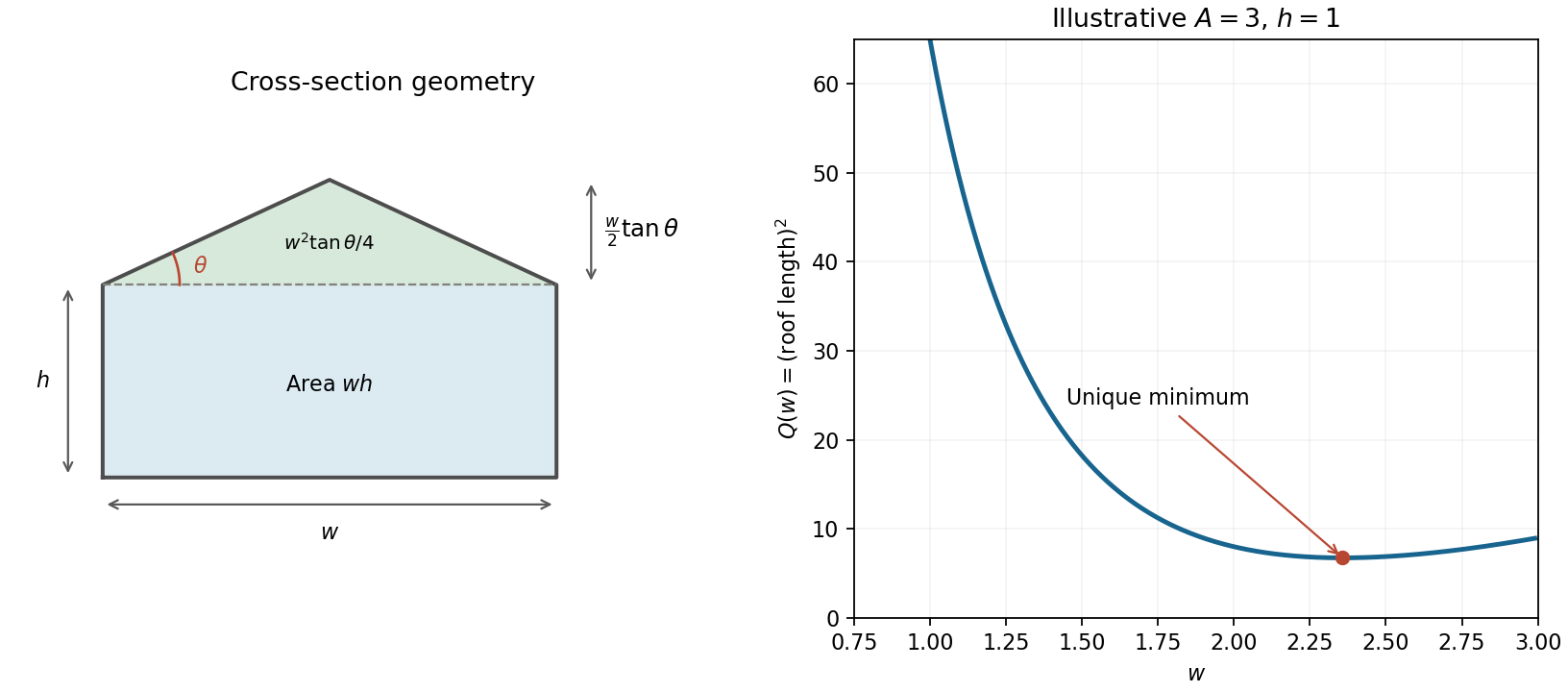
The triangular roof has height and two slopes of length . Hence the area constraint and cost areThe wall height is fixed, so its cost is constant. Assume the physical case . Minimize subject to the area constraint by Lagrange multipliers:Eliminating the positive common factors givesThus the optimum has andSet , so the area constraint gives . Substituting into the preceding equation and multiplying by yields . ThereforeFor a global check, the square of the total roof length isIts derivative has the sign of . Since , and , it has one root in this interval, with decreasing before that root and increasing afterwards. This proves the unique global minimum, rather than merely a stationary design. The minimum roof length at fixed wall height and cross-sectional area is independent of and of the positive factor . If , every feasible shape has equal cost; the displayed conditions then describe a possible minimizer but are not necessary.


Take a face on the flat base and let be its positive half-widths, with height . The upper vertices meet the spherical boundary at , and the rectangular parallelepiped has volume . A Lagrange multiplier givesMultiplication by respectively shows . Positivity and the constraint give . ThereforeBoundary choices with a zero dimension give zero volume, so this is the maximum in this configuration.
The maximum-volume cuboid in a hemisphere also has a bound covering arbitrary orientations. Let be any box's half-edge lengths, its centre coordinates in its orthonormal edge basis, and the vertical unit-vector coordinates. Remaining above the base plane requires , so for at least one index. Its farthest vertex obeyswhere containment supplies the first inequality. The arithmetic-geometric mean inequality applied to the three terms for and yields . Thus its full volume cannot exceed the value attained above; tilting cannot improve it. Boundary contact is allowed for the maximum; strict containment would give the same supremum.
The two derivatives are and . At the intersection their slopes are and , so their direction vectors and have zero dot product. Thus the tangent lines are perpendicular and their angle is
At an intersection, , so . Substitution into either parabola givesThe resulting linear equation for has only one solution, so this is the unique intersection.
For , the terms do not tend to zero, so the series diverges. For , group the positive terms into the dyadic blocks . Each block contains terms, and monotonicity givesWhen , the upper bounds form a convergent geometric series with ratio , proving convergence. When , the lower bounds do not tend to zero, so infinitely many blocks each make a nonvanishing contribution and the sum diverges. Thus the p-series criterion isThis dyadic comparison is the mechanism of the Cauchy condensation test. In particular is the divergent harmonic series.
Apply the ratio test to the infinite series whose partial sums are . Assuming the terms are eventually nonzero and the limit exists, letIf , the series has absolute convergence, by eventual comparison with a decaying geometric series. If , including an infinite limit, the terms fail to tend to zero and the series diverges. If , the test is inconclusive: both and have that ratio limit, but only the second converges. A finite partial sum itself requires no convergence test; the issue is the limit as .
Use the Maclaurin series on the positive side:In the last expression the original square root covers , whose leading term is . Hence and . All three are positive for sufficiently small positive , soThus is greatest and least in the stated limit.
There are unlisted articles, also show them or only show them.