
For period , use the Fourier series conventionThe Fourier coefficients have prefactor on . First, . For the useful antiderivatives areAt the endpoints and , soConsequently, on ,The Dirichlet-Jordan convergence theorem justifies equality at every point of continuity of the periodic extension. At odd integers the extension has a jump discontinuity between and , so the series converges to their average , regardless of any assigned endpoint value. This is the case of the Fourier series of a periodically extended exponential.
Assume . For any nonzero integer ,For , the product-to-sum identity expresses the integrand as one half the sum of cosines with nonzero frequencies and , so the integral is zero. For , use to get . Finally, for the integrand is one. The complete Fourier orthogonality formula isThe constant mode has twice the squared norm of a positive-frequency cosine mode.
At the origin the Hessian matrix isThus the second-derivative test gives a saddle point. Its opposite signs can also be checked without a test formula: for , whereas for . Both types of values occur arbitrarily close to the zero value at the origin, excluding either a local maximum or a local minimum.
The product rule gives the two partial derivativesThey both vanish at the origin. The exponential function is never zero, so any further stationary point must satisfy or , and or . Having both coordinates nonzero would require both opposite differences to be , which is impossible. If , the nonzero choices are ; if , they are . Hence the full list is
A directional derivative measures change per unit distance, so first normalize the direction: . The gradient isTaking the dot product with the unit vector,Using the unnormalized vector would instead give , the change per unit parameter along ; it is not the rate per unit distance requested here.
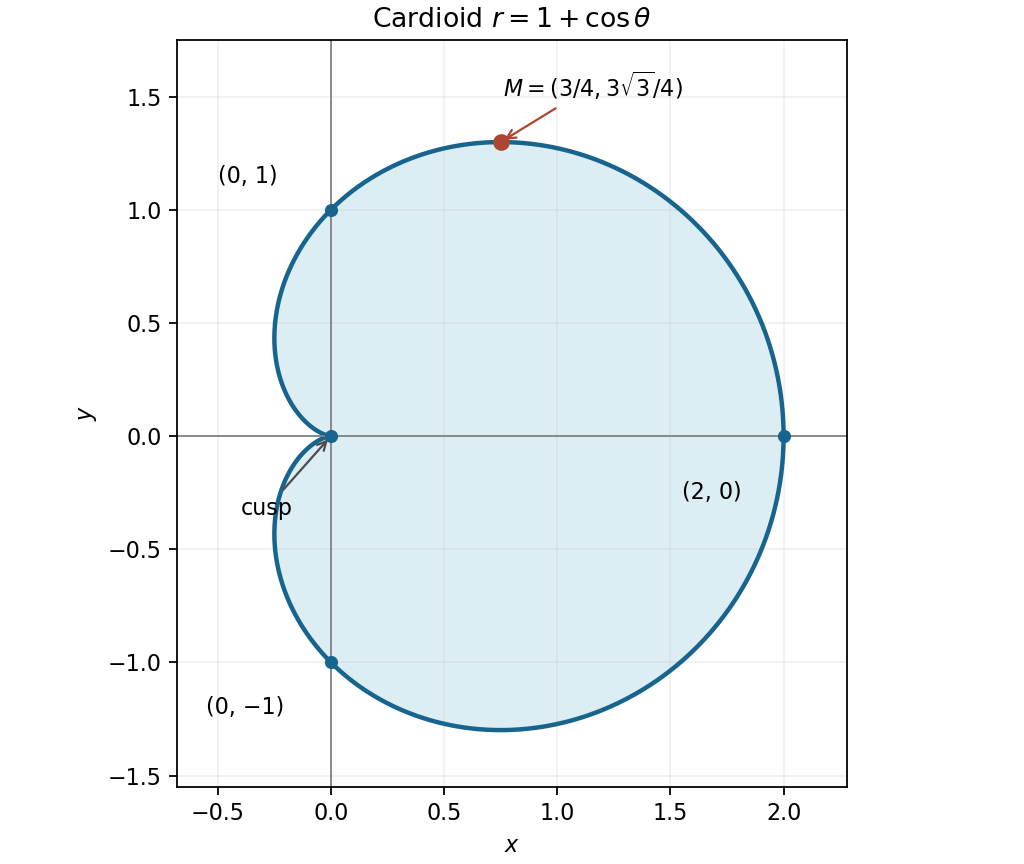
Differentiate , :Squaring and adding cancels the mixed terms and uses , givingFor this cardioid, the polar arc length integrand isThe cosine inside the absolute value changes sign at . Therefore the perimeter isin coordinate length units. The isolated cusp does not obstruct this piecewise smooth arc length integral.
Each radial segment from to lies inside the cardioid. Integrating the polar area element givesThe three integrals are respectively , and . Thusin square coordinate units, agreeing with the scale-one case of the area and perimeter of a cardioid.
Convert the cardioid from polar coordinates to Cartesian coordinates:The curve is symmetric about the horizontal axis. It has a cusp at the origin at , passes through , and reaches on the right. Its leftmost horizontal coordinate is , since .

There are unlisted articles, also show them or only show them.