
Past exam of the mathematics course of the year 2 of the natural sciences course of the University of Cambridge 2004 Paper 2 5 Solution Created 2026-10-18 Updated 2026-10-20
For causal functions the convolution is . In a half-plane of absolute convergence, changing variables in its Laplace transform and using Fubini's theorem givesThis proves the convolution theorem for Laplace transforms. Transforming the differential equation gives . The direct transform pairs and then giveFor a continuous forcing, call the last term . The Leibniz integral rule gives and . Also . Thus both the original equation and the initial values hold.
For an impulse at positive time , the Dirac delta evaluates the convolution, yieldingHere is the Heaviside step function. The displacement remains continuous at , while its derivative jumps upward by one, exactly as required by integrating the differential equation across the unit impulse.
Past exam of the mathematics course of the year 2 of the natural sciences course of the University of Cambridge 2004 Paper 2 4 Solution Created 2026-10-18 Updated 2026-10-20
The residue theorem states that a positively oriented simple closed contour enclosing isolated poles and none on the contour has integral times the sum of their residues, provided the function is holomorphic elsewhere inside. Near a simple zero of , . HenceFor , this gives for every integer .
To evaluate the real integral, integrate around an upper semicircle, with a small upper semicircular indentation excluding zero. Use the branch real on the positive axis and with argument between zero and in the upper half-plane. The large arc tends to zero as and the small arc as . The only enclosed pole is , whose contribution isOn the negative real axis the upper boundary value is . The two real segments therefore contributeComparing real parts yieldsThe integral is absolutely convergent at both zero and infinity, so no principal-value interpretation is needed.
Past exam of the mathematics course of the year 2 of the natural sciences course of the University of Cambridge 2004 Paper 2 3 b Created 2026-10-18 Updated 2026-10-20
Past exam of the mathematics course of the year 2 of the natural sciences course of the University of Cambridge 2004 Paper 2 2 Solution Created 2026-10-18 Updated 2026-10-20
Use Green's second identity in the source coordinate:Take and , the fundamental solution of the Laplace equation satisfying . With localized charge and the decaying potential, the boundary integral tends to zero on expanding spheres. The volume identity then gives , hence the Coulomb potentialConvergence of this integral and a condition fixing the potential at infinity are needed: mere pointwise decay of is not enough, and a harmonic function could otherwise be added. A bounded, compactly supported charge distribution is a sufficient setting for this derivation.
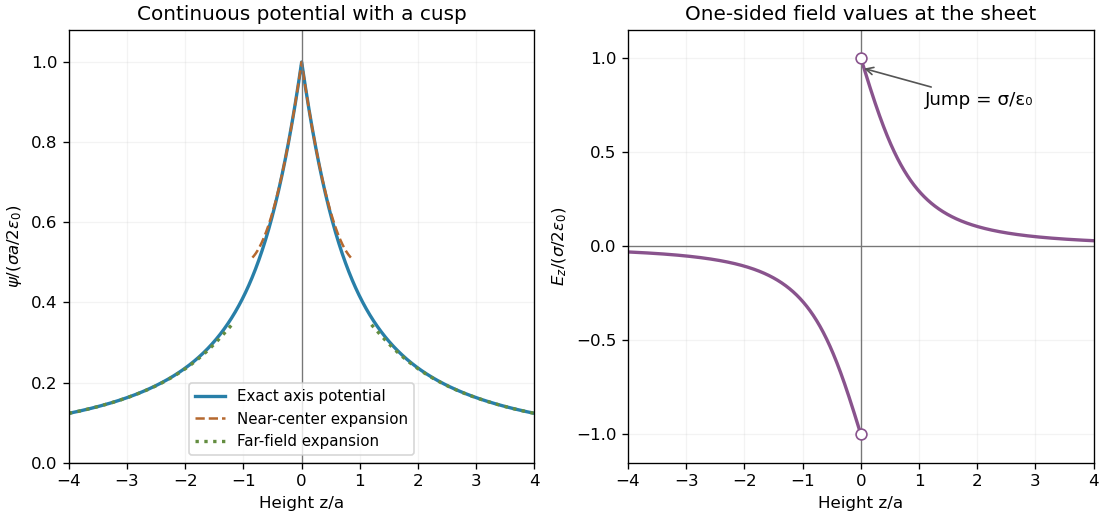
For the disk put . On its axis, every ring of radius is at distance , soFor subtract ; for add . This is the electrostatic potential of a uniformly charged disk with zero potential at infinity. The absolute value is essential for reflection symmetry and the correct behavior on the lower axis.

Past exam of the mathematics course of the year 2 of the natural sciences course of the University of Cambridge 2004 Paper 1 9 Solution Created 2026-10-18 Updated 2026-10-20
For variations with , integration by parts gives . The fundamental lemma of the calculus of variations therefore gives the Euler-Lagrange equationFor the ramp, use conservation of energy from rest at the rim. The vertical drop is , so . The spherical surface arc length is . On a monotone segment described by , the travel time is consequentlyFor increasing this has the printed limits to ; for a descent, reverse the decreasing angular limits to keep time positive. The azimuth is a cyclic coordinate of this integrand. Its conserved derivative gives the first integral for the brachistochrone on a hemispherical ramp:Solving for its square yieldsFor a regular stationary path with finite , this tends to zero as the rim is approached. The ratio of azimuthal to meridional displacements is , which also tends to zero. Hence the initial direction is along a meridian toward the bottom. This conclusion concerns the initial heading; the later route can turn before reaching the bottom when its rim endpoints require a nonzero azimuthal displacement.
Past exam of the mathematics course of the year 2 of the natural sciences course of the University of Cambridge 2004 Paper 1 8 a Created 2026-10-18 Updated 2026-10-20
Past exam of the mathematics course of the year 2 of the natural sciences course of the University of Cambridge 2004 Paper 1 7 b Created 2026-10-18 Updated 2026-10-20
Past exam of the mathematics course of the year 2 of the natural sciences course of the University of Cambridge 2004 Paper 1 5 Solution Created 2026-10-18 Updated 2026-10-20
A real orthogonal matrix satisfies ; a complex unitary matrix satisfies . Their columns are orthonormal in the corresponding real or complex inner product.
Adopt the convention that a complex inner product is linear in its second argument, conjugate symmetric, and positive definite: , with equality exactly when . Conjugate symmetry and second-argument linearity then imply antilinearity in the first:For the specified real symmetric matrix use . Its upper block is the outer product , so it has one zero eigenvalue and one eigenvalue . A complete orthonormal eigenbasis isIf , the last two eigenvalues coincide and their eigenspace is the span of ; every nonzero vector in that span is an eigenvector. Since , the zero eigenspace remains one-dimensional.
Past exam of the mathematics course of the year 2 of the natural sciences course of the University of Cambridge 2004 Paper 1 4 b Created 2026-10-18 Updated 2026-10-20
Past exam of the mathematics course of the year 2 of the natural sciences course of the University of Cambridge 2004 Paper 1 3 b Created 2026-10-18 Updated 2026-10-20
Past exam of the mathematics course of the year 2 of the natural sciences course of the University of Cambridge 2004 Paper 1 2 Solution Created 2026-10-18 Updated 2026-10-20
With constant positive thermal diffusivity , no internal heat source and one spatial coordinate, the heat equation isSeparation of variables makes each spatial mode decay by . The endpoint conditions determine whether the initial triangular profile is expanded in a Fourier sine series or a Fourier cosine series.
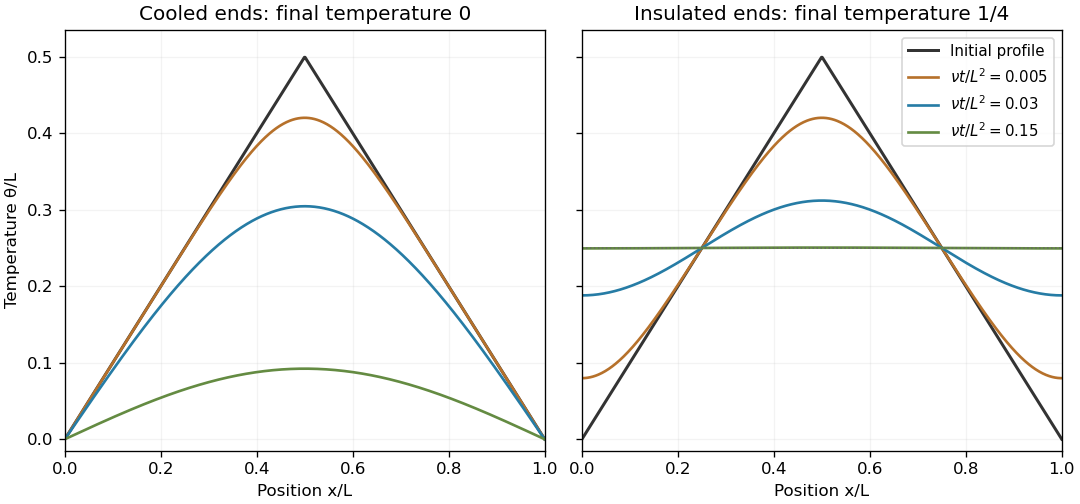
The same triangular initial temperature with cooled and insulated ends
. Original heat-equation solutions for several dimensionless times. Fixed zero-temperature ends cool the bar to zero; insulated ends preserve its initial mean and approach a uniform temperature. Details.
Past exam of the mathematics course of the year 2 of the natural sciences course of the University of Cambridge 2004 Paper 1 10 Solution Created 2026-10-18 Updated 2026-10-20
For example, impose homogeneous Dirichlet boundary conditions , and use variations vanishing there. Homogeneous Neumann boundary conditions are another choice removing the boundary terms. Put , , and . At a stationary function let . The quotient rule gives . After integration by parts, stationarity under every allowed variation givesso the fundamental lemma of the calculus of variations yields the stated Sturm-Liouville problem. Conversely an eigenfunction with those boundary conditions has and makes the quotient stationary. The lowest eigenvalue minimizes the Rayleigh quotient under the usual self-adjoint, lower-bounded hypotheses; higher eigenvalues are stationary values with orthogonality constraints when minimizing successively.
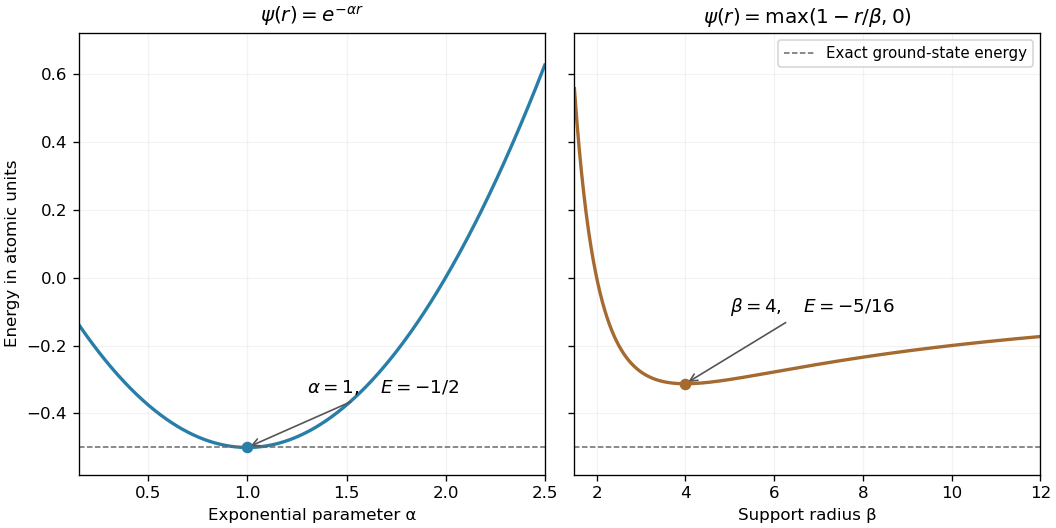
The hydrogen equation becomes . Its radial energy quotient is thereforeRegularity at zero and decay at infinity remove the boundary term . The condition fixes an arbitrary amplitude for these trial functions; it is not their three-dimensional probability normalization, which cancels from the quotient.
For , elementary exponential integrals give , , and . HenceFor the compactly supported linear trial for hydrogen, the norm, gradient and Coulomb integrals are , , and , respectively. ThusThe derivative changes from negative to positive at four, so this is the minimum over positive . The quantum variational principle gives upper bounds on the ground-state energy; the exponential trial is better, and in fact satisfies the exact differential equation at . It is the nodeless hydrogen ground state in the given units. The linear trial is admissible for the energy quadratic form despite its derivative jump at ; it need not possess a classical second derivative at that point.

There are unlisted articles, also show them or only show them.