
Past exam of the mathematics course of the year 2 of the natural sciences course of the University of Cambridge 2005 Paper 2 6 i Created 2026-10-18 Updated 2026-10-20
Past exam of the mathematics course of the year 2 of the natural sciences course of the University of Cambridge 2005 Paper 2 5 Solution Created 2026-10-18 Updated 2026-10-20
The one-sided Laplace transform is for sufficiently large . Integration by parts, with the exponential suppressing the upper boundary, givesDifferentiation under the integral gives , proving . Start with and apply this rule repeatedly:With all three initial data zero, transforming the forced equation gives . Thus and the listed inverse transform givesThe cubic factor is also the resonant exponential particular solution associated with the triple characteristic root .
Past exam of the mathematics course of the year 2 of the natural sciences course of the University of Cambridge 2005 Paper 2 4 Solution Created 2026-10-18 Updated 2026-10-20
A pole of order at has extending holomorphically to a nonzero value there. Its residue is the coefficient of in the Laurent series. The Cauchy integral theorem gives for a closed contour in a simply connected domain of holomorphicity. The residue theorem replaces zero by times the enclosed residues for a positively oriented simple contour avoiding finitely many poles.
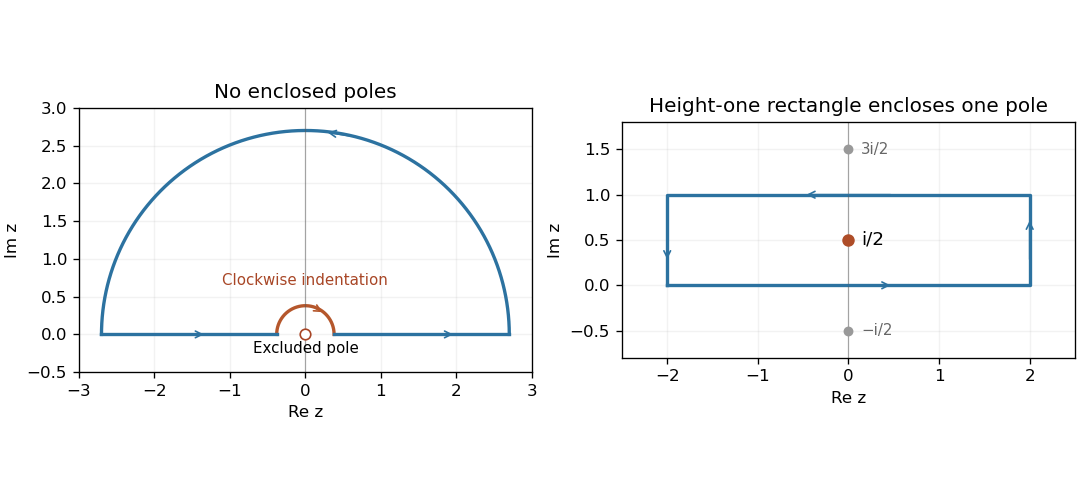
For the first integral, use the upper-half-plane semicircle, with a small clockwise upper semicircle excluding the origin. Near zero,There are no poles inside the indented contour. The large arc vanishes because and the integrand there is ; the small arc tends to . Therefore the real-axis complex principal value is . Taking real parts gives the ordinary convergent cosine-difference inverse-square integralThe real numerator cancels to second order at zero, so this final real integral itself needs no principal-value convention.
For , the simple poles are , . Differentiating the denominator givesIntegrate around the rectangle with vertices . It contains only . On the top side , and reversed traversal therefore contributes times the bottom integral. The vertical sides vanish for . The residue theorem gives , so the exponential moment of the hyperbolic secant is
Past exam of the mathematics course of the year 2 of the natural sciences course of the University of Cambridge 2005 Paper 2 3 Solution Created 2026-10-18 Updated 2026-10-20
Compute the complex derivative along real increments to get , and along imaginary increments to get . Equality gives the Cauchy-Riemann equations, .
For the specified real part, observe that . Thus the most general holomorphic function with this real part on the connected plane isThe difference of two such holomorphic functions has zero real part, so the Cauchy-Riemann equations make its imaginary part constant.
Next, . Its real and imaginary parts satisfy and . Their partial derivatives are continuous everywhere, proving that the complex hyperbolic cosine is entire.
Past exam of the mathematics course of the year 2 of the natural sciences course of the University of Cambridge 2005 Paper 2 2 Solution Created 2026-10-18 Updated 2026-10-20
Set in Laplace's equation. Separation gives and . Single-valued angular periodicity requires integer . For the radial factors are ; for they are . A term linear in is excluded by periodicity. Thus the harmonic Fourier expansions in planar concentric domains have the general formFor , the specified boundaries contain only a constant mode and a first cosine mode. The two-boundary annular harmonic interpolation givesAt , the cosine term vanishes and the logarithmic term is ; at , the first term vanishes and the cosine amplitude is . Each component is harmonic, and the maximum principle ensures uniqueness for these continuous Dirichlet boundary conditions.
Past exam of the mathematics course of the year 2 of the natural sciences course of the University of Cambridge 2005 Paper 2 10 Solution Created 2026-10-18 Updated 2026-10-20
A group representation is a homomorphism . It is a reducible representation if there is a nonzero proper invariant subspace of preserved by every , and an irreducible representation otherwise. With invertible,so changing basis gives another representation. Its character of a representation is , and cyclicity of the trace gives .
A conjugacy class consists of as varies. Since , a power equals the identity exactly when does. Thus conjugation preserves element order, including infinite order.
For the square, let be rotation by and reflection in a horizontal symmetry axis. The dihedral group has the eight elementsThe conjugacy classes of a finite dihedral group specialize toThe two central rotations are singletons. Reflection conjugation reverses rotations, while conjugation by shifts a reflection exponent by two, giving the two reflection classes.
For finite groups over , character orthogonality and completeness make the irreducible characters a basis of the class functions. The latter space has one independent value per conjugacy class. Hence the square group has five inequivalent irreducible complex representations. The sum of squares of irreducible representation dimensions is eight, forcing four one-dimensional representations and one two-dimensional representation. The four scalar choices , supply the former; the ordinary action on the plane supplies the latter.
Past exam of the mathematics course of the year 2 of the natural sciences course of the University of Cambridge 2005 Paper 2 1 Solution Created 2026-10-18 Updated 2026-10-20
For a bounded region with piecewise smooth boundary and a continuously differentiable vector field, the divergence theorem gives , with outward unit normal . Apply it to . The cross terms cancel, giving the Green's second identityThe terms cancel identically. Sending proves the whole-space identity provided the boundary integral tends to zero. The boundary term at infinity in Green's second identity requires adequate derivative decay as well as field decay; mere pointwise convergence does not suffice. The screened kernels used below satisfy the required decay.
Take . Apply the identity with and , treating the source through its Dirac delta function, or excising a small source sphere and taking its radius to zero. It gives . Symmetry of the radial Green function then yields the requested representation.
For separation , the modified Helmholtz equation reduces to . Decay selects . Integrating the equation over a small sphere gives , so . ThusFor with , put . Then . When , decay removes , while removes an additional point source at the origin. HenceSince has a minus sign, the positive Yukawa kernel convolution isThe coincident-rate limit is for the convolution, and the origin limit for general rates is . Both are finite; the apparent denominators in the distinct-rate formula are removable limits.
Past exam of the mathematics course of the year 2 of the natural sciences course of the University of Cambridge 2005 Paper 1 9 Solution Created 2026-10-18 Updated 2026-10-20
Introduce a Lagrange multiplier for the normalization and vary . With variation satisfying , integration by parts givesThe upper endpoint term vanishes, and the lower term vanishes because with the stipulated regular differentiable behavior. More generally the natural endpoint condition is there. The fundamental lemma of the calculus of variations gives , the stated Sturm-Liouville problem.
The Rayleigh-Ritz variational principle estimates the lowest eigenvalue by minimizing over an admissible finite-dimensional trial family. Restricting the family can only raise the minimum.
For the specific radial problem, and . The trial has . Normalization gives , with the negative sign an equivalent choice. The numerator is , soThis is the quadratic case of the power-law variational bound for a circular membrane. The exact first eigenvalue is smaller because the polynomial trial is not the exact Bessel function of the first kind eigenfunction. Expanding a trial in the exact orthonormal eigenbasis expresses its Rayleigh quotient as a weighted average of eigenvalues, so no admissible trial can lie below the lowest one.
Past exam of the mathematics course of the year 2 of the natural sciences course of the University of Cambridge 2005 Paper 1 8 Solution Created 2026-10-18 Updated 2026-10-20
Take and a source position . Before the source, the zero initial data require . After it, set ; the homogeneous equation becomes . Continuity of and a unit jump in at give , . Thus the causal Green function of a damped oscillator isHere is the Heaviside step function. For , take the continuous limit , giving . The formula is also unchanged when a nonzero changes sign. Its continuity removes a delta derivative, and its unit first-derivative jump supplies the required Dirac delta function.
For the forced equation use . The zero-initial-data Green function representation isThe sine-product identity reduces this to elementary exponential-trigonometric integrals. Evaluating givesFor an independent check, the steady particular part is , while the decaying homogeneous part has coefficients and that impose .
Past exam of the mathematics course of the year 2 of the natural sciences course of the University of Cambridge 2005 Paper 1 7 Solution Created 2026-10-18 Updated 2026-10-20
Define the weighted inner product . For the stated operator , integration by parts gives the Lagrange identity for a Sturm-Liouville operatorThe endpoint terms vanish for Dirichlet boundary conditions. Taking proves each eigenvalue is real, since makes the squared weighted norm positive. For eigenfunctions of distinct eigenvalues, the same identity gives , proving their orthogonality.
For the specific equation, divide by to obtain , so its weight is , with . Put , and . The logarithmic change of variable in a Sturm-Liouville problem gives . Remove the first derivative with ; the equation becomes , with .
The Dirichlet spectrum with inverse-square weight is thereforeIndeed . Values give a linear or hyperbolic transformed solution and no nonzero solution vanishing at both ends.
Past exam of the mathematics course of the year 2 of the natural sciences course of the University of Cambridge 2005 Paper 1 6 Solution Created 2026-10-18 Updated 2026-10-20
For , a singular point is a regular singular point if and are analytic there. The Bessel differential equation has and , so zero is regular singular.
Use the Frobenius method with , . Matching coefficients gives and , with missing negative-index coefficients zero. The regular root is . Then , all odd coefficients vanish, and the Frobenius series for Bessel functions has recurrenceFor noninteger , the root supplies an independent even-power series with and . None of these denominators vanishes. With standard normalization this is , independent of the Bessel function of the first kind . The real powers here are understood for .
For integer and the stated normalization , iteration givesThe ratio of consecutive term magnitudes is . Thus the series converges absolutely for every finite complex , defining an entire function for integer . At integer order, ; an independent solution is instead the Bessel function of the second kind.
Past exam of the mathematics course of the year 2 of the natural sciences course of the University of Cambridge 2005 Paper 1 5 Solution Created 2026-10-18 Updated 2026-10-20
A unitary matrix satisfies over the complex numbers; a real orthogonal matrix satisfies . Their inverses are their conjugate transposes and transposes, respectively.
With , the coordinate has eigenvalue . In the plane, the traceless symmetric two-by-two matrix has eigenvalues , where . If , choose with and . Then an orthonormal eigenbasis isIf equals or , the corresponding eigenspace is the span of the two listed vectors with that eigenvalue. If , then , the plane is the zero eigenspace, and retains eigenvalue ; if also , every vector belongs to the zero eigenspace. This includes the degenerate cases that a division by would miss.
For the Cauchy-Schwarz inequality, take and remove the orthogonal projection of along . Positivity of the squared norm givesMultiplication by and square roots prove ; the case is immediate. Equality means linear dependence. ThereforeTaking the nonnegative square root proves the triangle inequality.
Past exam of the mathematics course of the year 2 of the natural sciences course of the University of Cambridge 2005 Paper 1 4 Solution Created 2026-10-18 Updated 2026-10-20
By the spectral theorem, the Hermitian matrix has a complete orthonormal eigenbasis. If , idempotence gives , so every eigenvalue is zero or one. Since , at least one is zero. ThereforeThe trace of an idempotent equals its rank; here Hermiticity further identifies as an orthogonal projection matrix.
A complex inner product is conjugate-linear in its first argument, linear in its second, conjugate symmetric and positive definite: and for nonzero . An orthonormal basis is a spanning linearly independent family with . The associated norm is .
For two distinct basis elements , their orthogonality and unit norms give . Hence their distance is ; if the same element is selected twice, it is zero.
Past exam of the mathematics course of the year 2 of the natural sciences course of the University of Cambridge 2005 Paper 1 3 Solution Created 2026-10-18 Updated 2026-10-20
Use the conventionThese are the Fourier transform and inverse Fourier transform for suitably integrable data. Assuming the required ordinary transforms exist and the lower derivatives vanish at both ends, integration by parts gives . Repeating this argument yieldsThe decay assumptions are used to discard the boundary terms at each step.
For positive diffusivity , transforming the heat equation gives . Thus , where . The convolution theorem and the Gaussian heat kernel giveFor , the Fourier transform of a Gaussian is . Multiplying by the heat factor and inverting gives the Gaussian initial data for the heat equation solutionIt recovers the initial profile as and preserves its spatial integral .
Past exam of the mathematics course of the year 2 of the natural sciences course of the University of Cambridge 2005 Paper 1 2 Solution Created 2026-10-18 Updated 2026-10-20
Set in the heat equation. Separation of variables gives . Zero endpoint temperatures impose Dirichlet boundary conditions , selecting for . The separated factors can therefore be chosen asZero and negative separation eigenvalues give only the zero spatial solution under these boundary conditions.
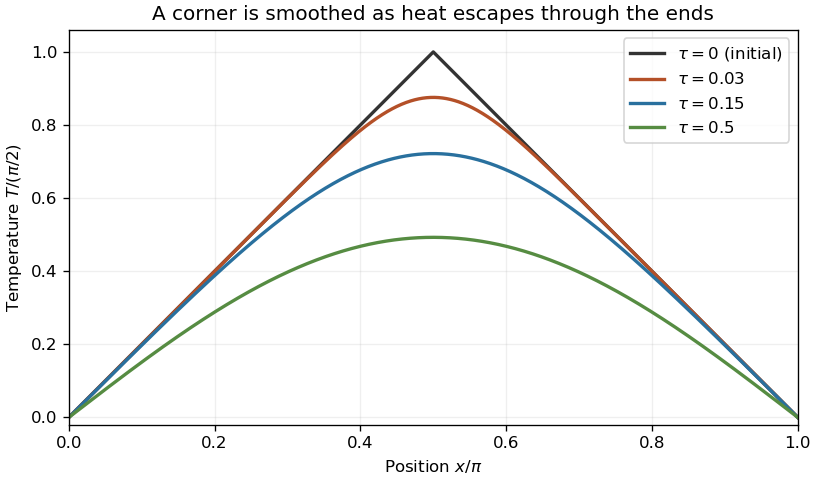
The initial profile is continuous and triangular, with midpoint height . Its Fourier sine series coefficients areConsequently the heat flow from a triangular initial temperature isFor , each summand has magnitude at most . The Weierstrass M-test proves absolute and uniform convergence. The initial Fourier sine series equals the continuous piecewise smooth profile, and for the exponential factors justify termwise spatial and time differentiation on every time interval bounded away from zero.
Past exam of the mathematics course of the year 2 of the natural sciences course of the University of Cambridge 2005 Paper 1 10 Solution Created 2026-10-18 Updated 2026-10-20
Along an extremal, differentiate . The chain rule givesWhen , the Euler-Lagrange equation makes the right side zero. This proves the Beltrami identity, .
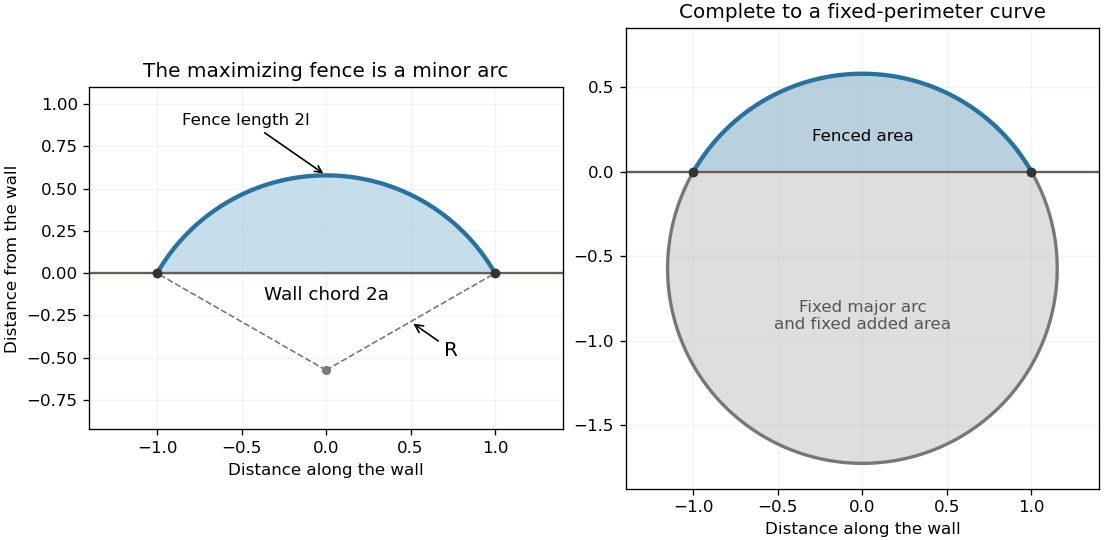
Place the wall on with attachments at , and write the fence above it as . Maximize area subject to length . The isoperimetric constraint gives the augmented integrand , where is a constant multiplier. Its Euler-Lagrange equation is , so the fence has constant negative curvature. Equivalently the Beltrami identity is .
The resulting maximum-area circular segment with fixed arc length and chord hasHere is the half-angle subtended by the arc. Its half-length is and half-chord is . The function increases from one to , so the given range determines a unique minor arc. Its enclosed area is .
There is also a global maximality proof for simple fences in the chosen half-plane, without assuming competitors are graphs. Complete the candidate minor arc with the complementary major arc of the same circle, which lies below the wall. Attach this same fixed major arc to any competing fence of length . The completed closed curve always has perimeter , and its area is the competitor's fenced area plus the same fixed area below the wall. The planar isoperimetric inequality bounds that total by , attained by the candidate circle. Hence no competitor encloses more area, and equality requires the circular arc.


Past exam of the mathematics course of the year 2 of the natural sciences course of the University of Cambridge 2005 Paper 1 1 Solution Created 2026-10-18 Updated 2026-10-20
For , the chain rule gives . Differentiating the radial factor gives , so in Cartesian coordinatesThe origin is excluded because the scalar field is singular there.
The Stokes theorem states for a sufficiently smooth vector field and oriented surface with piecewise smooth boundary. The boundary orientation follows the right-hand rule relative to .
For the convective acceleration identity, use the Levi-Civita symbol contraction . It givesRearranging proves the required vector identity.
For orthogonal coordinates, define the scale factors of orthogonal coordinates and tangent unit vectors . They form an orthonormal basis, and . Equating with identifies each component. Thus the gradient in orthogonal coordinates isThis holds on a regular coordinate chart where all scale factors are positive.
Past exam of the mathematics course of the year 2 of the natural sciences course of the University of Cambridge 2004 Paper 2 8 Solution Created 2026-10-18 Updated 2026-10-20
A right coset of in is . Right multiplication by is a bijection , with inverse , so every right coset has elements. The analogous map proves the same assertion for left cosets.
Write the displayed matrices as . Direct multiplication givesAll new coordinates are integers, so the set is closed. Matrix multiplication is associative, the identity is , andwhich also has integer coordinates. Thus it is the Integer Heisenberg group.
The subset contains the identity, and multiplication and inversion add or negate , so it is a subgroup. Its right cosets areThey are exactly the sets with fixed integer coordinates , as described by cosets of a coordinate subgroup of the integer Heisenberg group. The factor order is essential; multiplying by on the other side would also change the upper-right coordinate by .
Past exam of the mathematics course of the year 2 of the natural sciences course of the University of Cambridge 2004 Paper 2 7 Solution Created 2026-10-18 Updated 2026-11-05
A normal mode has all coordinates following one fixed displacement pattern with a common time factor. Its normal frequency is that factor's oscillation frequency; normal mode coordinates are amplitudes in a basis of such patterns, making the linear equations independent. A zero-frequency mode can instead have constant velocity along a symmetry direction.
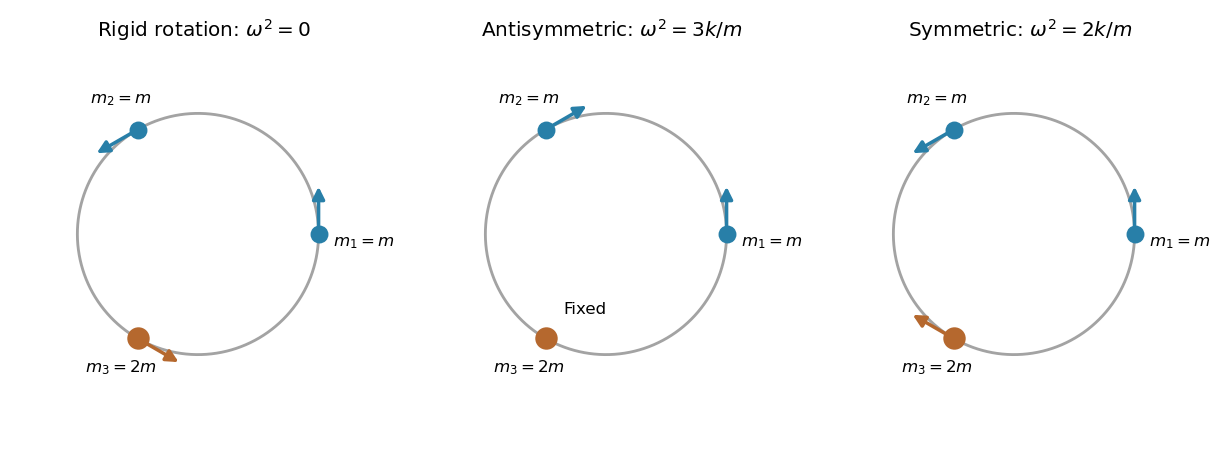
For the unit circle, each angular displacement equals its corresponding arc displacement. The kinetic energy and change in potential energy areAny common spring prestress changes only the constant , because the sum of the three arc lengths is fixed. The Euler-Lagrange equations giveThese are the normal modes of three beads connected by springs on a circular hoop, with third mass . For , their three mode vectors and squared angular frequencies areThe zero mode rotates the entire configuration without stretching a spring. The antisymmetric mode moves the equal masses oppositely while leaving the third fixed. In the symmetric mode the equal masses move together against the third, with zero total angular momentum. These vectors are orthogonal in the mass inner product with matrix .
Writing gives independent equations , , . In particular , retaining possible slow common rotation. For , the two positive frequencies coincide at ; their two-dimensional space is all patterns with .

Past exam of the mathematics course of the year 2 of the natural sciences course of the University of Cambridge 2004 Paper 2 6 Solution Created 2026-10-18 Updated 2026-10-20
An isotropic tensor has unchanged components under every rotation of the Cartesian axes. Under proper rotations in three dimensions, rank one has no nonzero isotropic tensor, rank two has , and rank three has . Here is the Kronecker delta and the Levi-Civita symbol. If invariance under reflections is also required for a true tensor, the rank-three case vanishes; is then a pseudotensor.
The velocity gradient tensor for the given field isIts symmetric part, the strain-rate tensor if is interpreted as a velocity, isThe antisymmetric part has the specified ordering , withThe index ordering matters for this sign; it agrees with a local rotation velocity . This is the axial part of the scalar, symmetric-traceless and axial tensor decomposition, retaining the trace inside the symmetric part here.
At the specified point, . The upper block has characteristic polynomial . Thus the principal values and unit eigenvectors areThese mutually orthogonal directions are the principal strain rates' axes for this local field; reversing an eigenvector does not change its axis.
There are unlisted articles, also show them or only show them.