
Past exam of the mathematics course of the year 2 of the natural sciences course of the University of Cambridge 2007 Paper 2 9 Solution Created 2026-10-18 Updated 2026-10-20
A group homomorphism satisfies ; a bijective one is a group isomorphism. Its kernel of a group homomorphism is . It is a subgroup, and for , ,Thus , and applying the same argument to gives equality. Therefore is a normal subgroup.
Write . Direct matrix multiplication gives , and . Consequently these matrices form the integer shear group, a subgroup of . It is an infinite cyclic group, generated by , since and no nonzero integer power is the identity.
The map is a bijective group homomorphism from the additive group of integers, proving the required group isomorphism. There are proper subgroups: for example omits . In fact every subgroup is for an integer , by the classification of subgroups of an infinite cyclic group; gives the trivial subgroup and the whole group.
Past exam of the mathematics course of the year 2 of the natural sciences course of the University of Cambridge 2007 Paper 2 8 Solution Created 2026-10-18 Updated 2026-10-20
Lagrange's theorem states that the group order of a finite group divides the group order; more precisely .
If every element squares to the identity element, every element is its own inverse element, and . Thus a group of exponent two is abelian. For distinct nonidentity , the four elements are distinct: for example would imply , and would imply . Products remain in this set because commute and square to one. Thus they form a Klein four-group subgroup of order four.
Now let with odd prime number . By Lagrange's theorem, every element order is one of . If an element has order , its square has order . If no element had order , all nonidentity elements would therefore have order two. There are at least two distinct such elements, producing a subgroup of order four. This contradicts . Hence there is an element of order .
Past exam of the mathematics course of the year 2 of the natural sciences course of the University of Cambridge 2007 Paper 2 7 Solution Created 2026-10-18 Updated 2026-10-20
For a conservative system near a stable equilibrium, the quadratic Lagrangian has the form , with symmetric mass matrix and stiffness matrix . A normal mode satisfies the generalized eigenvalue problem for small oscillations , so the frequency equation is .
To quadratic order, vertical velocities contribute only fourth-order corrections to the kinetic energy, leaving . A string of length with small horizontal difference shortens its vertical projection by . The upper segment carries all three masses, the middle segment two, and the lower segment one. Hence their increases in gravitational potential energy sum toSubtracting from gives the stated approximate Lagrangian. Here andFor a mode with middle displacement zero, write . The middle row requires , so . A nonzero mode then has , and the outer rows require . Therefore the necessary and sufficient condition isWhen it holds, the mode shape is with . This is the force-cancellation mechanism of the stationary middle mass in a three-mass spring chain, applied to the equivalent quadratic stiffnesses here.
Past exam of the mathematics course of the year 2 of the natural sciences course of the University of Cambridge 2007 Paper 2 6 Solution Created 2026-10-18 Updated 2026-10-20
A two-index Cartesian tensor has components transforming as under an orthogonal change of orthonormal basis. The tensor order here counts indices, rather than the matrix rank. Its scalar, symmetric-traceless and axial tensor decomposition follows by settingThen , with antisymmetric and symmetric and traceless. There are three independent antisymmetric components and five independent symmetric traceless components: three off-diagonal entries and two independent diagonal ones in the latter case.
For the symmetric tensor relative to a nonzero vector , put , , and . The symmetric tensor decomposition relative to an axis givesIn particular . Define the orthogonal projection onto the plane perpendicular to , and setThis tensor is symmetric and kills . Its trace is . To verify the full decomposition, set and split into its longitudinal component , two mixed components, and . The mixed terms are exactly , and gives the longitudinal coefficient. Thus all requested constraints and the reconstruction hold.
Past exam of the mathematics course of the year 2 of the natural sciences course of the University of Cambridge 2007 Paper 2 4 Solution Created 2026-10-18 Updated 2026-10-20
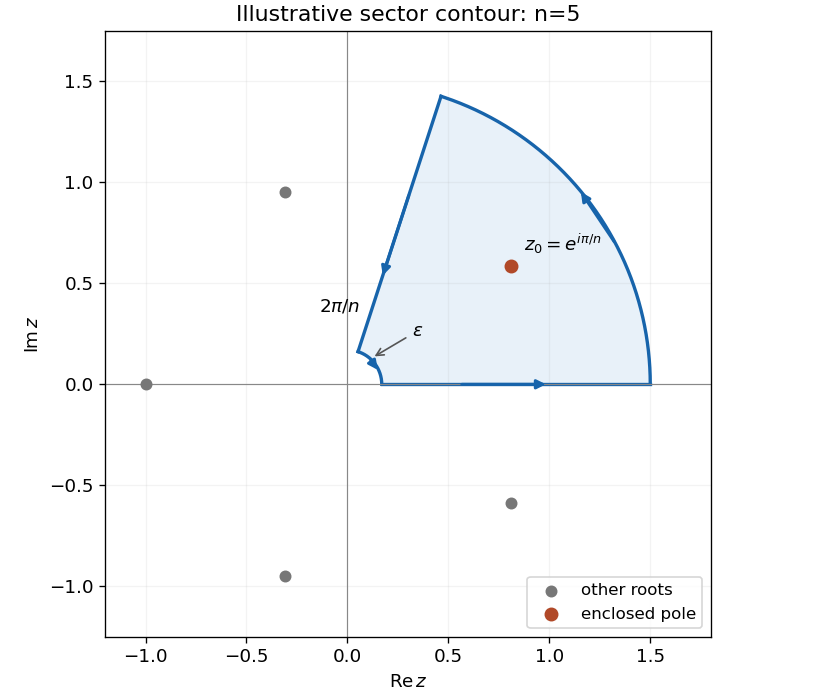
The residue theorem states that the contour integral of a meromorphic function around a positively oriented simple closed contour equals times the sum of its enclosed residues, provided there are no singularities on the contour. The roots of are , . They are simple poles, with residues .
Use the sector contour of angle , running outward along the positive axis and inward along the rotated ray. It encloses only . The large-arc contribution is , hence vanishes. With , the two ray contributions giveSince ,For the second integral, use on a branch continuous across the sector away from zero, with a small inner arc of radius . Its large arc is and its small arc is , both vanishing for . On the rotated ray, changes by , so the two radial contributions add rather than subtract. The enclosed residue is . ConsequentlyBoth answers are instances of the Mellin integral of a reciprocal binomial. The direct contour argument also tracks the branch needed when is odd.
Past exam of the mathematics course of the year 2 of the natural sciences course of the University of Cambridge 2007 Paper 2 3 i Created 2026-10-18 Updated 2026-10-20
Past exam of the mathematics course of the year 2 of the natural sciences course of the University of Cambridge 2007 Paper 2 2 i Created 2026-10-18 Updated 2026-10-20
Past exam of the mathematics course of the year 2 of the natural sciences course of the University of Cambridge 2007 Paper 2 10 Solution Created 2026-10-18 Updated 2026-10-20
Substitute and into the quadratic expression. Its coefficients of and are and . The cross term is zero for every matrix in this particular cyclic group, because each has one nonzero entry per row. ThusLet generate the group. For , ; for , . Since , each is its own inverse and . The group law is respected: , and makes it independent of the representative modulo four. This proves that is a group representation.
This quarter-turn action on diagonal quadratic forms hasso it is not faithful. Quadratic forms cannot distinguish a simultaneous sign reversal of both coordinates. The invariant coefficient directions and correspond to the fixed form and the form whose sign changes under a quarter-turn.
Past exam of the mathematics course of the year 2 of the natural sciences course of the University of Cambridge 2007 Paper 2 1 Solution Created 2026-10-18 Updated 2026-10-20
Put in Laplace's equation, multiply by , and separate the two variables:With , the angular equation becomes . Requiring a smooth axisymmetric harmonic function at both poles selects and the Legendre polynomial , for nonnegative integers . The radial Cauchy-Euler equation has solutions and . Superposition over the angular eigenfunctions therefore givesThis expansion assumes regularity on each whole angular sphere; without it, singular angular solutions would also be possible. The boundary data in the shell involve only the modes. Define the spherical-shell harmonic interpolation weightsEach equals one at the inner boundary and zero at the outer one, and does the reverse. Hence the steady temperature isEach term is a harmonic function, and substitution verifies both prescribed boundary values. Uniqueness follows from the maximum principle for harmonic functions.
Past exam of the mathematics course of the year 2 of the natural sciences course of the University of Cambridge 2007 Paper 1 9 Solution Created 2026-10-18 Updated 2026-10-20
Take a variation with . Differentiating the functional at zero and using integration by parts givesThe boundary term vanishes. Since the remaining integral must vanish for every smooth endpoint-zero variation, the fundamental lemma of the calculus of variations gives the Euler-Lagrange equation .
For the mechanical problem put . The Lagrangian is independent of , a cyclic coordinate, so its conjugate momentum is conserved. Therefore is constant, including the factor of two between and the canonical momentum for this normalization of .
For the radial coordinate, and . Its Euler-Lagrange equation isFor a circular orbit , the radial velocity and acceleration vanish. Using and leaves , henceThis is the circular orbit condition for a radial kinetic Lagrangian applied to the coefficients here.
Past exam of the mathematics course of the year 2 of the natural sciences course of the University of Cambridge 2007 Paper 1 8 Solution Created 2026-10-18 Updated 2026-10-20
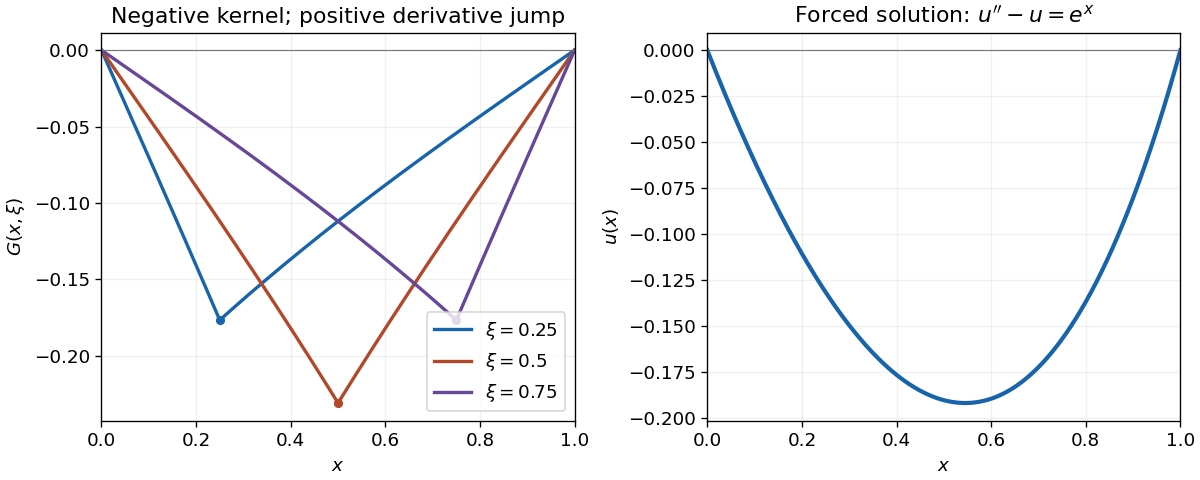
Choose the left homogeneous solution and the right one . Their Wronskian is . The Dirichlet modified Helmholtz Green function on an interval, with operator sign , is thereforeIt vanishes at both endpoints, is continuous at , and its first derivative jumps by , giving . The Green-function representation then givesThe two integrals are and , respectively. Substituting them and simplifying givesDirect differentiation verifies and both zero boundary values. The negative kernel also explains why the solution is negative inside the interval despite the positive right-hand side.


There are unlisted articles, also show them or only show them.