
The first four terms form the cubic Taylor polynomial about :With a continuous fourth derivative nearby, Taylor's theorem gives a remainder . Continuous derivatives through third order suffice for the weaker remainder . These are local approximations; equality with an infinite Taylor series requires additional convergence information.
The known root gives a factor by the factor theorem. Polynomial division leaves , soConsequently all the roots areThe three linear factors account for the full degree of the polynomial, so there are no further complex roots.
Past exam of the mathematics course of the year 1 of the natural sciences course of the University of Cambridge 2009 Paper 2 9 Solution Created 2026-10-18 Updated 2026-10-20
Past exam of the mathematics course of the year 1 of the natural sciences course of the University of Cambridge 2009 Paper 2 8 Solution Created 2026-10-18 Updated 2026-10-20
Past exam of the mathematics course of the year 1 of the natural sciences course of the University of Cambridge 2009 Paper 2 7 Solution Created 2026-10-18 Updated 2026-10-20
Past exam of the mathematics course of the year 1 of the natural sciences course of the University of Cambridge 2009 Paper 2 6 Solution Created 2026-10-18 Updated 2026-10-20
Expanding gives , so and . Hence , proving that it solves the one-dimensional wave equation. Equivalently its two summands are oppositely travelling profiles, as in D'Alembert's formula.
Past exam of the mathematics course of the year 1 of the natural sciences course of the University of Cambridge 2009 Paper 2 5 Solution Created 2026-10-18 Updated 2026-10-20
Factorization gives , so the zeros are and , with a double root at two. The derivatives are and . ThusThe second derivative changes sign at one, confirming the inflection point. The curve rises from , crosses at , reaches its local maximum, falls to touch the axis at two, then rises to . Neither local extremum is a global extremum on the whole real line.
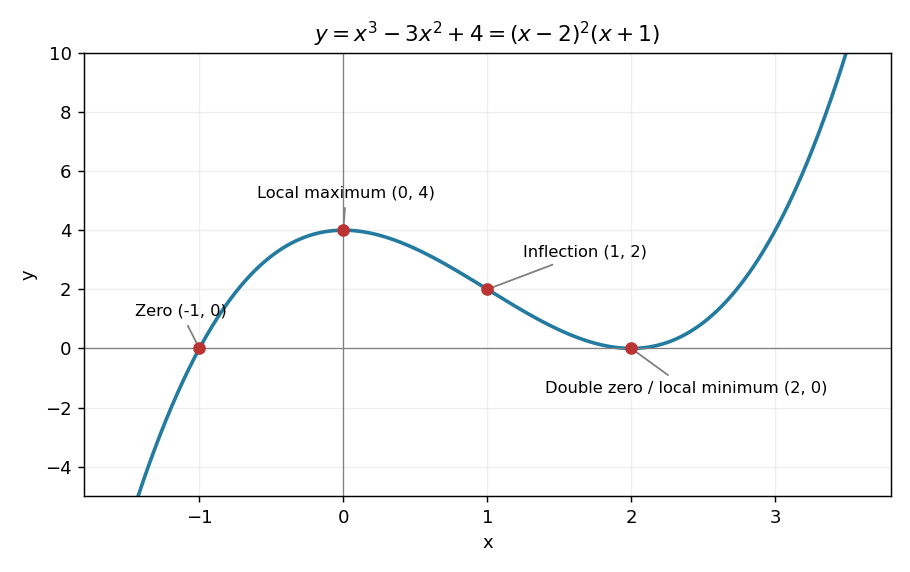
Zeros, two stationary points and an inflection point of the cubic
. Details. 
Past exam of the mathematics course of the year 1 of the natural sciences course of the University of Cambridge 2009 Paper 2 4 Solution Created 2026-10-18 Updated 2026-10-20
Zero is an eigenvalue exactly when the determinant vanishes. Here , soFor either value the other eigenvalue is two, as follows from the trace.
Past exam of the mathematics course of the year 1 of the natural sciences course of the University of Cambridge 2009 Paper 2 3 Solution Created 2026-10-18 Updated 2026-10-20
Past exam of the mathematics course of the year 1 of the natural sciences course of the University of Cambridge 2009 Paper 2 10 Solution Created 2026-10-18 Updated 2026-10-20
For , the exponential power series gives the normalization of the Poisson distribution:For , the limiting law assigns probability one to and zero to every positive integer . Negative would not define the stated probability distribution.
Past exam of the mathematics course of the year 1 of the natural sciences course of the University of Cambridge 2009 Paper 2 1 Solution Created 2026-10-18 Updated 2026-10-20
If , the equation would imply , contradicting the assumed nonparallel directions. Hence . Then and force . This proves that the two vectors are linearly independent.
Past exam of the mathematics course of the year 1 of the natural sciences course of the University of Cambridge 2009 Paper 1 9 Solution Created 2026-10-18 Updated 2026-10-20
The line has equation , with normal vector . The distance from a point to a line is the absolute value of the normal component of the displacement:The perpendicular foot is , which lies on the line and realizes this shortest distance.
There are unlisted articles, also show them or only show them.